Thursday, August 13, 2026
HomeLearning & Education60+ Interesting Animal Trivia Questions for Kids

60+ Interesting Animal Trivia Questions for Kids

Fun animal trivia questions for kids packed with surprising facts, playful challenges, and fascinating creatures from around the world.

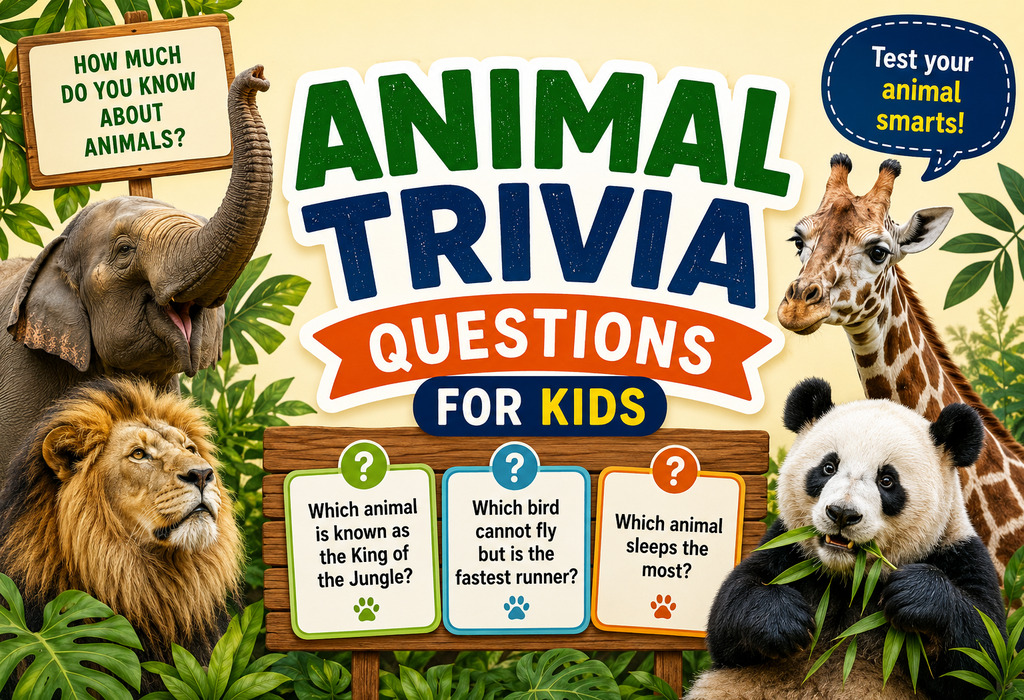
Ask a five-year-old why flamingos are pink, and you might get a giggle, a shrug, or a funny guess. That’s what makes animal trivia questions for kids so much fun, they turn curiosity into an exciting game. Whether you’re planning a classroom quiz, a rainy-day activity, or some screen-free family fun, animal trivia questions and answers keep kids engaged. With fascinating creatures, surprising facts, and plenty of tricky questions, there’s something for every young animal fan. Get ready to test their knowledge, share some laughs, and see which animal facts can stump even the grown-ups.

Easy Animal Trivia Questions With Answers for Kids

These are perfect for younger children or as icebreakers before moving into trickier rounds. They cover animals most kids already recognize, so confidence builds fast right from the first question.

  1. What do you call a baby dog?
    Answer: A puppy.
  2. What do you call a baby cat?
    Answer: A kitten.
  3. How many legs does a spider have?
    Answer: Eight.
  4. What is the largest animal on Earth?
    Answer: The blue whale.
  5. What is the tallest animal in the world?
    Answer: The giraffe.
  6. What sound does a cow make?
    Answer: Moo.
  7. What do bees make?
    Answer: Honey.
  8. Which bird cannot fly but can run very fast?
    Answer: The ostrich.
  9. What do you call a group of lions?
    Answer: A pride.
  10. What is a baby cow called?
    Answer: A calf.
  11. Which animal is known as “man’s best friend”?
    Answer: The dog.
  12. What do pandas mostly eat?
    Answer: Bamboo.
  13. What is the fastest land animal?
    Answer: The cheetah.
  14. How many hearts does an octopus have?
    Answer: Three.
  15. What is a baby kangaroo called?
    Answer: A joey.

Animal Questions for Kids: Pets and Farm Animals

Kids love these because they connect to animals they might already know in real life. From backyard pets to barnyard favorites, this set turns everyday animals into a source of surprising facts.

  1. How many stomach compartments does a cow have?
    Answer: Four.
  2. What is a baby sheep called?
    Answer: A lamb.
  3. How long do most pet goldfish live if cared for well?
    Answer: About 10 years.
  4. What do rabbits use their long ears for?
    Answer: To hear predators and cool down.
  5. Which farm animal is known for producing wool?
    Answer: The sheep.
  6. What is a group of chickens called?
    Answer: A flock.
  7. How many eggs can a healthy hen lay in a year on average?
    Answer: Around 200 to 300.
  8. What helps horses sleep standing up?
    Answer: A locking mechanism in their legs.
  9. What is a baby horse called?
    Answer: A foal.
  10. Which pet is famous for purring when happy?
    Answer: The cat.

Weird Animal Trivia That Will Surprise Kids

This is where trivia gets fun. These animal facts sound made up, but every one is true, and they’re the questions kids tend to remember and repeat for weeks.

  1. What color are flamingos born?
    Answer: Gray. They turn pink from the shrimp and algae they eat.
  2. How many brains does an octopus have?
    Answer: Nine—one central brain and eight smaller ones in its arms.
  3. Can a snail sleep for years at a time?
    Answer: Yes, some snails can sleep for up to three years.
  4. Which animal’s fingerprints are so close to a human’s that they can confuse investigators?
    Answer: Koalas.
  5. How do snakes “smell” the air around them?
    Answer: With their tongues.
  6. What color do reindeer eyes turn in winter?
    Answer: Blue, to help them see in low light.
  7. Which mammal cannot jump at all?
    Answer: The elephant.
  8. How long can a sloth hold its breath underwater?
    Answer: Up to 40 minutes.
  9. What does a group of flamingos do to stay warm?
    Answer: They huddle together and often stand on one leg.
  10. Which sea creature can regrow an entire lost arm?
    Answer: The starfish.
  11. What is unusual about a shark’s eyelids?
    Answer: Most sharks cannot blink because they don’t have movable eyelids.
  12. Which bird can fly backward?
    Answer: The hummingbird.
  13. What do owls have instead of movable eyeballs?
    Answer: Fixed eye tubes, which is why they turn their whole head to look around.
  14. How many teeth does a snail have?
    Answer: Thousands, arranged in rows on its tongue.
  15. Which animal’s name literally means “water horse”?
    Answer: The hippopotamus.

Hard Trivia Questions About Animals

These are best saved for older kids, curious tweens, or as a challenge round for the whole family. Expect a few stumped grown-ups, since several of these facts surprise adults just as much as kids.

  1. What is the smallest mammal in the world by length?
    Answer: The Kitti’s hog-nosed bat, also called the bumblebee bat.
  2. How fast can a peregrine falcon dive?
    Answer: Over 240 miles per hour, making it the fastest animal on Earth.
  3. How many species of mammals exist worldwide?
    Answer: More than 6,000.
  4. What is the national bird of New Zealand?
    Answer: The kiwi.
  5. How does a pufferfish protect itself from predators?
    Answer: It gulps water to inflate its body into a spiky ball.
  6. Which animal has the strongest bite force relative to its size?
    Answer: The saltwater crocodile.
  7. How long was the longest blue whale ever recorded?
    Answer: About 108 feet, roughly the length of a Boeing 737.
  8. What is the deadliest creature by human death toll each year, even though it isn’t venomous?
    Answer: The mosquito, due to the diseases it spreads.
  9. How many hours a day does a koala typically sleep?
    Answer: About 18 to 20 hours.
  10. What is the only continent with no native reptiles or snakes?
    Answer: Antarctica.
  11. How do bats find prey in complete darkness?
    Answer: Through echolocation, using high-frequency sound waves.
  12. What is the largest living rodent in the world?
    Answer: The capybara.
  13. Which animal has blood pressure roughly twice as high as a human’s?
    Answer: The giraffe.
  14. How many toes does an elephant have on its front feet compared to its back feet?
    Answer: Four in front, three in back.
  15. What is unique about a tardigrade, sometimes called a “water bear”?
    Answer: It can survive extreme heat, cold, radiation, and even the vacuum of space.

Ocean and Sea Creature Trivia Questions

Underwater animals give kids some of the strangest facts of all. The ocean is still mostly unexplored, which makes these questions a great way to spark bigger conversations about the natural world.

  1. What is the largest fish in the ocean?
    Answer: The whale shark.
  2. Which sea creature sings songs that can travel for miles underwater?
    Answer: The humpback whale.
  3. How many arms does a starfish usually have?
    Answer: Five, though some species have more.
  4. Which ocean animal has three hearts and blue blood?
    Answer: The octopus.
  5. What is the fastest fish in the ocean?
    Answer: The sailfish, which can swim up to 68 miles per hour.
  6. How do jellyfish move through the water?
    Answer: By contracting and relaxing their bell-shaped bodies to push water out.
  7. What do sea otters do to keep from drifting apart while sleeping?
    Answer: They hold hands, or paws, and wrap themselves in kelp.
  8. Which creature has existed almost unchanged for more than 200 million years?
    Answer: The horseshoe crab.

Wild Animal Trivia From Around the World

From African savannas to Arctic ice, this round travels the globe. These questions work well for kids who are curious about geography as much as animals themselves.

  1. What is the largest land mammal in the world?
    Answer: The African bush elephant.
  2. Which big cat is known as the “king of the jungle” even though it mostly lives on grasslands?
    Answer: The lion.
  3. How many members can be in a pack of African wild dogs?
    Answer: Anywhere from two to 40, with the strongest packs around seven to 15.
  4. What is the tallest land mammal on the planet?
    Answer: The giraffe.
  5. Which animal is the only one born with horns?
    Answer: The giraffe, though its horns are soft at birth and harden later.
  6. What is the world’s largest land carnivore?
    Answer: The polar bear.
  7. Which nocturnal animal relies on strong hearing and smell to hunt in the dark?
    Answer: The owl, along with foxes and bats.

Tips for Turning Animal Trivia Into a Game Kids Actually Enjoy

A list of questions is only half the fun. How you use it matters just as much, and a few small setup choices can turn a quiet reading exercise into a game kids beg to replay.

  • Sort by age first: Start younger kids on the easy section and save the hard trivia questions about animals for a bonus round.
  • Turn it into teams: Two or three kids per team keeps quieter kids from checking out and adds a bit of friendly competition.
  • Use props when you can: Stuffed animals, flashcards, or printed pictures help visual learners connect the question to the answer.
  • Reward curiosity, not just correct answers: If a child gives a wrong but thoughtful guess, ask them why they think that, it often leads to a great conversation.
  • Mix categories instead of running through them in order: Jumping between weird animal trivia and easy facts keeps the energy up and prevents the quiz from feeling like a test.
  • Let kids invent their own questions: After a round or two, ask them to write a trivia question about their favorite animal. It reinforces what they just learned and builds confidence.

Common Mistakes Parents and Teachers Make With Trivia Nights

A few small adjustments can make a big difference in how well a trivia session lands. Even experienced parents and teachers fall into these habits without realizing it.

  • Making every question too hard too soon: Confidence builds momentum, so open with a few easy wins before introducing harder animal trivia questions and answers.
  • Reading questions too fast: Kids process spoken information more slowly than adults, especially in a group setting with distractions.
  • Skipping the “why”: A fact sticks better when it’s paired with a short explanation, like why flamingos are pink or why owls turn their whole head.
  • Not adapting for different ages in the same group: In mixed-age settings, alternate between simple and advanced questions so nobody feels left out or bored.

Animal trivia works because it hands kids something real to be curious about, whether that’s an octopus with nine brains or a giraffe with blood pressure twice as high as ours. Used well, a simple list of questions becomes a shared activity that builds vocabulary, sparks classroom discussion, and gives families an easy way to connect without a screen in the middle. Keep this list handy for the next long car ride, birthday party, or lazy Sunday afternoon, and don’t be surprised if the kids start asking to play again before you’ve even finished the last question.

Advertisements
Vishal Pandit
Vishal Pandithttps://playbees.firstcry.com/
Senior Content Writer | Early Childhood Learning & Educational Content Specialist Vishal is an experienced educational content writer with a postgraduate qualification in English Literature and expertise in creating engaging, research-backed resources for children aged 1–8. He specializes in nursery rhymes, children's songs, phonics, worksheets, coloring pages, early literacy, and play-based learning activities. His content is carefully researched using trusted educational sources and written in age-appropriate, easy-to-understand language. With a strong background in SEO and digital publishing, Vishal creates original, fact-based articles that support parents, teachers, and caregivers. Following PlayBees' editorial standards, he ensures every piece is accurate, inclusive, engaging, and developmentally appropriate. His goal is to make learning enjoyable, inspire curiosity, and provide practical resources that help children build confidence and lifelong learning skills.
RELATED ARTICLES

LEAVE A REPLY

Please enter your comment!
Please enter your name here

- Advertisment -

Most Popular