
Table of Contents
- Why Letter Writing Still Matters for Kids
- Types of Letters Kids Should Know
- Letter Writing Format for Kids: The Basic Structure
- Simple Letter Writing for Kids: A Step-by-Step Approach
- How to Write a Letter for Kids: Examples by Age and Purpose
- Common Mistakes Kids Make (and How to Fix Them)
- Making Letter Writing a Regular Habit
Somewhere between the last handwritten thank-you note and the first text message, an entire skill quietly disappeared from most households. Letter writing for kids is having a bit of a comeback though, and not just for nostalgia’s sake. It teaches patience, structure, and a kind of thoughtfulness that a quick text rarely demands. If your child has ever scribbled “I love you Grandma” on a scrap of paper, they’ve already taken the first step.
Why Letter Writing Still Matters for Kids
A handwritten letter forces a child to slow down and organize their thoughts before putting pen to paper. It’s a small, old-fashioned habit that quietly builds skills texting and typing never really touch.
- Stronger handwriting: Regular letter writing gives kids repeated practice forming letters and words by hand, which builds fine motor control over time.
- Better spelling instincts: Without autocorrect to fix mistakes instantly, kids get real practice noticing and correcting their own spelling errors.
- Improved written communication: Organizing thoughts into a greeting, body, and closing lays the groundwork for the essay structure they’ll use throughout school.
- Greater empathy: Thinking about what a grandparent, friend, or teacher would want to hear helps kids consider another person’s perspective.
- A sense of patience and delayed gratification: Waiting for a letter to be written, mailed, and answered teaches kids that not everything happens at text-message speed.
Types of Letters Kids Should Know
Not every letter serves the same purpose, and kids benefit from understanding that the tone and structure change depending on who’s on the receiving end. Two categories cover almost everything a child will need to write.
1. Informal (Friendly) Letters
Informal letters are the ones kids write to grandparents, cousins, pen pals, or friends who’ve moved away. The tone is warm and personal, and there’s plenty of room for doodles, jokes, or a favorite sticker in the margin.
These letters typically include casual openings like “Dear Grandma” and closings such as “Love” or “Your friend.” Because the audience is familiar, kids can write more freely without worrying about strict rules.
2. Formal Letters
Formal letters come into play when a child writes to a teacher, a librarian, a local business, or even a newspaper editor. This type of letter writing for kids introduces the idea that language shifts depending on the audience, an important lesson well before middle school.
The tone here is respectful and direct, using phrases like “Dear Mr. Alvarez” instead of nicknames. Formal letters also tend to be shorter and more focused, since the goal is usually to make a specific request or share a specific piece of information.
Letter Writing Format for Kids: The Basic Structure
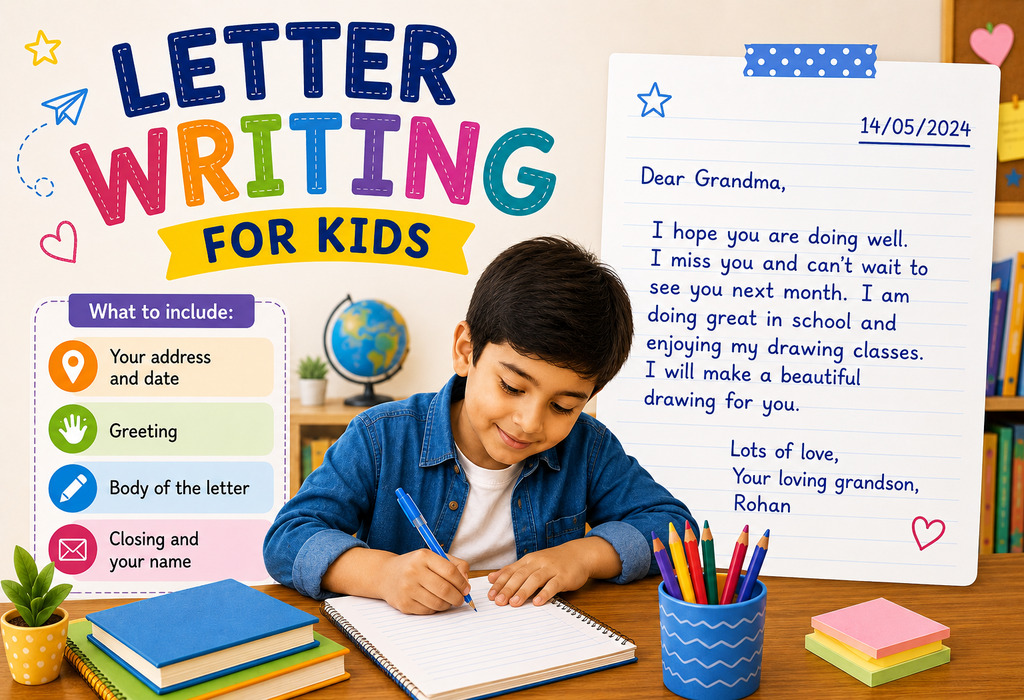
Once a child understands the difference between informal and formal letters, the next step is learning the actual format for kids, the backbone that holds any letter together. Most elementary school curriculums teach five core parts.
The Date
The date goes in the top right or top left corner and is usually the first thing a child writes. It’s a small detail, but it teaches kids to think about their letter as a moment in time, especially handy for pen pals who write back and forth over months.
The Greeting
The greeting sets the tone for everything that follows, so it matters more than kids usually realize. “Dear” works for nearly every audience, but the name after it (a nickname for friends, a title for adults) signals whether the letter is informal or formal letter writing for kids.
The Body
This is where the actual message lives, usually two to four short paragraphs for a child’s letter. Encouraging kids to write one idea per paragraph, whether it’s a story, a question, or a thank-you, keeps the letter easy to follow for both the writer and the reader.
The Closing
The closing wraps up the letter with a friendly or respectful sign-off before the child’s name. “Love,” “Your friend,” and “Sincerely” are the three closings most kids learn first, each suited to a different kind of relationship.
The Signature
A signature is more than just a name at the bottom, it’s the child’s personal stamp on something they created. Even young writers who can barely spell their own name feel a sense of pride signing off on a finished letter.
Simple Letter Writing for Kids: A Step-by-Step Approach
Kids rarely need a lecture on grammar to write a good letter, they need a simple process they can repeat. Breaking it into small, manageable steps keeps the task from feeling overwhelming.
- Pick a recipient. Ask who the child wants to write to and why, since a clear purpose makes the rest of the letter come together faster.
- Brainstorm three things to say. A quick list of ideas, like a recent birthday, a funny pet story, or a question, gives the letter direction before writing begins.
- Write the date and greeting. These two lines get the letter started without requiring much thought, which helps build early writing confidence.
- Draft the body. Encourage one idea per paragraph, using simple, everyday language rather than pushing for complex sentences.
- Add the closing and signature. Finishing with a signature gives kids a satisfying sense of completion.
- Decorate if it’s informal. Stickers, drawings, or colored pens make friendly letters feel more personal and fun to send.
How to Write a Letter for Kids: Examples by Age and Purpose
Seeing a finished example often teaches more than any explanation of rules. Below are two full-length samples, each labeled by part, showing exactly how an informal and a formal letter come together.
1. Informal (Friendly) Letter Example
This is the kind of letter an 8-year-old might send to a grandparent after a fun weekend. Notice how casual and personal every part of it feels.
Date: October 12, 2025
Greeting: Dear Grandma,
Body: How are you? I miss you so much! Yesterday I rode my bike without training wheels for the first time. I fell down twice, but I didn’t cry, and by the end of the day I could ride all the way to the mailbox and back.
We also planted sunflower seeds in the backyard. Dad says they might grow taller than me by summer! I can’t wait to show you when they bloom.
Can you come visit soon? I want to show you my new bike and my sunflowers.
Closing: Love,
Signature: Mia
What makes it informal: The greeting uses a family nickname, the body wanders between two unrelated topics the way real conversation does, and the closing (“Love”) reflects a close, familiar relationship.
2. Formal Letter Example
This is the kind of letter a 10-year-old might send to a teacher to say thank you. The tone stays polite and focused from start to finish.
Date: October 12, 2025
Greeting: Dear Mrs. Patel,
Body: My name is Owen Carter, and I am a student in your third-grade science class. I am writing to thank you for helping me with my volcano project last week.
Before you explained how the baking soda and vinegar reaction worked, I did not understand why my volcano kept fizzling out too quickly. Because of your help, my project worked perfectly, and I learned a lot about chemical reactions.
Thank you again for taking the time to help me.
Closing: Sincerely,
Signature: Owen Carter
What makes it formal: The greeting uses a title and last name, the body sticks to a single, specific purpose, and the closing (“Sincerely”) keeps a respectful distance appropriate for a teacher.
Common Mistakes Kids Make (and How to Fix Them)
Most letter writing mistakes are easy to spot once a parent knows what to look for. A few patterns show up again and again in early drafts.
- Skipping the greeting or closing: Kids often jump straight into their news out of excitement. A quick checklist taped near their writing spot works as a gentle reminder without feeling like nagging.
- Mixing formal and informal tones: Starting with “Dear Sir” and ending with “Love, Zoe” confuses the reader about the relationship. Reading the letter aloud together helps kids hear when the tone doesn’t quite match.
- Rambling without paragraph breaks: This usually happens when a child has a lot to say and no clear plan. A short brainstorm before writing, as outlined in the step-by-step approach above, keeps the letter organized.
- Forgetting the date or signature: These small details are easy to overlook when a child is focused on the message itself. Placing a simple template nearby helps kids remember every part of the format.
- Writing overly short, one-line letters: Kids sometimes stop after a single sentence, unsure of what else to add. Prompting with a specific question, like “What was the best part of your day?”, usually unlocks more to say.
Making Letter Writing a Regular Habit
Letter writing for kids sticks best when it isn’t treated as a one-time school assignment. These simple habits help turn it into something kids look forward to.
- Set up a pen pal exchange: Pairing a child with a cousin, classmate, or family friend gives them a reason to write and something to look forward to in return.
- Encourage a weekly note to a grandparent: A short, regular letter builds the habit faster than an occasional, pressure-filled one.
- Keep a “letter kit” within reach: Stock a small box with paper, envelopes, stamps, and colored pens so nothing stands between the idea and the writing.
- Tie letters to real events: Birthdays, holidays, and school trips give kids a natural reason to write and something specific to say.
- Let kids decorate their letters: Stickers, drawings, and doodles make informal letters more fun and give reluctant writers extra motivation.
- Read letters together before mailing: A quick review catches missing parts of the format and turns into a low-pressure teaching moment.
- Celebrate replies when they arrive: Getting a letter back reinforces that writing is a two-way conversation, which keeps kids motivated to write again.
Letter writing for kids isn’t about reviving an old-fashioned habit for its own sake. It’s a practical, low-pressure way to strengthen handwriting, vocabulary, and the ability to communicate clearly with different audiences, skills that carry over into everything from school assignments to future workplace emails. Whether your child is scrawling a quick note to a grandparent or carefully composing a thank-you letter to a teacher, each attempt builds a little more confidence. Start small, keep the tools handy, and let the letters pile up one at a time.
Also Read:
Long Vowel Sounds
Hyperbole for Kids
All About Me Questions for Kids