

Table of Contents
“Lucy Locket” is a short and playful traditional nursery rhyme that tells a tiny story about losing something and someone else finding it. Children enjoy this rhyme because it is simple, rhythmic, and easy to remember, making it fun to sing again and again. The gentle storytelling sparks curiosity and encourages kids to listen carefully to details. For parents and teachers, this rhyme is a lovely tool for early learning, as it helps build language awareness, listening skills, and memory. Its steady beat supports speech development, while the repeated sounds help children notice rhymes and word patterns. Because the story is brief and lighthearted, it holds young attention spans easily and fits well into storytime, circle time, or bedtime routines.
Lucy Locket Song Lyrics
This classic rhyme shares Lucy Locket words that are short, catchy, and perfect for early learners to enjoy through rhythm and repetition.
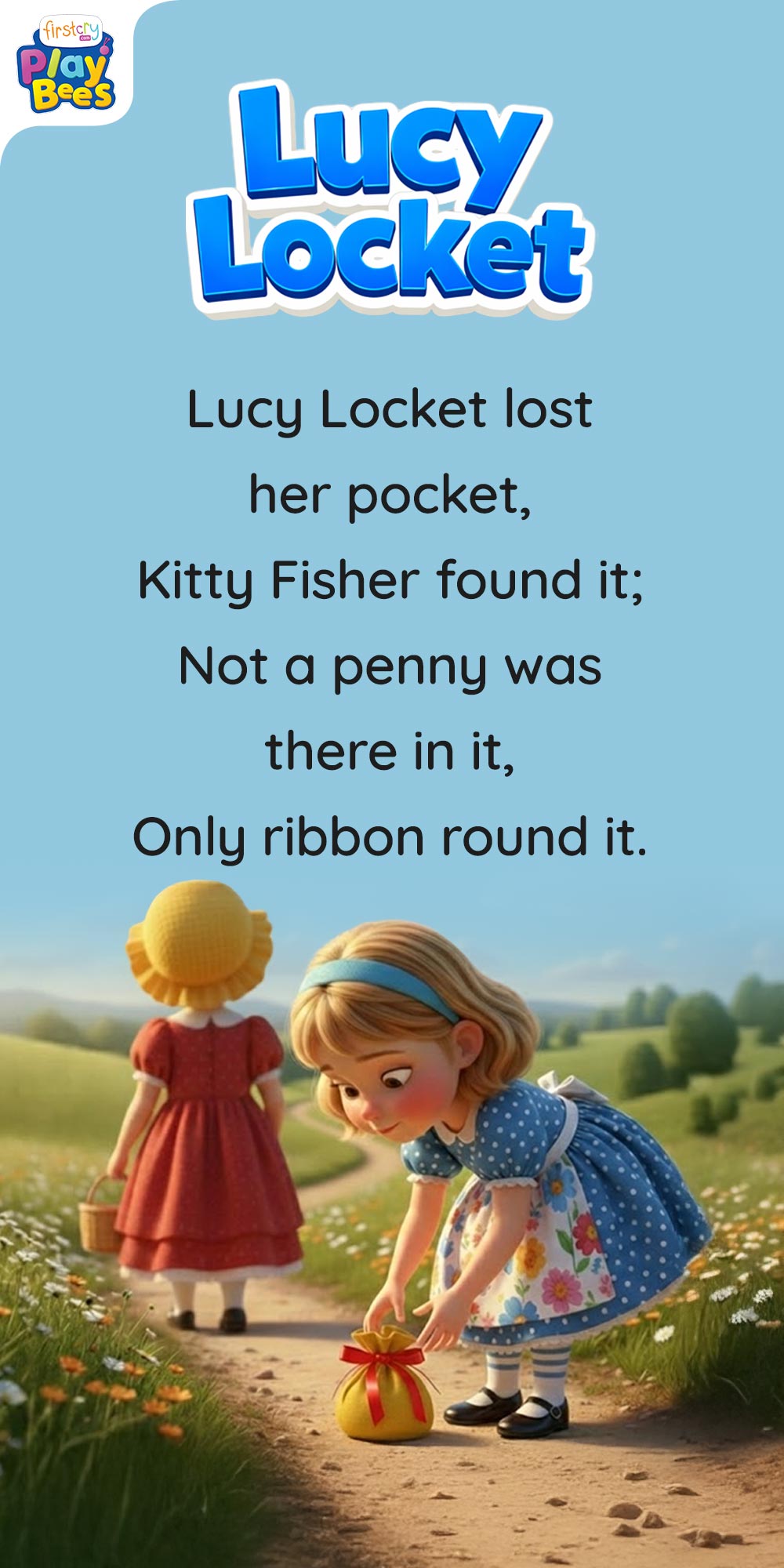
Lucy Locket lost her pocket,
Kitty Fisher found it;
Not a penny was there in it,
Only ribbon round it.
Other Versions of the Lucy Locket Song
Over time, this traditional rhyme has been shared mostly in its original form, with only small variations in wording or rhythm.
Version 1 – Repetition for Sing-Along
Lucy Locket lost her pocket,
Lucy Locket lost her pocket,
Kitty Fisher found it,
Nothing in it, nothing in it,
But the binding round it.
Version 2 – Name Variation (Sometimes used in folk play)
Lucy Locket lost her pocket,
Jenny Fisher found it;
Nothing in it, nothing in it,
But the binding round it.
Version 3 – Action-Friendly Classroom Version
Lucy Locket lost her pocket,
(Oh dear, where is it?)
Kitty Fisher found it,
(Here it is!)
Nothing in it, nothing in it,
But the binding round it.
Version 4 – Slow Rhythm Teaching Version
Lucy Locket lost her pocket,
Kitty Fisher found it.
Nothing in it,
Nothing in it,
Only the binding round it.
Gestures – How to Teach Lucy Locket to Kids
Using actions makes the rhyme more engaging and helps children remember the words more easily. Simple movements also support coordination and listening skills.
- “Lucy Locket”: Point to an imaginary character in front of you to show who the rhyme is about.
- “Lost her pocket”: Pretend to search your pockets to act out the idea of losing something.
- “Kitty Fisher found it”: Mime picking something up from the floor with a surprised face.
- “Nothing in it”: Turn your hands out to show they are empty, reinforcing the meaning.
- Repeat “Nothing in it”: Shake your head gently to emphasize that there is nothing inside.
- “But the binding round it”: Trace a small circle with your fingers to show the edge or binding.
History & Quick Facts
“Lucy Locket” is a traditional English nursery rhyme with roots dating back to at least the early 19th century. It was first published in collections of English nursery rhymes around the 1800s, although the exact author is unknown, as with many folk rhymes. The rhyme was passed down orally before appearing in print, which helped it become widely known across England and later in other English-speaking countries. Its simplicity and catchy rhythm made it popular in homes and schools, where it has remained a favorite for generations.
Interesting Facts
- The rhyme is very short, which makes it easy for toddlers to memorize and recite confidently.
- It has been included in many classic nursery rhyme books across different countries.
- The tune is often adapted freely, as the rhyme can be spoken or sung.
- “Lucy Locket” has been translated into several languages as part of global nursery rhyme collections.
- The characters may have been inspired by common names used in older English folk stories.
- The rhyme is often used to teach the idea of opposites, such as lost and found.
Suitable Age & Learnings
This rhyme is best suited for children aged 2 to 5 years, as it matches their language and attention levels perfectly. It supports early development through simple words and a clear rhythm.
- Listening skills: Children learn to follow a short story from beginning to end.
- Memory building: Repetition helps kids remember words and line order.
- Rhyming awareness: The rhyme introduces similar ending sounds in a natural way.
- Vocabulary growth: Words like “lost,” “found,” and “pocket” expand everyday language.
- Social learning: The idea of finding and sharing encourages gentle social understanding.
- Confidence in speaking: Short lines make it easy for children to recite aloud.
FAQs
1. What is the Lucy Locket rhyme about?
It tells a simple story about Lucy losing her pocket and someone else finding it empty.
2. What is the rhyming scheme of Lucy Locket?
The rhyme follows an AABB rhyming scheme, where the first two lines rhyme and the last two lines rhyme.
3. Why is Lucy Locket good for toddlers?
Its short length, clear rhythm, and easy words make it perfect for early language development.
“Lucy Locket” may be short, but it carries big value for young learners. Its gentle rhythm and simple story make it enjoyable for children and easy for adults to teach. Through repetition and rhyme, kids build early language, memory, and listening skills without pressure. The playful idea of losing and finding adds a touch of curiosity that keeps children engaged. Whether sung, spoken, or paired with actions, this rhyme fits beautifully into daily learning routines. It remains a timeless example of how simple nursery rhymes can support joyful early education.
Explore Other Rhymes for Kids:
Miss Mary Mack Nursery Rhyme With Lyrics
Little Miss Muffet Nursery Rhyme With Lyrics
Mary, Mary, Quite Contrary Nursery Rhyme With Lyrics