
Table of Contents
Starting school is a big milestone for children and for the parents who walk them to the door. Many families wonder what will actually be taught, how the day will feel, and whether their child will be ready. A clear picture of the curriculum for kindergarten takes much of that worry away. In this guide, you will learn what children study, how teachers approach learning, how to choose a program, and how to support your child at home.
What Is a Kindergarten Curriculum?
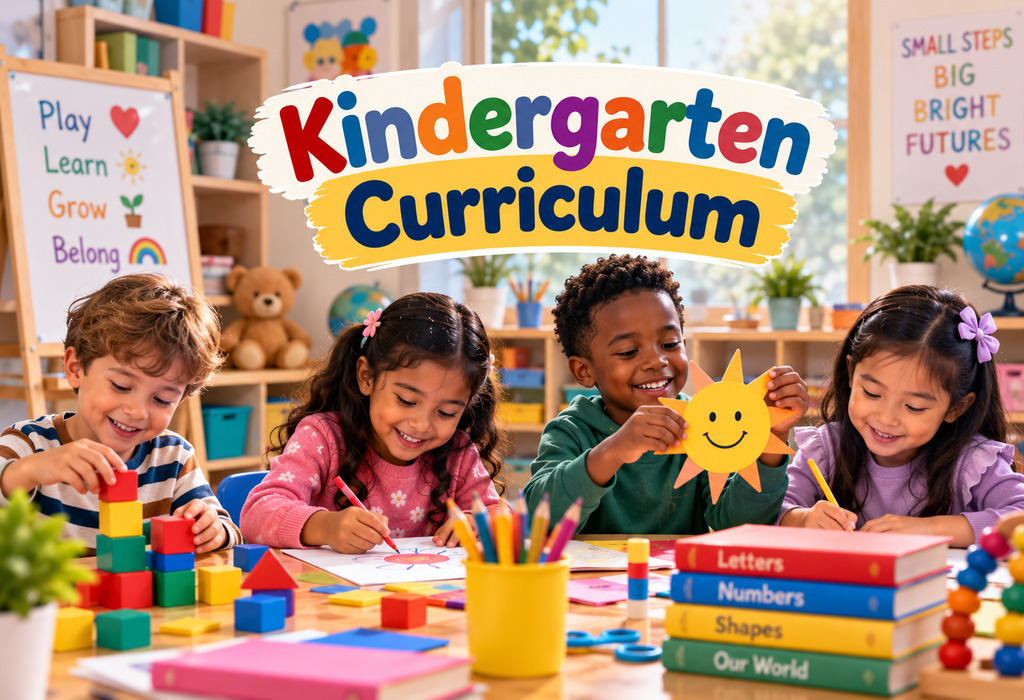
If you are asking what is a kindergarten curriculum, the short answer is that it is the plan for what children learn and how they learn it during the year. It covers core subjects such as reading, writing, math, science, and social studies, along with social skills, creative arts, and physical activity. In the United States, most schools align their plans with state standards, and many follow Common Core expectations. A strong plan balances structured lessons with play, so children build skills while staying curious. The first few weeks usually focus on routines, classroom rules, and friendships before academics pick up speed.
Language Arts and Literacy
Literacy is the heart of the kindergarten year. Children begin by recognizing uppercase and lowercase letters and learning the sound each letter makes. Phonics lessons then teach them to blend sounds into short words, and they practice common sight words that appear again and again in books.
By the end of the year, many children can read simple sentences and short storybooks. Writing grows alongside reading. Children learn to:
- Print letters correctly
- Write their own name
- Spell short words by listening for sounds
- Share ideas through drawings and simple sentences
Read alouds, songs, rhymes, and conversations build vocabulary and listening skills too. Do not worry if your child reads later than a classmate. Children develop at different speeds, and the fine motor skills needed for writing keep strengthening through age six.
Math
Kindergarten math builds number sense. Children learn to count, recognize, and write numbers, usually up to 20, and understand that each number stands for a quantity. Teachers use blocks, counters, and other objects so abstract ideas become something children can touch and see.
Common math topics include:
- Counting forward and skip counting by 2s, 5s, and 10s
- Comparing groups to see which has more or less
- Naming flat shapes and solid shapes, such as squares, circles, cubes, and spheres
- Making and extending simple patterns
- Adding and subtracting with objects and pictures
Early lessons on measurement, time, and coins may appear as well, often through everyday routines like checking the daily schedule.
Science
Young children are natural scientists, so science lessons start with their own questions. They observe plants and animals, learn the life cycle of a butterfly or frog, and explore the five senses. Weather is a favorite topic because children experience it every day. Many classrooms include simple experiments, such as planting seeds or watching ice melt, to teach observing, predicting, and describing. Some programs add basic engineering through building challenges, which encourages problem solving.
Social studies helps children understand their place in the world. Lessons begin with family, friends, and community helpers, then widen to maps, neighborhoods, and traditions from different cultures. Children talk about rules, fairness, and why people work together. Stories, holidays, and foods from around the world introduce diversity in a friendly way.
Kindergarten is also where children learn how to be part of a group. Teachers guide them to share, take turns, listen while others talk, and solve disagreements calmly. They practice naming feelings, managing frustration, and following directions. Attention spans are still short at this age, so lessons are broken into small chunks with movement in between. These habits matter as much as any academic skill because they help children feel safe, confident, and ready to learn.
Physical Development and the Arts
Gross motor skills grow through running, jumping, climbing, and group games. Fine motor skills develop through cutting with scissors, molding clay, drawing, and holding a pencil correctly. Art, music, and storytelling give children ways to express their imagination and often connect to other subjects.
Common Teaching Approaches
Schools do not all teach the same way. Knowing the main styles helps you read a school’s description with confidence.
- Play based learning treats play as a powerful teacher, with centers for pretend play, building, art, and sensory exploration.
- Montessori emphasizes independence, hands on materials, and learning at your own pace.
- Reggio Emilia is child led and focuses on creativity, projects, and collaboration.
- Waldorf values imagination, art, music, and storytelling, and holds back on early academics.
- Project or inquiry based learning lets children investigate real questions through hands on activities.
- Traditional programs use structured lessons in reading, math, and science to prepare children for first grade.
Many schools blend several of these ideas, so ask what a typical day looks like. Keep this kindergarten curriculum guide handy when you compare schools.
How to Choose the Best Curriculum for Kindergarten
The best curriculum for kindergarten is the one that fits your child, your family values, and your goals. A complete kindergarten curriculum should bring together academics, social growth, creativity, and physical activity. Use these questions as a starting point:
- Does it cover literacy, math, science, social studies, and social skills?
- Does it suit your child’s learning style, whether active, quiet, or hands on?
- How does the school balance play with structured lessons?
- How do teachers track progress, through observation, work samples, or short checks?
- Does it align with your state’s standards?
- Are teachers well trained and supported?
Visit classrooms if you can and watch how children and teachers interact. A cheerful, organized room with books, art, and open space for play is a good sign. If you plan to homeschool, many experienced parents suggest putting most of your energy into reading and math while letting curiosity guide other subjects through books, nature walks, and museum visits.
Supporting Learning at Home
Learning does not stop when the school day ends. Small habits make a big difference:
- Read together every day and let your child point out letters and words.
- Count everyday objects such as stairs, snacks, or toys.
- Label items around the house to build reading skills.
- Practice writing your child’s name with chalk, crayons, or finger paint.
- Talk about the daily schedule to make time feel less abstract.
- Ask open questions about their day and celebrate effort, not just results.
Keep it playful. Children learn best when they feel relaxed and curious.
Kindergarten lays the foundation for everything children will learn in the years ahead. A thoughtful curriculum blends literacy, math, science, social studies, and social skills with plenty of play, movement, and creativity. Knowing what to expect helps you choose a program that fits your child and support learning at home with confidence. Remember that every child grows at a different pace, so patience and encouragement matter more than perfection. With curiosity, routine, and your steady support, your child can start school with excitement and grow into a happy, capable learner.