
Table of Contents
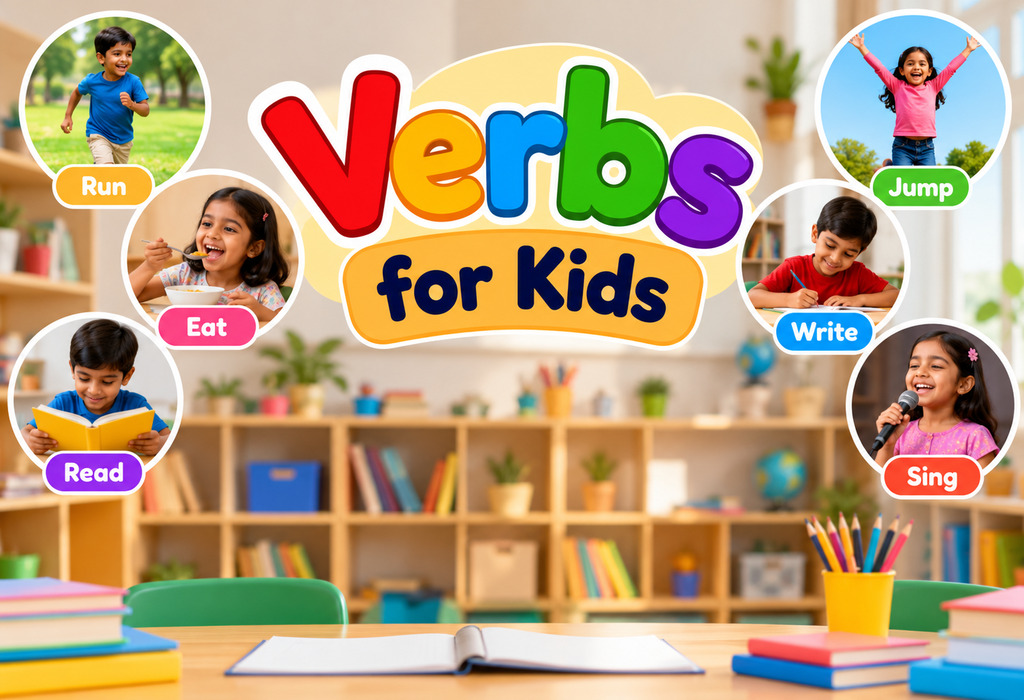
Verbs for kids are some of the first words children use to describe the world around them. Every time a child runs, jumps, eats, or sings, they are using a verb. Learning action verbs for kids helps children build strong sentences, express their ideas, and become confident readers and writers. This guide explains what a verb is, shares the main types, and offers a long list of verbs sorted by grade level. Parents and teachers can use it for quick practice at home or in the classroom.
What is a Verb?
The verb meaning for kids is simple: a verb is a word that tells what someone or something does, or what someone or something is. Verbs are the words that make a sentence work. Without a verb, a sentence feels unfinished.
Some verbs show action, like “run,” “write,” and “jump.” Other verbs show a state of being or a feeling, like “is,” “am,” and “feel.” Children can spot most verbs by asking, “What is the person or thing doing?” or “What is it like?”
Examples:
- The dog barks loudly. (action)
- Mia reads a book every night. (action)
- We play in the park. (action)
- The soup is hot. (state of being)
Every sentence needs at least one verb to make sense, so learning verbs is the first step to writing strong sentences.
Types of Verbs for Kids
Children do not need to learn every grammar term at once. These three types are a great starting point.
1. Action Verbs
Action verbs show something a person, animal, or thing does. Most of the verbs young learners meet first are action verbs. They are easy to act out, which makes them fun to learn.
Examples: jump, swim, throw, laugh, build
2. Helping Verbs
Helping verbs work with another verb to give more meaning. They can show when something happens. Common helping verbs include is, am, are, was, were, can, will, and do.
Examples:
- She is singing a song.
- We will visit grandma tomorrow.
- I can tie my shoes.
3. Linking Verbs
Linking verbs connect the subject of a sentence to more information about it. They do not show action. Instead, they describe a state or feeling. Common linking verbs include is, am, are, was, were, seem, and feel.
Examples:
- The soup is hot.
- He seems happy.
- I feel tired.
List of Verbs for Kids
Here is a simple list of verbs for kids. Children can read the words aloud, act them out, and then use each one in a sentence.
Everyday Action Verbs
| Walk | Throw |
| Run | Catch |
| Jump | Push |
| Hop | Pull |
| Skip | Lift |
| Climb | Carry |
| Crawl | Clap |
| Dance | Wave |
| Swim | Point |
| Kick | Turn |
Verbs for Daily Routines
| Wake | Pack |
| Wash | Sweep |
| Brush | Comb |
| Dress | Rest |
| Eat | Wipe |
| Drink | Fold |
| Sleep | Pour |
| Sit | Clean |
| Stand | Cook |
| Open | Close |
Verbs for School
| Read | Spell |
| Write | Solve |
| Draw | Sing |
| Paint | Share |
| Color | Help |
| Cut | Copy |
| Paste | Count |
| Listen | Speak |
| Ask | Answer |
| Learn | Think |
Verbs for Feelings and Thinking
| Love | Imagine |
| Like | Enjoy |
| Hate | Worry |
| Smile | Miss |
| Laugh | Trust |
| Cry | Decide |
| Hope | Dream |
| Wish | Know |
| Believe | Wonder |
| Remember | Forget |
Verbs for Play and Fun
| Play | Chase |
| Race | Tumble |
| Build | Roll |
| Hide | Pretend |
| Seek | Create |
| Toss | Explore |
| Bounce | Cheer |
| Swing | Slide |
| Spin | Wiggle |
| Giggle | Tickle |
Verbs for Nature and Animals
| Grow | Fall |
| Bloom | Melt |
| Fly | Freeze |
| Swim | Blow |
| Buzz | Flow |
| Chirp | Dig |
| Roar | Climb |
| Bark | Sprout |
| Hunt | Gallop |
| Splash | Shine |
Verbs for Kindergarten
Verbs for kindergarten should be short, familiar, and easy to act out. At this age, children learn best through movement and play. Start with words they already use every day.
Starter words: sit, run, jump, clap, eat, sleep, play, hug, look, hop
Sample sentences:
- I clap my hands.
- The cat sleeps on the sofa.
- We hop like bunnies.
A fun idea is to play “Verb Simon Says.” Call out a verb and let children act it out together.
Verbs for 1st Graders
Verbs for 1st graders can include slightly longer words and simple sentence building. Children at this level begin to write short sentences on their own, so each verb should connect to a real action they know.
Words to practice: jump, paint, carry, listen, bake, climb, watch, build, laugh, stretch
Sample sentences:
- Dad bakes cookies on Sunday.
- The kids climb the tall slide.
- I listen to my teacher.
Encourage children to write one sentence for each verb. Drawing a small picture next to the sentence makes the word stick.
Verbs for Second Graders
Verbs for second graders introduce past tense. Children learn that verbs can change to show when something happened. Many verbs just add “ed,” while some change completely.
Regular past tense examples:
- walk becomes walked
- jump becomes jumped
- play becomes played
Irregular past tense examples:
- run becomes ran
- eat becomes ate
- go becomes went
- see becomes saw
Practice by asking, “What did you do yesterday?” Children can answer using past tense verbs, such as “I played soccer” or “I ate pasta.”
Verbs for 3rd Graders
Verbs for 3rd graders are more descriptive and precise. Instead of saying “walk,” a child might say “stroll,” “march,” or “tiptoe.” Stronger verbs make writing more colorful and interesting.
Stronger verb swaps:
- walk becomes stroll, march, or tiptoe
- say becomes shout, whisper, or announce
- look becomes stare, glance, or peek
- eat becomes munch, gobble, or nibble
Sample sentences:
- The puppy dashed across the yard.
- She whispered a secret to her friend.
- The children munched on crunchy apples.
Third graders can also begin to spot verb tenses: past, present, and future. This builds a solid base for more advanced grammar later.
Simple Ways to Teach Verbs at Home
Learning verbs does not need worksheets alone. Try these easy ideas:
- Charades: Take turns acting out a verb while others guess.
- Verb hunt: Read a picture book together and point out every action word.
- Sentence building: Pick a verb card and make a sentence using it.
- Story time: Ask children to retell their day using at least five verbs.
- Verb jar: Write verbs on paper slips, pull one out, and act it out or use it in a sentence.
Short, playful practice helps children remember words much better than long lessons.
Verbs are the heartbeat of every sentence, and children who understand them can express themselves with confidence. This list of verbs for kids gives parents and teachers an easy starting point for everyday learning. Beginning with simple action words and moving toward stronger, more descriptive verbs helps children grow step by step. Games, acting, and daily conversation make the learning fun and natural. With regular practice, kids will soon use verbs like little language experts in their speaking and writing.