

Table of Contents
“To market, to market” is a cheerful traditional nursery rhyme that follows a child on a simple shopping trip filled with playful surprises. The rhyme talks about going to the market, buying a pig, and then returning home with a fun twist, which makes children giggle and stay curious about what comes next. Kids enjoy this rhyme because of its catchy rhythm, repetition, and short storytelling style that’s easy to remember and sing along with. For early learners, it gently introduces ideas like everyday activities, cause and effect, and simple sequencing. Singing “To market, to market” also helps children build listening skills, improve language development, and enjoy music-based learning. Parents love it because it’s lighthearted, engaging, and perfect for sharing joyful learning moments together.
To Market, To Market Song Lyrics
These classic To market, to market words tell a short and playful story that children love to hear again and again.
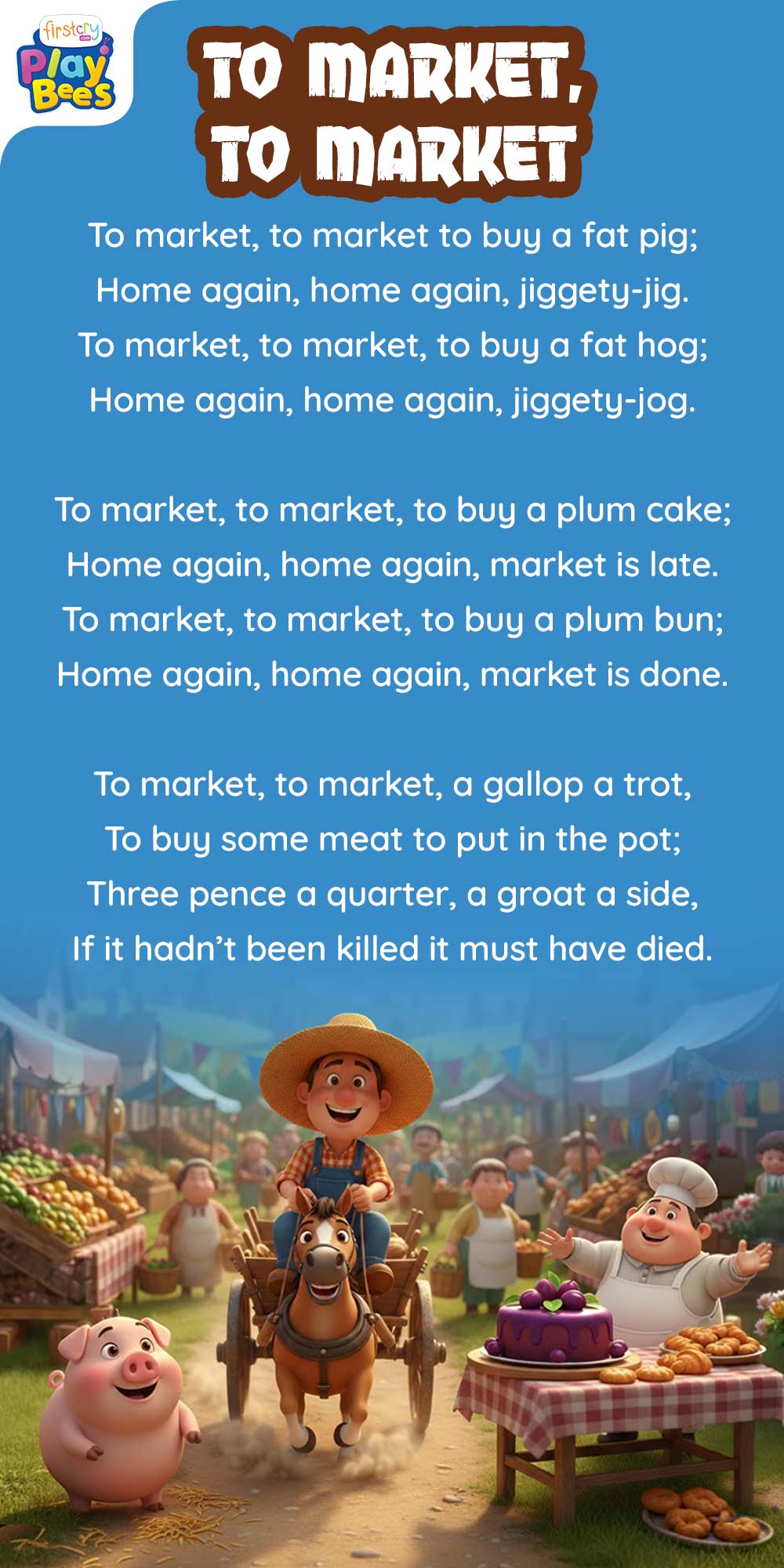
To market, to market to buy a fat pig;
Home again, home again, jiggety-jig.
To market, to market, to buy a fat hog;
Home again, home again, jiggety-jog.
To market, to market, to buy a plum cake;
Home again, home again, market is late.
To market, to market, to buy a plum bun;
Home again, home again, market is done.
To market, to market, a gallop a trot,
To buy some meat to put in the pot;
Three pence a quarter, a groat a side,
If it hadn’t been killed it must have died.
Other Versions of the To Market, To Market Song
This rhyme has a few small variations that keep the rhythm the same while changing some words.
Alternate Version 1 (Pig & Hog Version)
This is one of the most commonly sung variations, using both animals for repetition and rhythm.
To market, to market, to buy a fat pig,
Home again, home again, jiggety-jig.
To market, to market, to buy a fat hog,
Home again, home again, jiggety-jog.
Alternate Version 2 (Single-Verse Toddler Version)
This shorter version is often used for toddlers and very young children to help with memorization.
To market, to market, to buy a fat pig,
Home again, home again, jiggety-jig.
Alternate Version 3 (Repeated Pig Version)
Some versions repeat the “pig” line instead of changing animals, keeping the words familiar for young learners.
To market, to market, to buy a fat pig,
Home again, home again, jiggety-jig.
To market, to market, to buy a fat pig,
Home again, home again, jiggety-jig.
Gestures – How to Teach To Market, To Market to kids
Using actions makes this rhyme more exciting and helps children connect words with movement. Simple gestures also support memory and coordination while singing together.
- Pretend to walk in place when saying “to market, to market” to show going somewhere.
- Make a shopping or carrying motion with your hands to act out buying from the market.
- Use your hands to form a small pig shape or point to a picture when saying “fat pig.”
- Turn around in a small circle during “home again, home again” to show going back.
- Bounce gently or wiggle side to side for “jiggety-jig” to add playful movement.
- Repeat the actions with smiles and rhythm so children can copy easily and stay engaged.
History & Quick Facts
“To market, to market” is a traditional English nursery rhyme that dates back to at least the early 19th century. It was first recorded in print around 1805 in collections of children’s rhymes, although it was likely shared orally even earlier. The rhyme does not have a known single author, as it comes from folk tradition. Its simple structure and catchy rhythm helped it spread quickly among families and schools. Over time, it became popular as a lap rhyme and action song for young children.
Interesting Facts
- The rhyme comes from everyday life, as markets were an important part of communities long ago.
- It is often used as a lap rhyme, where children bounce along to the rhythm.
- The tune is simple and flexible, so adults can sing it fast or slow.
- Versions of the rhyme exist in different English-speaking countries with small word changes.
- It appears in many classic nursery rhyme books and early learning programs.
- Children enjoy the funny-sounding words like “jiggety-jig,” which add to its charm.
Suitable age & Learnings
This rhyme is best suited for toddlers and preschoolers who enjoy short, rhythmic songs. Children aged 1.5 to 5 years especially benefit from its repetition and actions.
- Language development: Children hear simple sentence patterns that support early speech skills.
- Listening skills: Following the rhyme helps kids focus on sounds and rhythm.
- Memory building: Repeating the verses strengthens recall and sequencing.
- Motor skills: Actions like bouncing and walking motions support physical coordination.
- Everyday vocabulary: Words like market, buy, and home introduce real-life concepts.
- Social bonding: Singing together encourages interaction between children and caregivers.
FAQs
1. What is the rhyme “To market, to market” about?
It’s about a playful trip to the market and returning home, told in a fun and rhythmic way for young children.
2. What is the rhyming scheme of To market, to market?
The rhyme follows a simple AABB rhyming pattern, making it easy for kids to remember.
3. Why is this rhyme good for toddlers?
Its short length, repetition, and actions make it engaging and suitable for early learners.
“To market, to market” is a timeless nursery rhyme that combines storytelling, rhythm, and fun in a way young children truly enjoy. Its simple words and playful sounds make it easy for little ones to join in, even after hearing it just a few times. Parents and teachers appreciate how naturally it supports early language, listening, and movement skills. The rhyme also encourages shared moments of laughter and learning through singing and actions. Whether used during playtime, circle time, or quiet bonding moments, it remains a favorite across generations. This gentle, cheerful rhyme continues to bring smiles while supporting early childhood development in a joyful way.
Explore Other Rhymes for Kids:
The Muffin Man Nursery Rhyme With Lyrics
The Farmer in the Dell Nursery Rhyme With Lyrics
This Little Light of Mine Nursery Rhyme With Lyrics