
Table of Contents
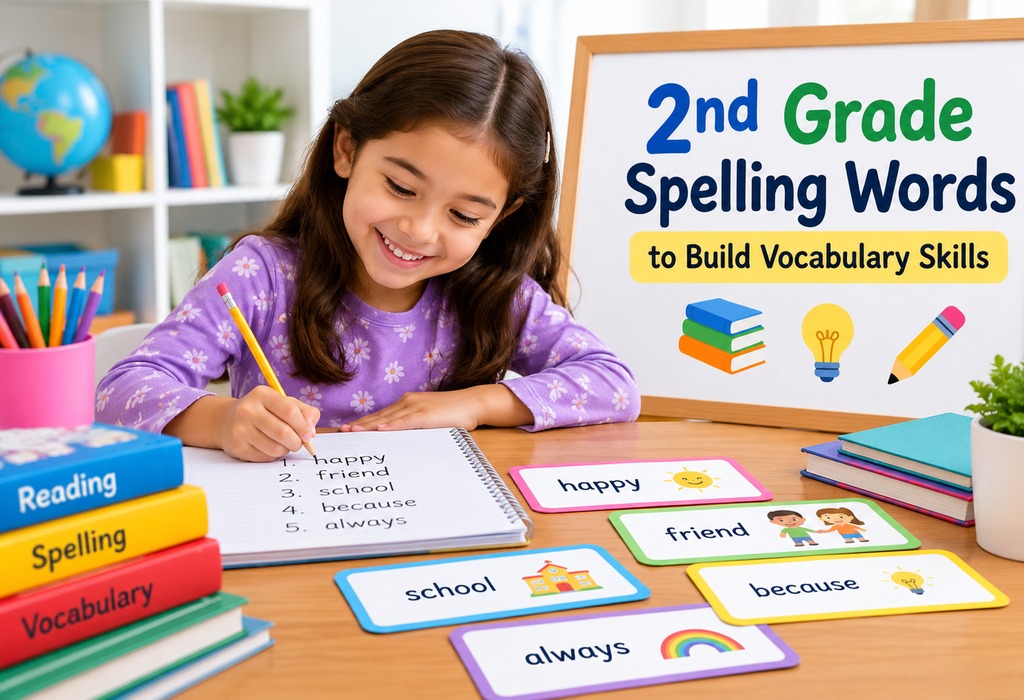
Second grade is a big year for young writers. Children move beyond simple three letter words and start working with blends, vowel teams, and word endings. Choosing the right 2nd grade spelling words helps kids read smoothly, write with confidence, and grow their vocabulary every week. Whether you need second grade spelling words for weekly practice or a complete list of spelling words for second graders to use at home, this guide offers organized groups, helpful examples, and easy practice ideas.
Why Spelling Matters in Second Grade
Spelling and reading grow together, because children who learn how sounds connect to letters begin to spot patterns in new words. Learning 2nd grade spelling words in small, themed groups keeps the task simple and builds a strong memory for words.
- Spelling helps kids read faster and with more ease.
- Clear spelling makes writing easier to read and understand.
- Kids can share ideas in sentences and stories without stopping to wonder how a word is written.
- Learning words by sound pattern builds vocabulary week after week.
- Small, regular practice builds confidence and a love for words.
Short Vowel and Blend Words
These words review short vowel sounds and teach consonant blends at the start or end of a word.
- black
- brick
- clap
- crash
- drum
- flat
- frog
- grin
- plan
- sled
- smell
- stick
- swim
- trap
- trust
- twin
Long Vowel Words
Long vowel words often use a silent e or a vowel pair. Teach children to listen for the vowel name inside the word.
- bike
- cake
- close
- globe
- kite
- note
- phone
- slide
- smile
- stone
- wave
- white
- whole
- write
Vowel Teams and R Controlled Words
Vowel teams use two letters to make one sound. R controlled words change the vowel sound when an r follows it. This group of second grade spelling words needs extra practice because the sounds can look different from how they are spelled.
- beach
- cloud
- coach
- dream
- feet
- found
- green
- house
- paint
- rain
- boat
- bird
- corn
- farm
- girl
- horse
- shark
- turn
Everyday and Sight Words
Some words do not follow clear rules, so children learn them by sight. These words appear often in books and school writing, so they are worth mastering early.
- again
- always
- because
- before
- friend
- little
- many
- people
- school
- should
- through
- together
- walk
- were
- would
Words with Endings
Second graders also learn how endings such as s, ed, and ing change a word. Practice adding each ending to a base word and notice any spelling changes.
- jumped
- helped
- playing
- running
- stopped
- baked
- making
- cries
- boxes
- wishes
Explain to your child that some words double the final letter before adding ing, as in running, while others drop the silent e, as in making.
Simple Spelling Rules for Second Graders
Spelling rules give kids a reason behind each word instead of leaving them to memorize everything. Introduce one rule at a time and practice it with words from your list of spelling words for second graders.
- Silent e: A silent e at the end of a word makes the vowel say its name, as in kite and cake.
- Doubling: In short words with one vowel, double the last letter before adding ing or ed, as in stopped and running.
- Dropping e: Drop the silent e before adding ing, as in making and baking.
- Plurals with es: Add es to words that end in s, x, ch, or sh, as in boxes and wishes.
- Changing y to i: Change the y to i before adding es or ed, as in cry and cries.
Post these rules on the fridge or a desk so your child can check them while writing. Seeing the same pattern across many second grade spelling words helps the rule stick.
Words That Sound Alike
Second graders also meet homophones, which are words that sound the same but have different spellings and meanings. These pairs often cause mistakes in writing, so they need special attention.
- to, too, two: I have two pets, and I want to play too.
- here, hear: Come here so you can hear the song.
- see, sea: We can see the sea from the beach.
- right, write: Write the right answer on the line.
- new, know: I know you have a new bike.
- be, bee: A bee will not be afraid of the flowers.
Ask your child to say each sentence aloud, then write it from memory. Drawing a small picture beside each word can also help children connect the spelling to the meaning. Adding homophones to weekly 2nd grade spelling words builds vocabulary and careful reading at the same time.
Tips to Practice Spelling at Home
A few minutes each day works better than one long session. Try these simple ideas to make practice enjoyable:
- Say the word, spell it out loud, then say it again.
- Write each word three times in different colors.
- Use sidewalk chalk, magnetic letters, or sand trays for hands on fun.
- Ask your child to use each word in a short sentence.
- Play a quick game of spelling bingo or word scramble.
- Review missed words the next day until they feel easy.
Start with five to ten words a week from this list of spelling words for second graders. Add new words only when your child feels comfortable with the earlier ones. Celebrate small wins, since confidence matters as much as accuracy.
Learning 2nd grade spelling words gives children a strong base for reading, writing, and vocabulary growth. Grouping words by sound pattern makes each lesson clear and easy to remember. Short daily practice with games and sentences keeps kids interested without causing stress. Parents and teachers can use these second grade spelling words as a flexible plan that fits any classroom or home routine. With patience, encouragement, and regular review, every child can become a confident speller.