
Table of Contents
Have you ever noticed how a child uses the word “big” for almost everything? A big dog, a big house, a big feeling. Teaching synonyms for kids is one of the easiest ways to help them move beyond these favorite words. Synonyms are words that have the same or nearly the same meaning, and learning them gives children more choices when they speak, read, and write. A richer vocabulary also helps kids understand stories better and explain their thoughts clearly. This guide explains what synonyms are, shares simple word lists, and offers fun ways to practice at home or in class.
What Are Synonyms?
A synonym is a word that means almost the same thing as another word. For example, “happy” and “glad” are synonyms because both describe a good feeling. The word “synonym” comes from Greek roots that mean “same name.”
An easy way to explain this to a child is to say that synonyms are word twins. They look different and sound different, but they carry a similar meaning. Some twins are very close, like “begin” and “start.” Others have small differences. “Tiny” feels smaller than “little,” and “enormous” feels larger than “big.”
Why Learning Synonyms Matters
Knowing many words gives children power over their language. Here is how synonyms help:
- They make writing more interesting, because kids can avoid repeating the same word.
- They improve reading, since a child who knows “quick” and “fast” can understand both when they appear in a book.
- They build confidence in speaking, because kids can pick the word that fits best.
- They prepare children for spelling and vocabulary tests in school.
- They help kids see small shades of meaning between similar words.
Examples of Synonyms for Kids
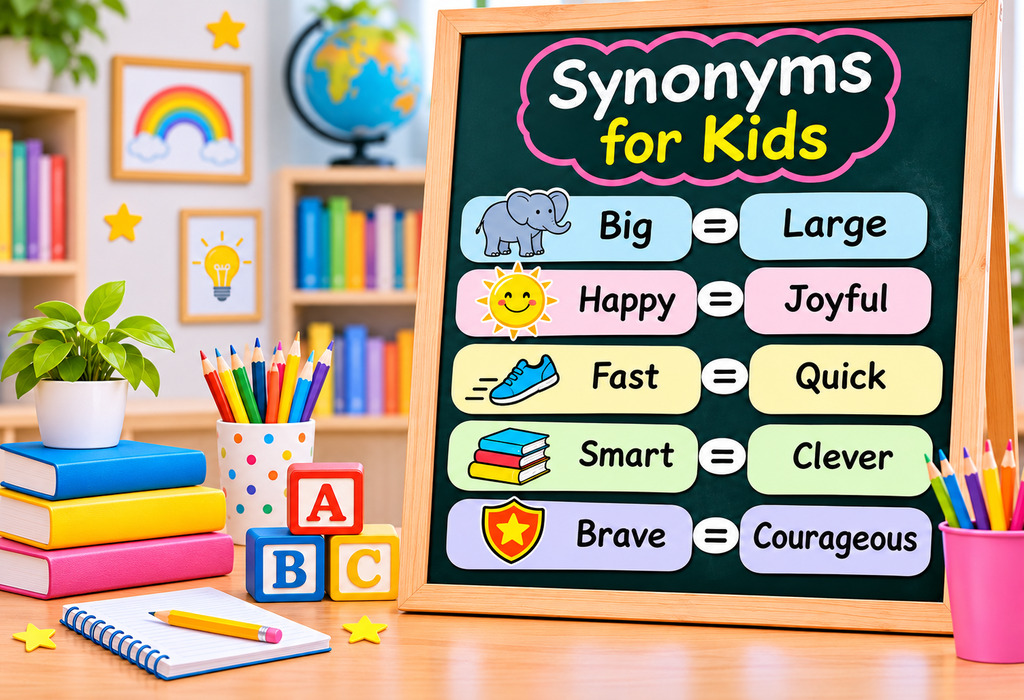
Simple examples work best when children first meet the idea. Here are some examples of synonyms for kids that you can share in everyday conversation:
- Big and large
- Small and tiny
- Happy and cheerful
- Sad and unhappy
- Fast and quick
- Smart and clever
- Begin and start
- End and finish
- Pretty and beautiful
- Funny and silly
You can say a sentence with one word, then ask your child to say it again with the synonym. “The puppy is small” becomes “The puppy is tiny.” This tiny change shows kids how flexible language can be.
List of Synonyms for Kids
Below is a list of synonyms for kids, grouped by theme so it is easier to learn and remember.
Feeling Words
- Happy: glad, joyful, cheerful, delighted
- Sad: unhappy, gloomy, upset, down
- Angry: mad, furious, cross, annoyed
- Scared: afraid, frightened, fearful, nervous
- Tired: sleepy, weary, worn out, drowsy
Action Words
- Run: dash, sprint, race, jog
- Walk: stroll, stride, wander, march
- Look: see, watch, peek, stare
- Talk: speak, chat, say, whisper
- Jump: leap, hop, bounce, spring
- Eat: munch, nibble, gobble, chew
Describing Words
- Big: large, huge, giant, enormous
- Small: little, tiny, mini, petite
- Good: great, fine, wonderful, excellent
- Bad: awful, poor, terrible, nasty
- Hot: warm, boiling, burning, scorching
- Cold: chilly, cool, freezing, icy
- Pretty: lovely, beautiful, attractive, charming
- Old: ancient, aged, elderly, antique
- New: fresh, modern, recent, brand new
Words About People
- Kid: child, youngster, little one, boy or girl
- Friend: pal, buddy, mate, companion
- Teacher: instructor, tutor, guide, educator
- Baby: infant, newborn, tot, little one
Notice that the word “kid” itself has synonyms like “child” and “youngster.” Pointing this out can make kids smile and show them that every word has cousins.
Words That Are Close but Not Exactly the Same
Older children can learn that synonyms are not always perfect swaps. Think about “walk” and “stomp.” Both describe moving on foot, but stomping sounds angry and heavy. In the same way, “cold” and “freezing” are related, but freezing is much stronger.
Ask your child questions like these:
- Which word sounds stronger, “warm” or “scorching”?
- Which word would you use for a soft voice, “say” or “whisper”?
- Which word fits a very big mountain, “large” or “enormous”?
These questions teach kids to choose words with care, which is a key skill for strong writing.
Fun Ways to Practice Synonyms
Learning works best when it feels like play. Try these simple activities:
- Synonym match: Write words on cards and ask your child to pair the twins, such as “quick” and “fast.”
- Word swap story: Read a short sentence aloud and ask your child to replace one word with a synonym.
- Synonym treasure hunt: Give your child a word and see how many synonyms they can find in ten minutes.
- Thesaurus time: Introduce a kid friendly thesaurus and let them explore words they love.
- Say it another way: At dinner, challenge everyone to describe their day without using the word “good.”
- Synonym bingo: Make bingo cards with words and call out their synonyms.
Short sessions of five to ten minutes each day work better than one long lesson. Praise every attempt, even when a swap is not perfect, and talk about why it did or did not fit.
Tips for Parents and Teachers
Helping children grow their word power does not need fancy tools or long lessons. These simple tips make learning synonyms easy and enjoyable at home or in the classroom.
- Start with words your child already knows and add one or two new synonyms at a time.
- Use the new words in everyday conversations so they stay fresh in your child’s memory.
- Read books together and pause when you spot an interesting word, then ask what other word could take its place.
- Keep a small word wall or notebook where your child can add new synonyms they discover.
- Turn practice into play with matching cards, bingo, and quick word swap games.
- Keep sessions short, about five to ten minutes a day, so learning never feels like a chore.
- Praise every attempt, even when a swap is not perfect, and talk about why a word did or did not fit.
- Encourage older kids to explore a kid friendly thesaurus and share their favorite finds.
- Keep the mood light and curious, because children learn faster when they are having fun.
Synonyms give children more ways to express what they think and feel. Starting with simple pairs and growing into longer word lists helps kids learn at a comfortable pace. Games, stories, and daily chats turn vocabulary practice into something children actually enjoy. With steady encouragement, your child will begin choosing sharper and more colorful words on their own. Start today with one word, and watch their language grow.