
Table of Contents
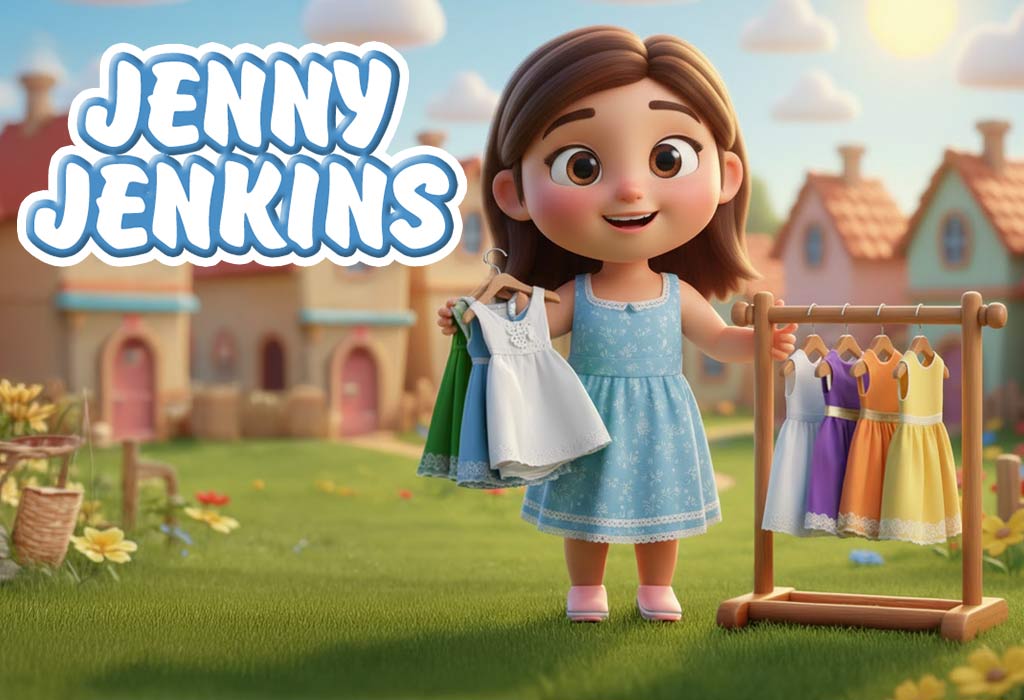
“Jenny Jenkins” is a playful call-and-response nursery rhyme that follows a young girl named Jenny who gives humorous, repetitive answers to simple questions. Children love this rhyme because of its predictable pattern, funny refusals, and bouncy rhythm that invites participation. As the questions repeat and slightly change, kids quickly learn to anticipate the responses, which keeps them engaged and confident. For early learners, this rhyme gently supports listening skills, memory, and language development through repetition. Parents and educators also enjoy using it because it’s easy to sing, doesn’t require props, and naturally encourages interaction. Its light humor and steady beat make it a comforting and enjoyable rhyme for group time, circle activities, or quiet bonding moments at home.
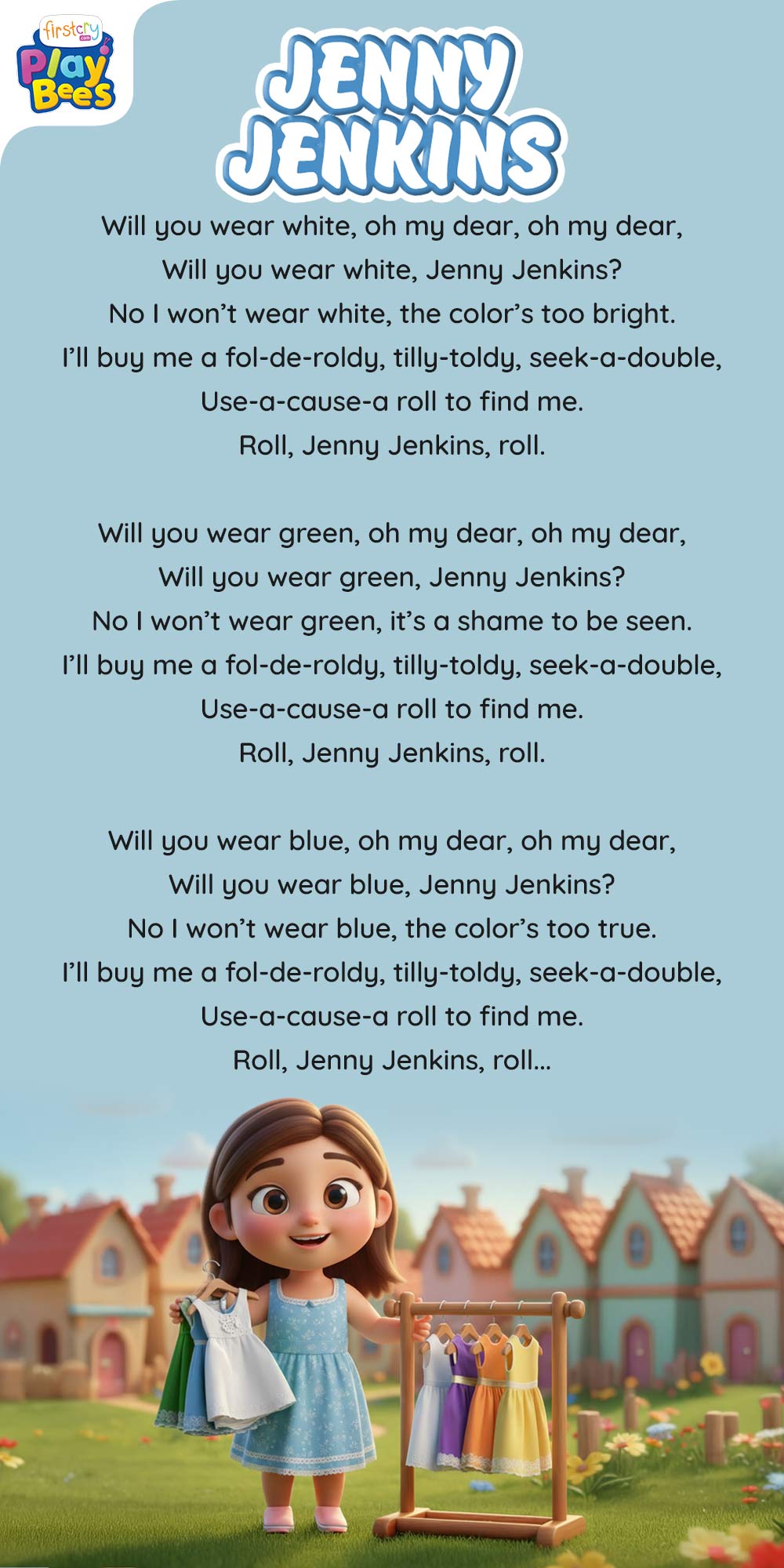
Jenny Jenkins Song Lyrics
Below are the classic Jenny Jenkins words, shared as they are commonly sung and taught to young children.
Will you wear white, oh my dear, oh my dear,
Will you wear white, Jenny Jenkins?
No I won’t wear white, the color’s too bright.
I’ll buy me a fol-de-roldy, tilly-toldy, seek-a-double,
Use-a-cause-a roll to find me.
Roll, Jenny Jenkins, roll.
Will you wear green, oh my dear, oh my dear,
Will you wear green, Jenny Jenkins?
No I won’t wear green, it’s a shame to be seen.
I’ll buy me a fol-de-roldy, tilly-toldy, seek-a-double,
Use-a-cause-a roll to find me.
Roll, Jenny Jenkins, roll.
Will you wear blue, oh my dear, oh my dear,
Will you wear blue, Jenny Jenkins?
No I won’t wear blue, the color’s too true.
I’ll buy me a fol-de-roldy, tilly-toldy, seek-a-double,
Use-a-cause-a roll to find me.
Roll, Jenny Jenkins, roll.
Will you wear yellow, oh my dear, oh my dear,
Will you wear yellow, Jenny Jenkins?
No I won’t wear yellow, I’ll never get a fellow.
I’ll buy me a fol-de-roldy, tilly-toldy, seek-a-double,
Use-a-cause-a roll to find me.
Roll, Jenny Jenkins, roll.
Will you wear brown, oh my dear, oh my dear,
Will you wear brown, Jenny Jenkins?
No I won’t wear brown, cause I’d never get around.
I’ll buy me a fol-de-roldy, tilly-toldy, seek-a-double,
Use-a-cause-a roll to find me.
Roll, Jenny Jenkins, roll.
Will you wear beige, oh my dear, oh my dear,
Will you wear beige, Jenny Jenkins?
No I won’t wear beige, cause it shows my age.
I’ll buy me a fol-de-roldy, tilly-toldy, seek-a-double,
Use-a-cause-a roll to find me.
Roll, Jenny Jenkins, roll.
Will you wear orange, oh my dear, oh my dear,
Will you wear orange, Jenny Jenkins?
No orange I won’t wear, it rhymes so there.
I’ll buy me a foldy roldy tildy toldy, seek a double,
Use a causa roll to find me.
Roll, Jenny Jenkins, roll.
Will you wear black, oh my dear, oh my dear,
Will you wear black, Jenny Jenkins?
No I won’t wear black, it’s the color of my back.
I’ll buy me a foldy roldy tildy toldy, seek a double,
Use a causa roll to find me.
Roll, Jenny Jenkins, roll.
Will you wear red, oh my dear, oh my dear,
Will you wear red, Jenny Jenkins?
I won’t wear red, it’s the color of my head.
I’ll buy me a fol-de-roldy, tilly-toldy, seek-a-double,
Use-a-cause-a roll to find me.
Roll, Jenny Jenkins, roll.
Will you wear pink, oh my dear, oh my dear,
Will you wear pink, Jenny Jenkins?
Well, what do you think? I won’t wear pink.
I’ll buy me a foldy roldy, tildy toldy, seek a double,
Usa causa roll to find me.
Roll, Jenny Jenkins, roll.
Then what will you wear, oh my dear, oh my dear,
What will you wear, Jenny Jenkins?
Oh, what do you care, if I just go bare.
I’ll buy me a fol-de-roldy, tilly-toldy, seek-a-double,
Use-a-cause-a roll to find me.
Roll, Jenny Jenkins, roll.
Roll, Jenny Jenkins, roll.
Roll, Jenny Jenkins, roll.
Other Versions of the Jenny Jenkins Song
Over time, this rhyme has been shared in slightly different ways across regions and classrooms.
Version 1: Gloves
Jenny Jenkins, Jenny Jenkins,
Will you marry me?
Jenny Jenkins, Jenny Jenkins,
Will you marry me?
I won’t marry you,
I won’t marry you,
I won’t marry you,
For your gloves are too small.
Version 2: Hat
Jenny Jenkins, Jenny Jenkins,
Will you marry me?
Jenny Jenkins, Jenny Jenkins,
Will you marry me?
I won’t marry you,
I won’t marry you,
I won’t marry you,
For your hat is too tall.
Version 3: Coat
Jenny Jenkins, Jenny Jenkins,
Will you marry me?
Jenny Jenkins, Jenny Jenkins,
Will you marry me?
I won’t marry you,
I won’t marry you,
I won’t marry you,
For your coat is too long.
Version 4: Name Game (Classroom Version)
Jenny Jenkins can be replaced with a child’s name to make it interactive.
Sammy Parker, Sammy Parker,
Will you marry me?
Sammy Parker, Sammy Parker,
Will you marry me?
I won’t marry you,
I won’t marry you,
I won’t marry you,
For your shoes are too big.
Gestures – How to Teach Jenny Jenkins to Kids
Using actions makes this rhyme more interactive and helps children remember the words more easily. Simple movements also keep little learners focused and excited.
- Point to an imaginary person when saying “Jenny Jenkins” so children understand the rhyme is about someone specific.
- Use a gentle shrug and shake your head while singing “Will you marry me?” to show it’s a playful question.
- Shake your index finger side to side during “I won’t marry you” to clearly show refusal in a fun way.
- Point down toward your feet when mentioning “boots” to connect words with body awareness.
- March in place slowly to match the rhythm, helping kids feel the beat of the song.
- Encourage children to repeat both the words and actions together to build confidence and coordination.
History & Quick Facts
“Jenny Jenkins” is a traditional English nursery rhyme with roots in oral folk culture. The exact author is unknown, as the rhyme was passed down verbally long before being written. It appeared in printed nursery rhyme collections in the 19th century, when many traditional children’s songs were first documented. Its simple structure and humorous repetition helped it spread quickly among families and schools. Over time, it became a favorite because it was easy to remember and adaptable for group singing.
Interesting Facts
- The rhyme is often sung as a call-and-response song, making it ideal for group participation.
- It has been shared in many English-speaking countries with small lyric variations.
- Teachers sometimes adapt the tune to fit classroom games or name songs.
- The melody is simple and closely related to other traditional folk tunes.
- The repeated refusals make children laugh and anticipate the next line.
- It remains popular today because it needs no music or props to enjoy.
Suitable Age & Learnings
“Jenny Jenkins” is well suited for toddlers, preschoolers, and early primary kids, usually ages 2–6 years. Its repetition and steady rhythm make it especially friendly for young learners who are just beginning to enjoy group songs.
- Listening skills: Children learn to follow repeated questions and answers closely.
- Memory building: The predictable pattern helps kids remember words and sequences.
- Language development: Repetition supports vocabulary and sentence structure.
- Rhythm awareness: Singing along helps children feel and match the beat.
- Social interaction: Call-and-response encourages turn-taking and group participation.
- Confidence: Familiar lines help shy children join in without pressure.
FAQs
1. What is the rhyme scheme of Jenny Jenkins?
The rhyme follows a simple repetitive pattern with matching end sounds, making it easy for children to predict and remember.
2. Is Jenny Jenkins suitable for classroom use?
Yes, it works well for circle time, music sessions, and action-based learning activities.
3. Why do children enjoy the repeated “no” responses?
The humorous refusal feels playful and gives children a sense of surprise and control.
“Jenny Jenkins” is a timeless nursery rhyme that continues to delight young children with its humor and repetition. Its simple structure makes it easy for kids to join in, even after hearing it just once or twice. Parents and teachers appreciate how naturally it supports early language and listening skills without feeling like formal learning. The rhyme’s flexibility allows it to be adapted with actions, names, or new verses to keep things fresh. Whether sung at home, in a classroom, or during playtime, it encourages connection and laughter. Overall, “Jenny Jenkins” remains a warm, engaging rhyme that turns simple words into joyful learning moments.
Explore Other Rhymes for Kids:
Skip to My Lou Nursery Rhyme With Lyrics
Jimmy Crack Corn Nursery Rhyme With Lyrics
On Top of Old Smokey Nursery Rhyme With Lyrics