
Table of Contents
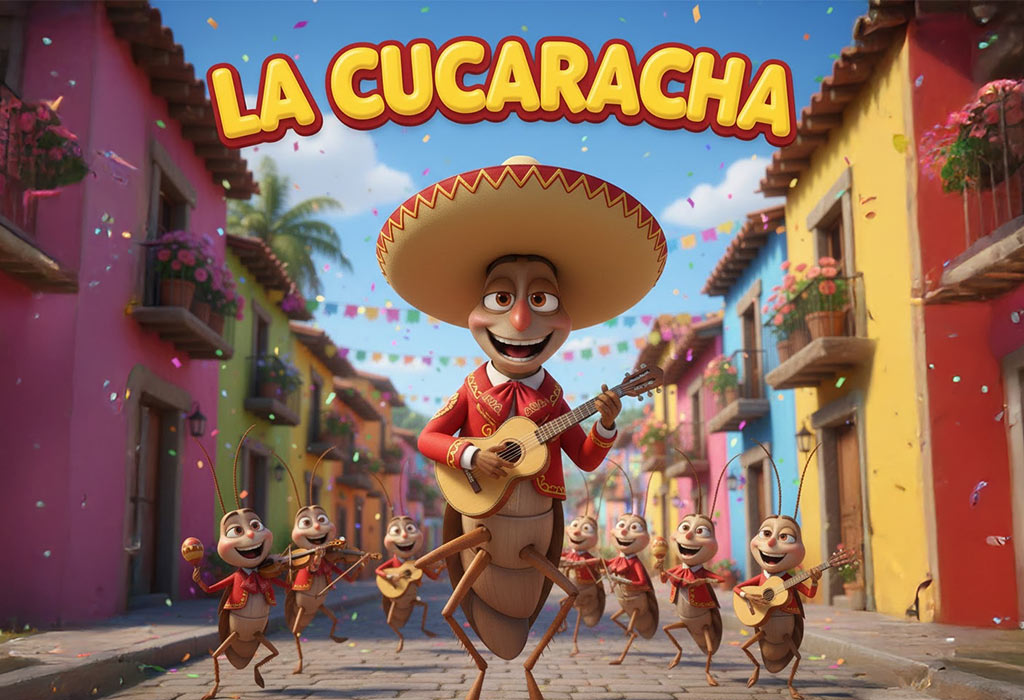
La Cucaracha is a lively and playful nursery rhyme that introduces children to rhythm, repetition, and a touch of cultural fun. The rhyme tells a humorous story through simple lines and a catchy tune, making it easy for young children to sing along and remember. Kids enjoy La Cucaracha because of its bouncy melody, repeated phrases, and fun sound patterns that invite clapping and movement. For parents and teachers, this rhyme is a gentle way to support early learning by building listening skills, language awareness, and musical timing. Singing the rhyme also helps children explore new words, especially from another language, which supports memory and curiosity. Overall, La Cucaracha creates a joyful learning moment where children can sing, move, and learn together in a relaxed and happy way.
La Cucaracha Song Lyrics
This playful rhyme is loved for its catchy tune, and the La Cucaracha words are easy for children to follow and repeat.
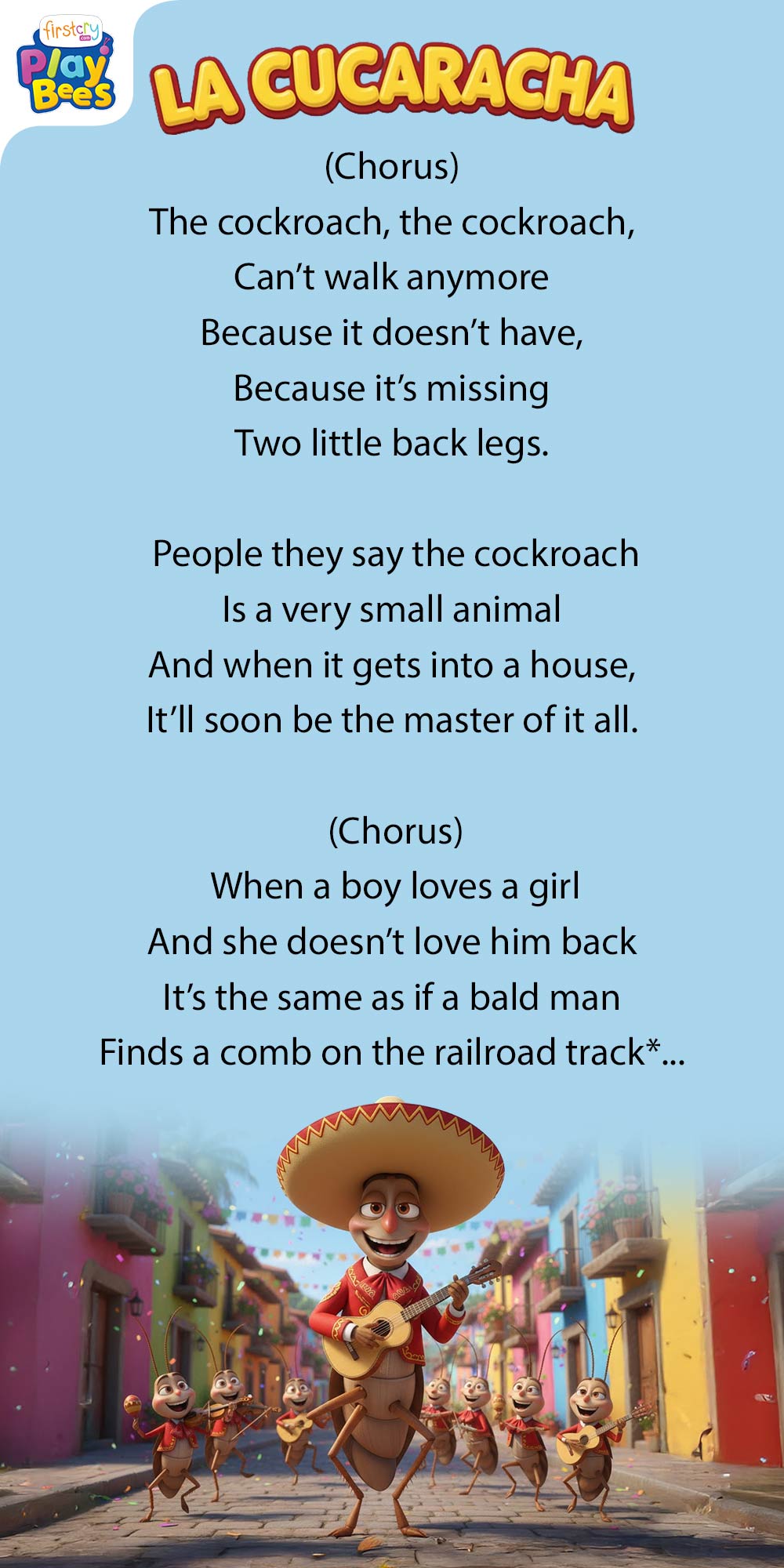
(Chorus)
The cockroach, the cockroach,
Can’t walk anymore
Because it doesn’t have,
Because it’s missing
Two little back legs.
People they say the cockroach
Is a very small animal
And when it gets into a house,
It’ll soon be the master of it all.
(Chorus)
When a boy loves a girl
And she doesn’t love him back
It’s the same as if a bald man
Finds a comb on the railroad track*.
(Chorus)
My neighbor across the street
Had Lady Claire as her name
And if she hadn’t died
She still would be called the same.
(Chorus)
When Rita was bathing
In the San Fernando River
The cockroach stung her
But she kept on swimming.
(Chorus)
Other Versions of the La Cucaracha Song
Over the years, this rhyme has been sung in many playful ways with small changes to the words and verses.
1. Traditional Spanish Version
La cucaracha, la cucaracha,
Ya no puede caminar,
Porque no tiene,
Porque le falta,
Una pata para andar.
La cucaracha, la cucaracha,
Ya no puede caminar,
Porque no tiene,
Porque le falta,
Una pata para andar.
2. Child-Friendly Classroom Version
La cucaracha, la cucaracha,
Marcha lento al caminar,
Salta un poquito,
Gira despacito,
Y comienza a bailar.
La cucaracha, la cucaracha,
Bate palmas al cantar,
Todos los niños,
Cantan contentos,
Y se ponen a saltar.
3. English Adaptation
La cucaracha, la cucaracha,
Marches slowly down the floor,
She is funny,
She is wiggly,
Let us sing and dance some more.
La cucaracha, la cucaracha,
Clap your hands and stomp your feet,
Sing together,
Laugh and wiggle,
Feel the music and the beat.
Gestures – How to Teach La Cucaracha to kids
Using actions makes this rhyme more interactive and helps children stay engaged while learning. Simple movements also support memory and coordination.
- Pretend to walk in place slowly to match the rhythm of the song.
- Point to one leg when singing about the missing leg to help children understand the story.
- Wiggle fingers playfully to act like a tiny insect moving around.
- Clap hands gently on the repeated lines to keep the beat steady.
- Encourage children to sway side to side to feel the music flow.
- End by marching together to make the activity energetic and fun.
History & Quick Facts
La Cucaracha is a traditional Mexican folk song with roots dating back to the early 19th century. The rhyme does not have a single known author, as it was passed down orally through generations. It became especially popular during the Mexican Revolution, when new verses were often added to reflect daily life and humor. Over time, the song spread beyond Mexico and became known worldwide as a cultural folk tune. Today, simplified versions are commonly used as a children’s rhyme because of the easy melody and repetitive structure.
Interesting Facts
- The rhyme originated in Mexico and is part of traditional folk music.
- There is no single official version, and lyrics often change by region.
- The tune is one of the most recognizable Spanish folk melodies.
- It has been translated and adapted into many languages for children.
- The song is often taught with actions to make learning more fun.
- Many modern versions focus on humor and child-friendly storytelling.
Suitable age & Learnings
This rhyme is suitable for children aged 2 to 6 years, as it uses simple words and a repetitive tune. It works well for group singing, movement play, and early language activities.
- Children learn rhythm and timing by clapping and moving along with the song.
- The rhyme supports early language skills through repeated phrases.
- Kids are introduced to Spanish sounds and basic vocabulary.
- Listening skills improve as children follow the tune and words.
- Movement-based singing helps develop coordination and balance.
- Cultural awareness grows as children explore music from different traditions.
FAQs
1. What is the rhyming scheme of La Cucaracha?
The rhyme follows a simple repeating pattern that focuses more on rhythm and melody than strict end rhymes, making it easy for children to remember and sing along.
2. Why is La Cucaracha good for young children?
It supports early language development, listening skills, and coordination by combining music, repetition, and simple movements in a fun way.
La Cucaracha remains a joyful and engaging nursery rhyme that brings music, movement, and cultural learning together. Its catchy tune and simple words make it easy for children to join in and have fun. Parents and teachers can use this rhyme to support early language and rhythm skills in a playful way. Overall, it is a wonderful addition to any child’s song collection, creating smiles and learning at the same time.
Explore Other Rhymes for Kids:
Bingo Nursery Rhyme With Lyrics
Three Little Kittens Nursery Rhyme With Lyrics
How Much Wood Would a Woodchuck Chuck Nursery Rhyme With Lyrics