


Table of Contents
Little Tommy Tucker is a short and cheerful nursery rhyme about a young boy who sings for his supper, introducing children to simple storytelling through rhythm and rhyme. Kids enjoy this rhyme because it is easy to remember, playful, and encourages imagination as they picture Tommy performing. The repetition and rhyme pattern make it fun for little ones to chant along with parents or teachers. For early learners, this rhyme supports language development by introducing new words in a simple context. It also helps improve listening skills, memory, and pronunciation. Because the lines are short and clear, toddlers can quickly pick them up and repeat them with confidence. Overall, Little Tommy Tucker is a charming rhyme that blends fun with foundational learning in a gentle and engaging way.
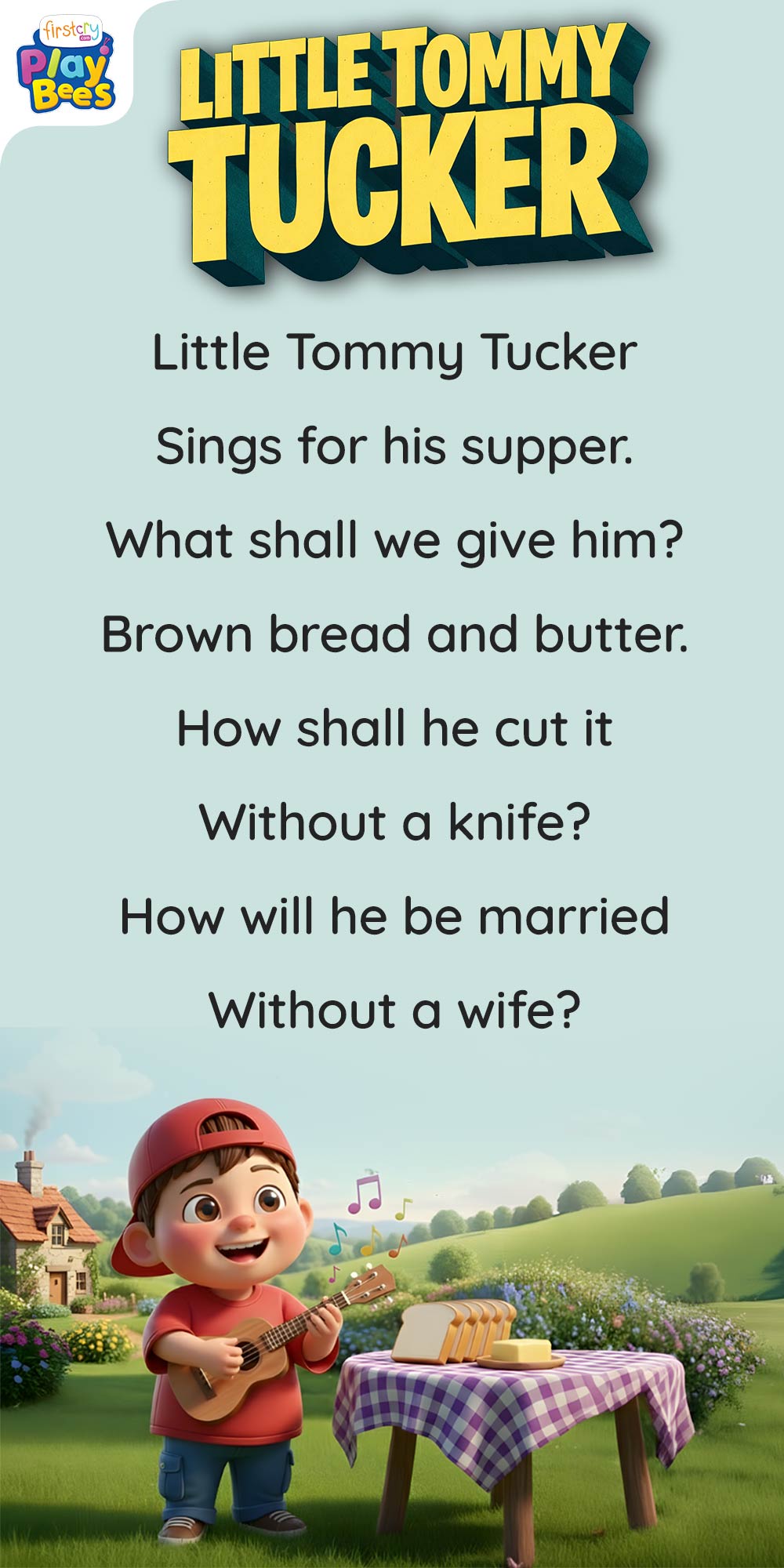
Little Tommy Tucker Song Lyrics
Here are the Little Tommy Tucker words that children love to sing along with:
Little Tommy Tucker
Sings for his supper.
What shall we give him?
Brown bread and butter.
How shall he cut it
Without a knife?
How will he be married
Without a wife?
Other Versions of Little Tommy Tucker Song
Over the years, a few slightly extended or adapted versions of this rhyme have appeared in children’s books and performances.
Extended Ending
Little Tommy Tucker,
Sings for his supper;
What shall he eat?
White bread and butter.
How shall he cut it
Without e’er a knife?
How will he be married
Without e’er a wife?
He shall have a slice,
And a nice piece twice.
Repetitive Classroom
Little Tommy Tucker,
Sings for his supper;
What shall he eat?
White bread and butter.
White bread and butter,
Is what he shall eat;
Sing, little Tommy,
For something to eat.
Gestures – How to Teach Little Tommy Tucker to Kids
Adding simple actions makes the rhyme more interactive and helps children remember the words more easily. These easy, movement-based gestures can be used at home or in the classroom.
- Point to yourself or a child when saying “Little Tommy Tucker” to help children connect the name to a person.
- Pretend to sing into a microphone for “Sings for his supper” so kids can act like they are performing.
- Rub your tummy during “What shall he eat?” to show that Tommy is hungry.
- Pretend to hold and spread butter on bread for “White bread and butter” to make the food reference visual and fun.
- Make a cutting motion with your hand for “How shall he cut it” to demonstrate the action of slicing.
- Shrug your shoulders and shake your head gently for “Without e’er a knife” and “Without e’er a wife” to express confusion in a playful way.
History & Quick Facts
Little Tommy Tucker is a traditional English nursery rhyme that dates back to the 18th century. It was first published in Tommy Thumb’s Pretty Song Book around 1744, one of the earliest known collections of English nursery rhymes. The author of the rhyme is unknown, as many nursery rhymes were passed down orally before being written. Some historians believe the rhyme may have connections to the old English custom of “singing for one’s supper,” where performers would entertain in exchange for food. Over time, the rhyme became popular in children’s books and nursery collections, eventually spreading to classrooms and homes around the world.
Interesting Facts
- The rhyme was first printed in the mid-1700s, making it more than 250 years old and one of the older English nursery rhymes.
- The phrase “sing for his supper” reflects an old tradition where entertainers performed in return for a meal.
- The character name “Tommy Tucker” was a common fictional name used in old English rhymes.
- The rhyme has appeared in many classic nursery rhyme collections over the centuries.
- It is often recited rather than sung because there is no single official tune.
- The rhyme has been included in illustrated children’s books with colorful drawings of bread and butter to make it more engaging for young readers.
Suitable Age & Learnings
Little Tommy Tucker is most suitable for children aged 2 to 6 years, as the short lines and simple vocabulary are perfect for early learners. The rhyme’s rhythm and repetition make it easy for toddlers and preschoolers to follow and memorize.
- Language development: Children learn simple sentence structures and new vocabulary such as “supper,” “butter,” and “knife.”
- Rhyming skills: The rhyme helps children hear and recognize rhyming word pairs like “supper” and “butter.”
- Listening skills: Kids improve attention as they follow the short story from beginning to end.
- Memory building: Repeating the lines strengthens recall and confidence in speaking.
- Imagination: Children picture Tommy singing and eating, which encourages creative thinking.
- Social learning: Acting out the rhyme together promotes group participation and shared fun.
FAQs
1. What is the rhyming scheme of Little Tommy Tucker?
The rhyming scheme follows an AABB pattern, where “supper” rhymes with “butter” and “knife” rhymes with “wife.”
2. Why is this rhyme still popular today?
Its short length, simple language, and catchy rhymes make it easy for young children to learn and enjoy even today.
Little Tommy Tucker is a delightful nursery rhyme that has entertained children for generations. Its simple storyline and catchy rhymes make it easy for little ones to understand and remember. Parents and teachers appreciate how it gently builds early language and listening skills. With playful gestures and repetition, the rhyme becomes even more engaging for young learners. Though it is centuries old, it still feels fresh and fun in modern classrooms and homes. Sharing this rhyme with your child is a wonderful way to combine learning, laughter, and togetherness.
Explore Other Rhymes for Kids:
Little Jack Horner Nursery Rhyme With Lyrics
Old Mother Hubbard Nursery Rhyme With Lyrics
Peter Peter Pumpkin Eater Nursery Rhyme With Lyrics