
Table of Contents
“She Sells Seashells” is a classic tongue-twister rhyme that children love repeating again and again. It tells a simple story about a seashell seller by the seashore, but the real fun lies in how the words sound when spoken quickly. Kids enjoy this rhyme because it feels playful and slightly challenging, making them giggle as they try to say it smoothly. For parents and teachers, it’s a wonderful early-learning tool. Repeating the rhyme helps children improve pronunciation, listening skills, and speech clarity. It also builds confidence as kids practice tricky sounds and rhythms. Short, catchy, and engaging, this rhyme turns language practice into a fun activity that feels more like a game than a lesson.
She Sells Seashells Song Lyrics
A short and playful rhyme, often used to practice clear speech and rhythm, these She Sells Seashells words are loved by children and adults alike.
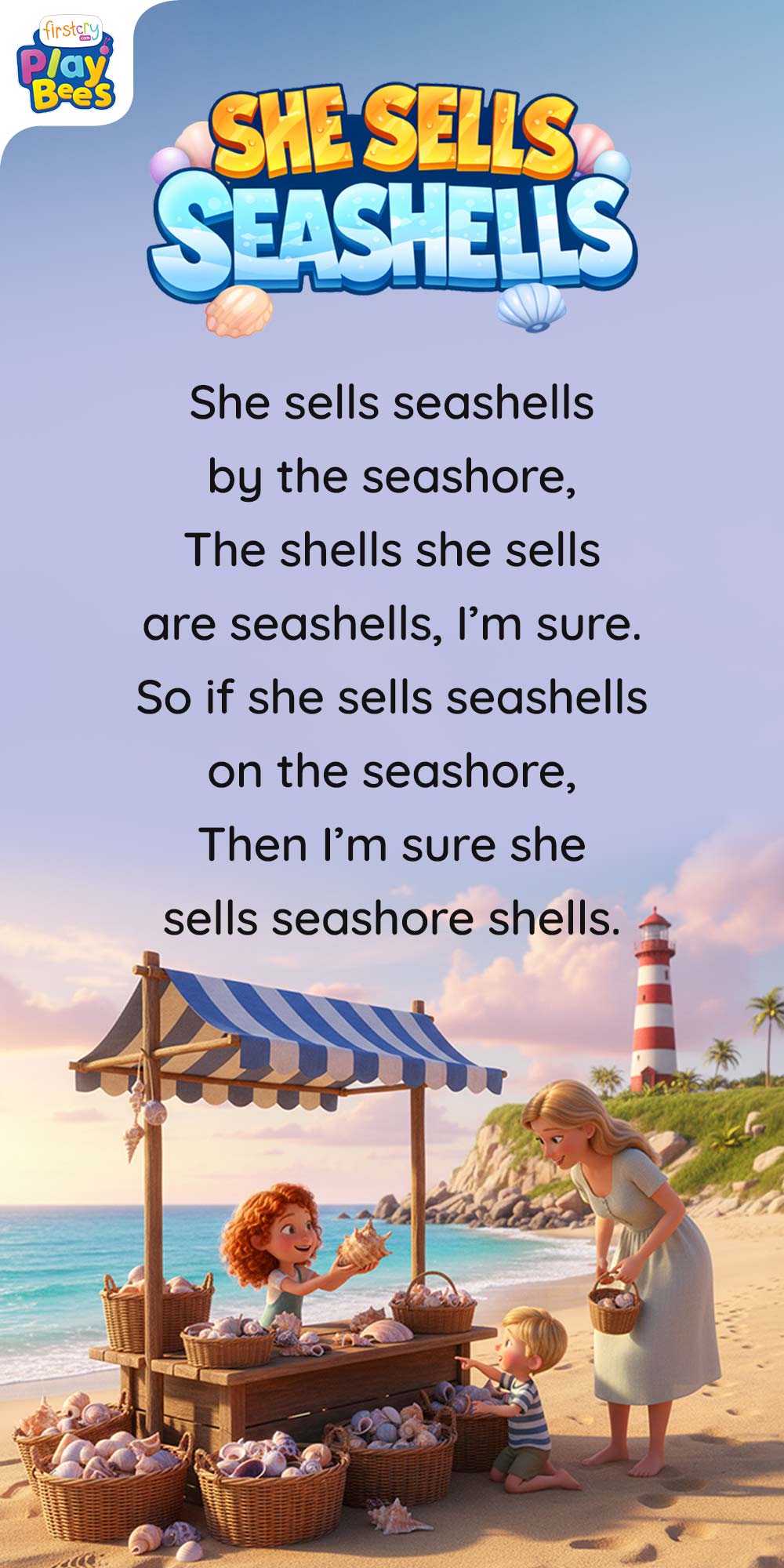
She sells seashells by the seashore,
The shells she sells are seashells, I’m sure.
So if she sells seashells on the seashore,
Then I’m sure she sells seashore shells.
Other Versions of the She Sells Seashells Song
Over time, this rhyme has appeared in several fun variations that keep the core idea but change the wording slightly.
Version 1 – Repeated Line (Beginner Friendly)
She sells seashells by the seashore,
She sells seashells by the seashore,
She sells seashells by the seashore,
And loves the shells she sells.
Version 2 – Extended Tongue-Twister
She sells seashells by the seashore,
The shells she sells are seashells, I’m sure,
So if she sells seashells by the seashore,
Then she sells seashore seashells.
Version 3 – Rhythmic Play Version
She sells seashells by the sunny seashore,
Soft shiny seashells and many more,
She sells seashells, small and bright,
From morning sun to evening light.
Version 4 – Faster Challenge Version
She sells seashells by the seashore,
Seashells she sells, she sells once more,
Swiftly she sells, shell by shell,
She sells seashells very well.
Gestures – How to Teach She Sells Seashells to Kids
Using actions makes this rhyme easier to understand and more exciting for young learners.
- Pretend to scoop shells from the ground with your hands to show “seashells.”
- Move one hand forward as if offering something to act out “she sells.”
- Point down and around your feet to represent the “seashore.”
- Make a gentle wave motion with both hands to show the sea nearby.
- Encourage kids to tap their hands together slowly to match the rhythm of the words.
- Finish by smiling and clapping to celebrate completing the rhyme clearly.
History & Quick Facts
“She Sells Seashells” is believed to have originated in the 19th century as a tongue-twister rather than a traditional song. It is often linked to Mary Anning, a famous fossil collector from England, although she did not write the rhyme herself. The words were popularized in speech and elocution exercises, especially to help people practice clear pronunciation. Over time, it became widely shared as a children’s rhyme and classroom favorite.
Interesting Facts
- The rhyme is mainly used as a tongue-twister to practice clear speech sounds.
- It became popular in English-speaking schools as a fun language exercise.
- Many children first learn it through games rather than songs.
- It has been translated into other languages as a pronunciation challenge.
- The rhyme does not have an official tune and is often spoken instead of sung.
- It remains one of the most famous tongue-twisters in the world.
Suitable Age & Learnings
This rhyme is best suited for children aged 3 to 7 years, when language and speech skills are rapidly developing. It can be enjoyed both at home and in early learning classrooms.
- Children improve pronunciation by practicing similar sounds repeatedly.
- It helps develop listening skills as kids focus on the correct word order.
- The rhyme builds confidence when children successfully say tricky phrases.
- Kids learn rhythm and flow in spoken language through repetition.
- New vocabulary like “seashells” and “seashore” expands word knowledge.
- It encourages patience and practice when words feel challenging at first.
FAQs
1. Is She Sells Seashells a song or a tongue-twister?
It is mainly known as a tongue-twister, though it’s sometimes spoken rhythmically like a rhyme.
2. What is the rhyming scheme of She Sells Seashells?
The rhyme follows a simple end-sound repetition, focusing more on alliteration than a formal rhyming pattern.
3. Why do kids find this rhyme challenging?
The repeated “s” and “sh” sounds make it tricky, which is exactly why it’s great for speech practice.
“She Sells Seashells” may be short, but it has lasting value in early childhood learning. Its playful words encourage kids to experiment with sounds and enjoy language without pressure. Parents love it because it supports speech development in a natural, fun way. Teachers use it as a simple tool to build clarity and confidence in young speakers. Whether spoken slowly or turned into a lively challenge, the rhyme never fails to bring smiles. It’s a timeless reminder that learning can be joyful, engaging, and full of laughter.
Explore Other Rhymes for Kids:
Betty Botter Nursery Rhyme With Lyrics
Fuzzy Wuzzy Was a Bear Nursery Rhyme With Lyrics
How Much Wood Would a Woodchuck Chuck Nursery Rhyme With Lyrics