
Table of Contents
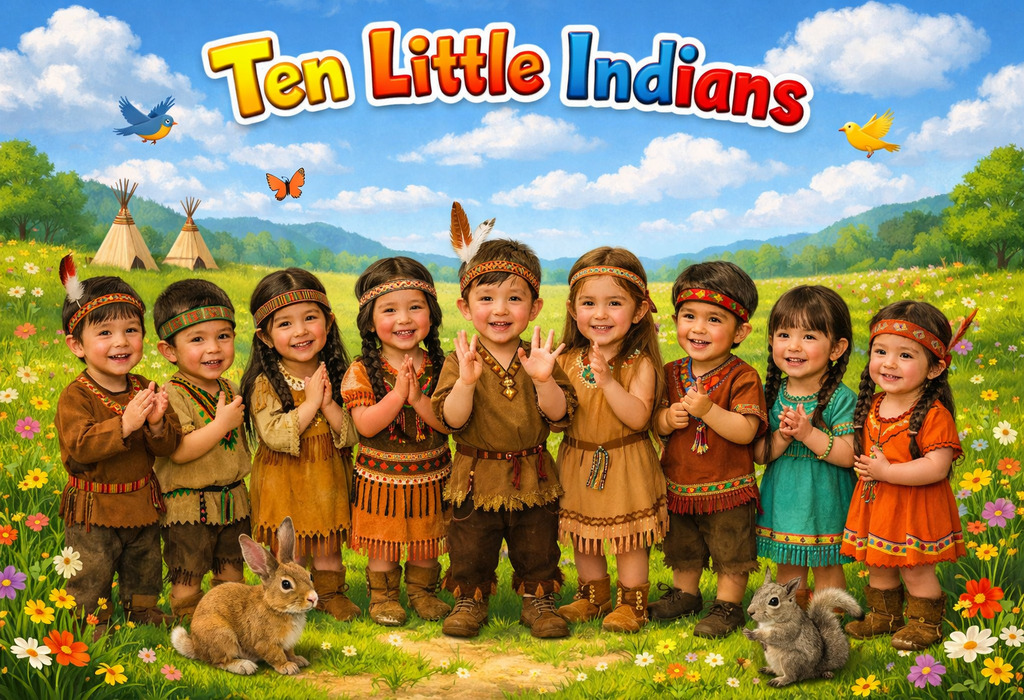
“Ten Little Indians” is a cheerful counting rhyme that introduces children to numbers in a fun and musical way. The song counts from one to ten while repeating a simple and catchy pattern that young learners can easily remember. Children enjoy the rhythm, repetition, and playful tone, which makes it perfect for singing in classrooms and at home. Parents and teachers often use this rhyme to help kids practice early counting skills and number recognition. The simple structure also supports language development and listening skills. Because the rhyme encourages children to sing along and use their fingers to count, it turns learning into an interactive activity. Over the years, it has remained a popular nursery rhyme that helps toddlers and preschoolers build confidence with numbers while enjoying music and movement.
Ten Little Indians Song Lyrics
The Ten Little Indians words are easy for children to follow and make counting from one to ten fun and memorable.
Ten little Injuns standin’ in a line,
One toddled home and then there were nine;
Nine little Injuns swingin’ on a gate,
One tumbled off and then there were eight.
Eight little Injuns gayest under heav’n.
One went to sleep and then there were seven;
Seven little Injuns cuttin’ up their tricks,
One broke his neck and then there were six.
Six little Injuns all alive,
One kicked the bucket and then there were five;
Five little Injuns on a cellar door,
One tumbled in and then there were four.
Four little Injuns up on a spree,
One got fuddled and then there were three;
Three little Injuns out on a canoe,
One tumbled overboard and then there were two.
Two little Injuns foolin’ with a gun,
One shot t’other and then there was one;
One little Injun livin’ all alone,
He got married and then there were none.
Other Versions of Ten Little Indians Song
Some versions of this rhyme have small changes in wording while keeping the same counting rhythm and melody.
1. Ten Little Indian Girls
One little, two little, three little Indians,
Four little, five little, six little Indians,
Seven little, eight little, nine little Indians,
Ten little Indian girls.
2. Ten Little Children
One little, two little, three little children,
Four little, five little, six little children,
Seven little, eight little, nine little children,
Ten little children.
3. Classic Ten Little Indians
One little, two little, three little Indians,
Four little, five little, six little Indians,
Seven little, eight little, nine little Indians,
Ten little Indian boys.
Gestures – How to Teach Ten Little Indians to Kids
Teaching this rhyme with actions helps children understand numbers better and keeps them engaged while singing.
- Show counting with fingers: Raise one finger for “one little,” two fingers for “two little,” and continue adding fingers as the numbers increase so children can visually connect numbers with counting.
- Point to each finger slowly: As you sing each number, gently tap or point to the fingers so kids can clearly see how counting works step by step.
- Clap for the final line: When the line “Ten little Indian boys” appears, encourage children to clap once or twice to add excitement and rhythm.
- Count backwards with fingers: During the second verse, slowly fold fingers down as the numbers decrease to help children understand reverse counting.
- March in place while singing: Ask children to gently march while counting the numbers to keep the activity energetic and playful.
- Finish with a big cheer: At the end of the rhyme, children can raise both hands and say the last line loudly to celebrate finishing the counting.
History & Quick Facts
“Ten Little Indians” is believed to have originated from a traditional American counting song that became widely known during the 19th century. The tune is often associated with the folk melody “Ten Little Injuns,” which appeared in minstrel songs during the 1800s. Over time, the rhyme was adapted into a simple children’s counting song used in schools and homes. Because of its repetitive structure and easy melody, it quickly became popular as a teaching rhyme for early number learning. Today the song is often modified to suit modern classrooms and children’s learning activities.
Interesting Facts
- The rhyme is mainly used to help young children practice counting from one to ten in a fun and musical way.
- Many classrooms use the song along with finger counting activities to help kids connect numbers with visual actions.
- The melody is simple and repetitive, which helps children memorize the rhyme quickly.
- Different countries sometimes change the words slightly while keeping the same counting pattern.
- The rhyme has appeared in children’s books, music collections, and preschool learning programs for many years.
- Teachers often combine the song with movement activities like clapping, jumping, or marching to keep children engaged.
Suitable Age & Learnings
“Ten Little Indians” is most suitable for children between 2 to 5 years old, as it introduces counting in a simple and playful way. The rhyme also supports early learning skills that toddlers and preschoolers are developing.
- Counting skills: Children learn to count numbers from one to ten while following the rhythm of the song.
- Number recognition: Repeating the numbers helps kids recognize and remember them more easily.
- Listening skills: The rhyme encourages children to listen carefully and repeat the sequence of numbers.
- Memory development: Singing the repetitive lines helps improve recall and memory in young learners.
- Language development: Children hear and repeat simple words and patterns that support early vocabulary growth.
- Coordination and movement: Using gestures like finger counting and clapping helps improve motor coordination.
FAQs
1. What is the rhyming scheme of Ten Little Indians?
The rhyme follows a repetitive and rhythmic pattern where each line repeats the phrase “little Indians,” creating a predictable and musical flow that helps children remember the numbers.
2. Why is Ten Little Indians used for teaching kids?
The rhyme is commonly used to teach counting because it clearly introduces numbers in sequence while using repetition and rhythm that young children can easily follow.
3. How can parents make the rhyme more interactive?
Parents can add actions such as finger counting, clapping, marching, or jumping while singing to keep children engaged and help them connect movement with numbers.
“Ten Little Indians” remains a classic counting rhyme that many children learn during their early years. Its simple rhythm and repeating lines make it easy for toddlers and preschoolers to sing along. The rhyme introduces numbers in a playful way while supporting language and listening skills. When combined with gestures like finger counting or clapping, it becomes an enjoyable learning activity for kids. Parents and teachers often use it as a first step in teaching basic number concepts. With music, movement, and repetition, the rhyme continues to make early learning both fun and memorable for young children.