
Table of Contents
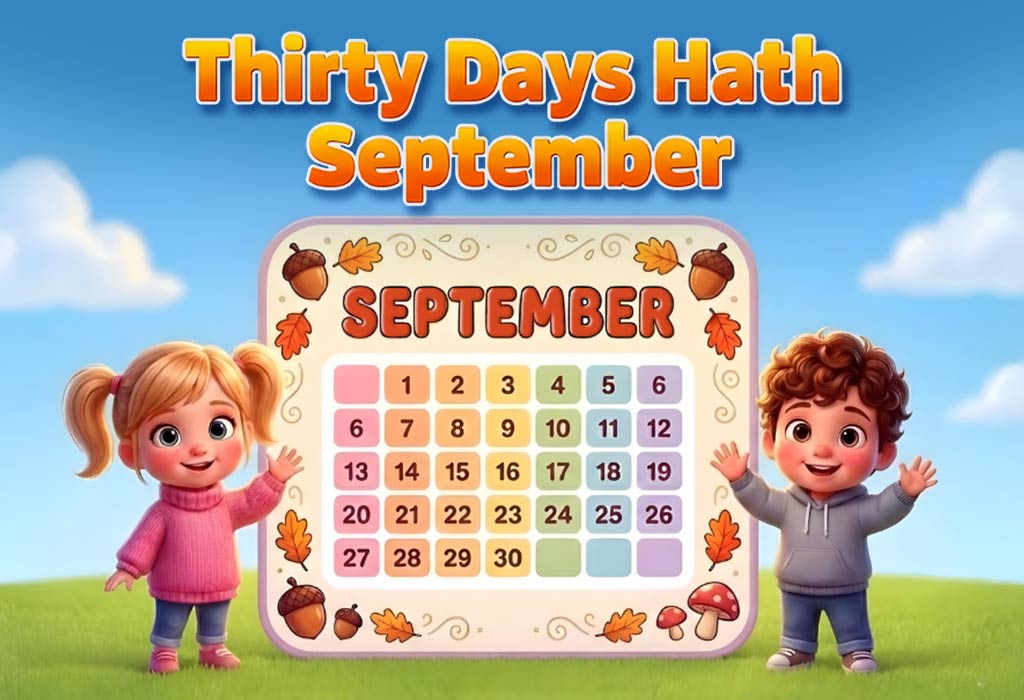
“Thirty Days Hath September” is a classic nursery rhyme that helps children learn how many days are in each month. It turns a tricky calendar concept into a simple, catchy verse that’s easy to remember. Kids enjoy it because of its rhythm and repetition, which make learning feel like a fun song rather than a lesson. Parents and teachers love it because it builds early math awareness, memory skills, and time understanding without pressure. By reciting the rhyme, children slowly become familiar with month names and number patterns. It’s often taught through singing, clapping, or finger counting, making it interactive and engaging. This rhyme is a gentle way to introduce calendars and seasons while boosting confidence, listening skills, and language development in young learners.
Thirty Days Hath September Song Lyrics
This well-known counting rhyme is often taught alongside other memory verses, and even resources sharing Thirty Days Hath September words highlight how rhythm helps children recall longer texts easily.
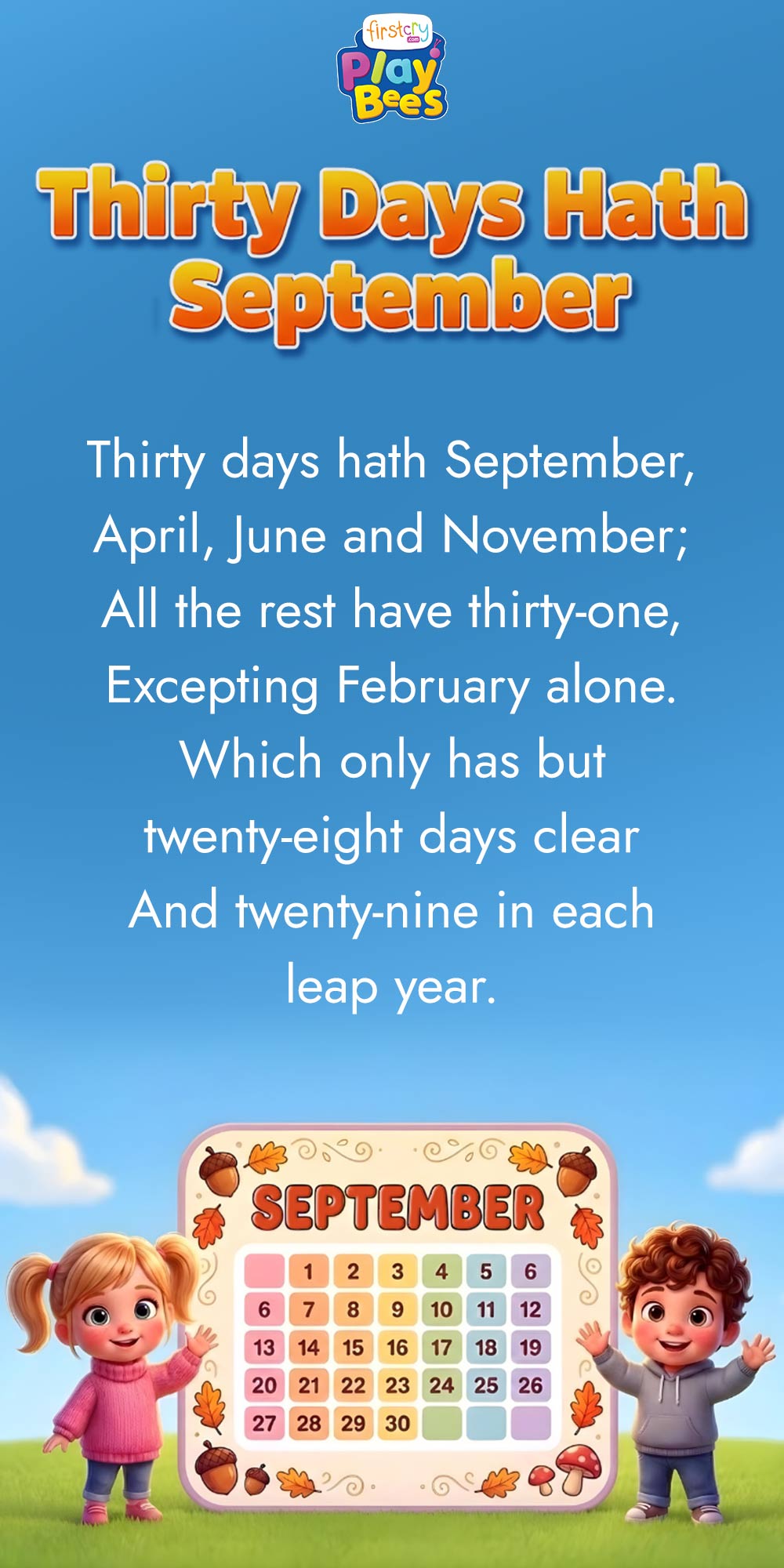
Thirty days hath September,
April, June and November;
All the rest have thirty-one,
Excepting February alone.
Which only has but twenty-eight days clear
And twenty-nine in each leap year.
Other Versions of the Thirty Days Hath September Song
Over the years, a few alternate versions of this rhyme have been shared to make it easier for children to remember. Some versions slightly change the wording or add hand-counting cues, while others include a short extra line to explain leap years more clearly for older kids.
Version 1 – Traditional Alternate Ending
Thirty days hath September,
April, June, and November;
All the rest have thirty-one,
Except February alone,
Which has twenty-eight days clear,
And twenty-nine in leap year.
Version 2 – Child-Friendly with Flow
Thirty days hath September,
April, June, and November too;
All the rest have thirty-one,
February’s days are few.
Twenty-eight days every year,
Twenty-nine in leap year, clear!
Version 3 – With Counting Emphasis
Thirty days hath September,
April, June, and November,
Count them once and count them right,
All the rest have thirty-one tight.
February’s short and neat,
Twenty-eight or twenty-nine complete.
Gestures – How to Teach Thirty Days Hath September to Kids
Using actions makes the rhyme more engaging and helps children remember it better. Simple gestures also support movement-based learning for active young minds.
- Hold up three fingers while saying “Thirty days” to help children visually connect numbers with words.
- Point to an imaginary calendar when naming the months to build calendar awareness.
- Clap once for each month mentioned to keep a steady rhythm and focus.
- Use both hands to show “twenty-eight” by counting fingers slowly for February.
- Add one extra finger when saying “twenty-nine in each leap year” to show the change.
- Encourage kids to repeat the actions along with the words to boost memory and confidence.
History & Quick Facts
“Thirty Days Hath September” is a traditional English rhyme believed to have originated in the 16th century. The exact author is unknown, as it was passed down orally before appearing in printed calendars and almanacs. It was created as a memory aid to help people remember the number of days in each month. Over time, it became popular in classrooms and homes because of its simplicity and usefulness. Today, it is widely taught to children around the world as an early learning rhyme.
Interesting Facts
- The rhyme was originally used by adults before becoming popular with children as a learning tool.
- It is taught in many countries and often translated into different languages for local learning.
- The rhyme does not follow a melody but is usually chanted in a steady rhythm.
- February is the only month highlighted separately, making it easy for kids to remember.
- Teachers often pair the rhyme with calendar activities and visual charts.
- It remains popular because it teaches real-life knowledge through simple words.
Suitable Age & Learnings
This rhyme is suitable for children aged 3 to 7 years, as it supports early memory and number concepts. It grows with the child, starting as a fun chant and later becoming a useful learning aid.
- Children learn month names by hearing them repeated in a clear sequence.
- The rhyme builds early math skills by introducing numbers like 28, 29, 30, and 31.
- Memory skills improve as children practice recalling the verse in order.
- Listening and pronunciation skills develop through repeated chanting.
- Kids gain basic time awareness by understanding months and days.
- Vocabulary grows with words like “February,” “September,” and “leap year.”
FAQs
1. What is the rhyming scheme of Thirty Days Hath September?
The rhyme follows a simple AABBCC pattern that makes it easy to remember.
2. Why is this rhyme still taught today?
Because it combines real-life learning with rhythm, making calendars easier to understand.
“Thirty Days Hath September” is more than just a nursery rhyme—it’s a practical learning tool wrapped in rhythm. It helps children understand months, numbers, and time in a gentle, enjoyable way. With simple words and repetition, kids can memorize important information without feeling overwhelmed. Parents and teachers can easily add gestures or activities to make learning even more fun. The rhyme’s long history shows how effective simple verses can be for education. By sharing this classic rhyme, you’re giving children a skill they’ll use for years, all through a cheerful and memorable song.
Explore Other Rhymes for Kids:
Finger Family Nursery Rhyme With Lyrics
Down by the Bay Nursery Rhyme With Lyrics
London Bridge Is Falling Down Nursery Rhyme With Lyrics