
Table of Contents
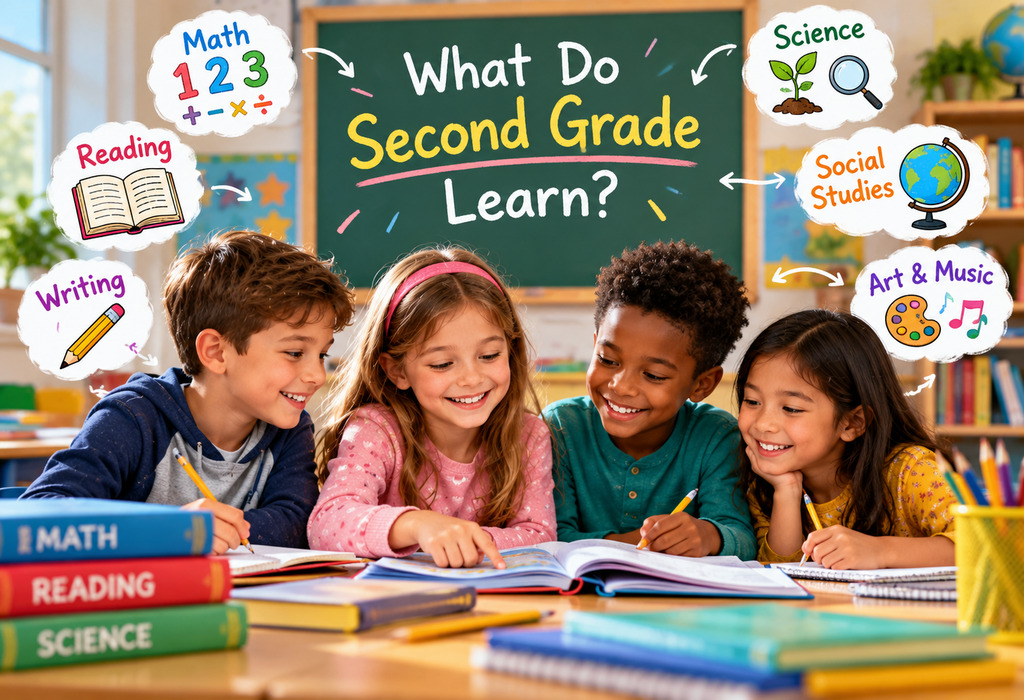
Second grade is the year when children move from learning to read to reading to learn. If you are wondering what do second graders learn, the answer covers a lot of ground: smoother reading, confident number work up to 1,000, longer pieces of writing, and a growing curiosity about science and the wider world. Curricula differ by country and school, but the core skills are surprisingly consistent. This guide walks through each subject so you know what to expect and how to support your child at home.
Second Grade at a Glance
Children in second grade are usually seven to eight years old, which matches Year 3 in England and similar stages in many other countries. Parents often ask what should a 2nd grader know by the end of the year. In short, a child should read simple chapter books fluently, add and subtract two digit numbers, write several connected sentences, and explain what they have learned in their own words. Teachers also expect more independence, such as following multi step instructions, packing a school bag and working calmly in a group.
Mathematics
Maths becomes far more flexible in second grade. Children stop relying on fingers and begin choosing strategies, such as making a ten or breaking numbers into hundreds, tens and ones. Families who want to know what do 2nd graders learn in math will find five main areas:
- Number sense: counting by 2s, 5s, 10s and 100s, and understanding place value in numbers up to 1,000.
- Addition and subtraction: quick recall of facts to 20, then adding and subtracting two digit numbers, including regrouping (carrying and borrowing).
- Early multiplication: odd and even numbers, equal groups and arrays, such as three rows of four counters.
- Measurement and time: using rulers in centimetres or inches, telling the time to the nearest five minutes, and counting mixed coins.
- Data and geometry: picture graphs, bar graphs, shape names, and splitting shapes into halves, thirds and quarters.
Reading and English
English in second grade is about fluency and understanding. Parents searching for what do 2nd graders learn in english will discover that reading sits at the centre of the year.
Children sound out longer words, tell long vowels from short ones, and tackle vowel teams such as ai, ee and oa. They learn to read two syllable words, common prefixes like un and re, and suffixes like ful and less. By the end of the year most pupils recognise the common sight words automatically.
Comprehension deepens too. Pupils retell stories, name characters, settings and events, find the main idea of a nonfiction text, and use headings, captions and diagrams to locate facts. They also begin to explain why an author wrote something and compare two books on the same subject. Reading aloud for about twenty minutes a day is the quickest way to build fluency.
Language Arts: Writing and Grammar
Another popular search is what do 2nd graders learn in language arts beyond reading. The answer is writing, grammar, spelling and speaking.
Children write opinion pieces that give reasons, short stories with a beginning, middle and end, and simple informative texts packed with facts. In grammar they meet nouns, verbs, adjectives and adverbs, as well as collective nouns such as a flock of birds, irregular plurals such as mice, and irregular past tense verbs such as ran and ate.
Capital letters, full stops, question marks, commas in lists and apostrophes are practised daily. Spelling lists follow patterns, and pupils are taught to proofread their own work. Speaking and listening grow through show and tell, group talks and learning to ask thoughtful questions.
Science
Science turns natural curiosity into method. Parents curious about what do 2nd graders learn in science will be glad to hear that lessons are usually hands on: children ask a question, observe, measure and record what happens.
Typical topics include:
- Living things: plant parts, life cycles, animal habitats and simple food chains.
- Materials: solids, liquids and gases, and changes such as melting, freezing and dissolving.
- Weather and seasons: reading a simple weather chart and spotting patterns across the year.
- Earth and space: landforms, water, the Sun, the Moon and the planets.
- Forces: pushes, pulls, magnets and why things speed up or slow down.
- The human body: healthy food, sleep, exercise and keeping safe.
Growing seeds in a cup or testing which objects float are classic activities that make these ideas stick. Children also learn to share findings with the class, which builds confidence in explaining their thinking.
Social studies helps children understand people, places and how communities work. Families asking what do 2nd graders learn in social studies can expect lessons on jobs people do, why rules matter, and how local and national leaders make decisions in simple terms.
Map skills grow as well. Pupils read map keys, use compass directions, and name continents, oceans and major landforms. They also meet early money ideas, such as needs versus wants, producers versus consumers, and why people make choices when resources are limited. Learning about neighbours from different backgrounds builds respect and empathy, and a walk around the local area is often the best geography lesson of all.
History and Heritage
History at this age is storytelling with a purpose. When parents ask what do 2nd graders learn in history, the focus is on past versus present, simple timelines and the people and traditions that shaped daily life.
Children compare how families lived long ago with today, use words such as before, after and decade, and hear about inventors, explorers, leaders and reformers. Festivals and holidays such as Diwali, Eid, Christmas and Lunar New Year help them appreciate their own heritage and that of their classmates. A family timeline, built from photographs and stories from grandparents, turns the subject into something personal. It also shows children that history is simply the story of real people, including their own relatives.
Not everything second graders learn appears on a report card. Teachers also work on taking turns, listening without interrupting, handling disappointment and solving small disagreements with words. Children learn to look after their belongings, follow classroom routines and take pride in effort rather than only results. Praising persistence, such as “you kept trying that tricky sum”, encourages a growth mindset that supports every other subject.
How Parents Can Help at Home
You do not need to recreate the classroom to make a difference. Short, playful routines work best:
- Read together every day and let your child choose some of the books.
- Turn shopping, cooking and travel into number games about prices, weights and times.
- Keep a simple journal or ask for a postcard to a relative to build writing stamina.
- Ask open questions such as “What surprised you today?” to practise explaining ideas.
- Explore a park or garden to spot plants, insects and weather changes.
- Keep homework to a calm, regular slot and speak with the teacher if worries arise.
Second grade is a year of steady growth rather than sudden leaps. Children deepen their reading, gain confidence with numbers and begin to write with real purpose. Science, social studies and history widen their view of the world and teach them to ask good questions. Every child moves at a different pace, so patience and encouragement matter more than perfection. With regular reading, playful practice and curiosity at home, your child can finish the year ready for the challenges ahead.