
Table of Contents
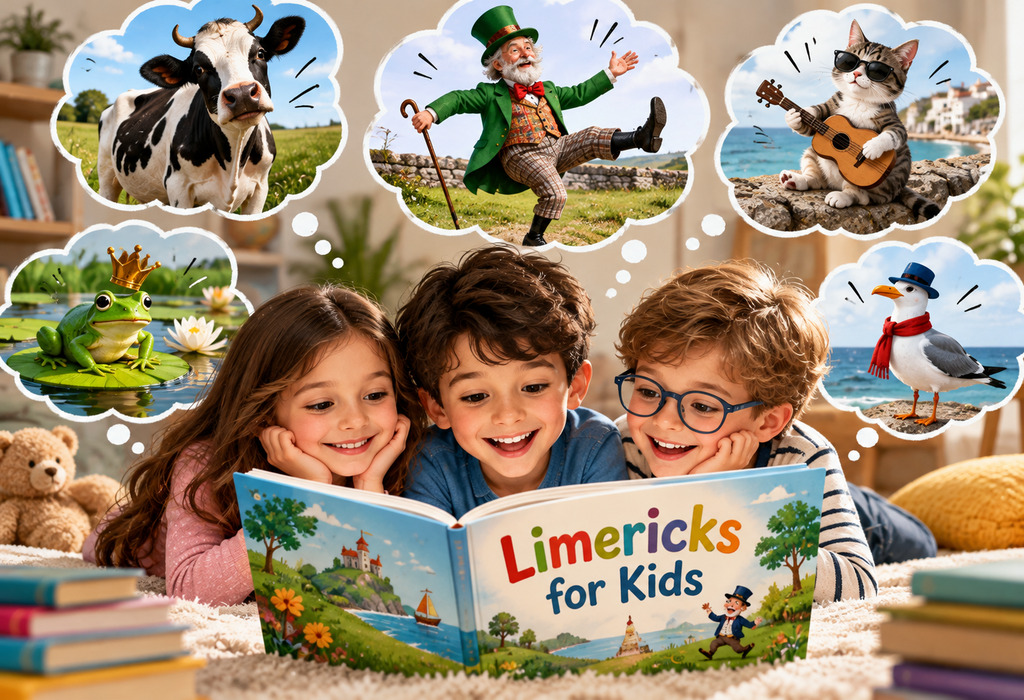
Few things make children giggle faster than a silly rhyme with a surprise at the end. Limericks for kids are short, bouncy poems that pack a whole funny story into just five lines. They are perfect for reading aloud at bedtime, sharing in the classroom, or reciting on a long car ride. In this collection, you will find 20 original limericks about animals, silly people, food, and nature, plus simple tips to help your child write their own.
What Is a Limerick?
A limerick is a humorous poem made up of five lines. It is usually playful, a little bit nonsensical, and built to end with a punchline. Limericks became popular in the nineteenth century, and the poet Edward Lear helped make them famous with his silly rhymes and drawings. Today they remain a favorite way to introduce children to poetry, because they are short, musical, and easy to remember.
How a Limerick Works
Every limerick follows the same simple pattern. Once children spot it, they can read and write limericks with confidence.
1. The rhyme scheme: Lines one, two, and five rhyme with each other. Lines three and four are shorter and rhyme with each other. Poets call this pattern AABBA.
2. The rhythm: The longer lines have about eight or nine beats, while the shorter lines have about five or six. Reading the poem aloud with a bouncy, galloping beat helps children feel the rhythm.
3. The twist: The last line is where the joke lands. It often brings a surprise, a silly action, or a funny conclusion.
Funny Limericks for Kids About Animals
Animals make wonderful characters because they can do all sorts of ridiculous things. These funny limericks for kids are sure to bring a smile to young readers.
1. The Dancing Frog
A frog from a pond near a mill Learned to dance on the top of a hill. He hopped left, then right, Till the moon, full and bright, Said, “Please, Mr. Frog, sit still!”
2. The Singing Goat
There once was a goat in a boat Who wore a bright red woolly coat. He sang to the sea, “Come sail here with me!” And the whales hummed along to each note.
3. The Tall Singer
A giraffe with a neck very long Liked to sing a loud morning song. She stretched to the sky, Tickled clouds passing by, And the birds in her hair sang along.
4. The Hungry Monkey
A monkey named Max loved to munch On bananas all day for his lunch. He ate ten, then ten more, Fell asleep on the floor, And woke up still hungry for brunch.
5. The Wobbly Pig
A pig with a wig, oh so big, Danced a silly and wobbly jig. He spun round and round, Fell down on the ground, And the cows cheered, “Hooray for that pig!”
Limerick Examples for Kids About Silly People
Funny characters are another classic limerick favorite. These limerick examples for kids feature people who find themselves in very silly situations.
6. The Pancake Tower
There once was a girl named Kate Who stacked pancakes high on her plate. The tower grew tall, Then began to fall, And she cheered, “Breakfast is great!”
7. The Boy with the Pot
There once was a boy named Ned Who wore a pot on his head. When asked, “Is it hot?” He said, “Not a lot, But it keeps me from napping in bed!”
8. The Kangaroo Visitor
There once was a teacher named Drew Who brought to class a kangaroo. It hopped on each desk, Made a bit of a mess, And the class said, “We love school, it’s true!”
9. The Giant Pie
A baker named Jack made a pie That was big as a cloud in the sky. It wobbled and swayed, The children all played, And each took a slice, oh my!
10. The Sneezy Boy
There once was a boy who would sneeze Each time he saw bumblebees. “Achoo!” he would say, And they buzzed away, Then he sneezed once more in the breeze.
Limerick Poems for Kids About Nature and Weather
Clouds, snowmen, and sleepy suns can all become funny characters in a limerick. These limerick poems for kids bring the outdoors to life.
11. The Playful Cloud
A cloud in the sky, soft and gray, Wanted badly to go out and play. It rained on a boy, Who jumped up with joy, And they splashed the whole afternoon away.
12. The Sleepy Sun
A sleepy young sun in June Yawned and asked for a nap on the moon. The moon said, “Not me, I’m busy, you see!” So the sun woke up by noon.
13. The Snowman Who Loved Spring
A snowman who dreamed about spring Put on shades and began to sing. But the sun grew bright, He melted from sight, And left just his hat, the poor thing.
14. The Busy Pencil
A pencil who wanted to write Scribbled stories all through the night. It wrote of a bear With purple hair, And the paper said, “Oh, what a sight!”
15. The Library Mouse
A mouse in a library named Lee Read books while she sipped her tea. She turned every page With the grace of a sage, Till she’d read every book, A to Z.
Kid Friendly Limericks with Imagination
Dragons, robots, pirates, and dreams give young readers plenty to imagine. These kid friendly limericks end the collection with a splash of adventure.
16. The Sleepless Robot
A robot named Beep couldn’t sleep, So he counted ten thousand sheep. They bounced on his head, Then jumped on his bed, And he woke up with a very loud beep.
17. The Baking Dragon
A dragon who wanted to bake Accidentally toasted the cake. The knights came to dine On the crispy design, And said, “Please make more, for goodness’ sake!”
18. The Unlucky Pirate
A pirate who sailed to find gold Dug up just a sock, smelly and old. He shouted, “Oh no!” Then gave it a throw, And his parrot said, “That was bold!”
19. The Winning Turtle
A turtle who raced a quick hare Said, “Slow is a fine way to fare.” The hare took a nap On a soft grassy lap, And the turtle won, fair and square.
20. The Sweet Dream
A boy who loved cookies and cream Had a wonderfully sweet kind of dream. He swam in a lake Made of chocolate cake, And woke up with a grin and a beam.
How to Help Kids Write Their Own Limericks
Reading limericks is fun, but writing them is even better. Here is an easy way to get started.
- Pick a character and a place: Start with something like “a cat from Peru” or “a boy named Sam.”
- List rhyming words: Choose three words that rhyme with the place or name, such as Peru, shoe, and blue.
- Write the first two lines: Introduce the character and let the rhymes lead the story.
- Add the short lines: Lines three and four tell what happens next, using a new pair of rhyming words.
- Finish with a twist: The last line should bring back the first rhyme and deliver the funny surprise.
Reading each draft aloud helps children hear if the rhythm bounces the way it should. It is fine if the limerick sounds silly, because silly is exactly the goal.
Fun Ways to Enjoy Limericks Together
1. Clap the beat: Tap or clap along to feel the rhythm of each line.
2. Finish the line: Read four lines and let your child guess the rhyming word that ends the poem.
3. Draw the story: Ask children to illustrate their favorite limerick, just as Edward Lear once did.
4. Hold a limerick contest: Let family members or classmates share their funniest creations.
Limericks are a joyful way to introduce children to rhyme, rhythm, and wordplay. Each poem in this list shows how five short lines can tell a funny story with a surprise at the end. Reading them aloud helps kids build vocabulary, listening skills, and confidence with language. Once they understand the AABBA pattern, they can start writing limericks of their own about anything they imagine. So pick your favorite from this collection, read it with plenty of expression, and enjoy the laughter that follows.