
Table of Contents
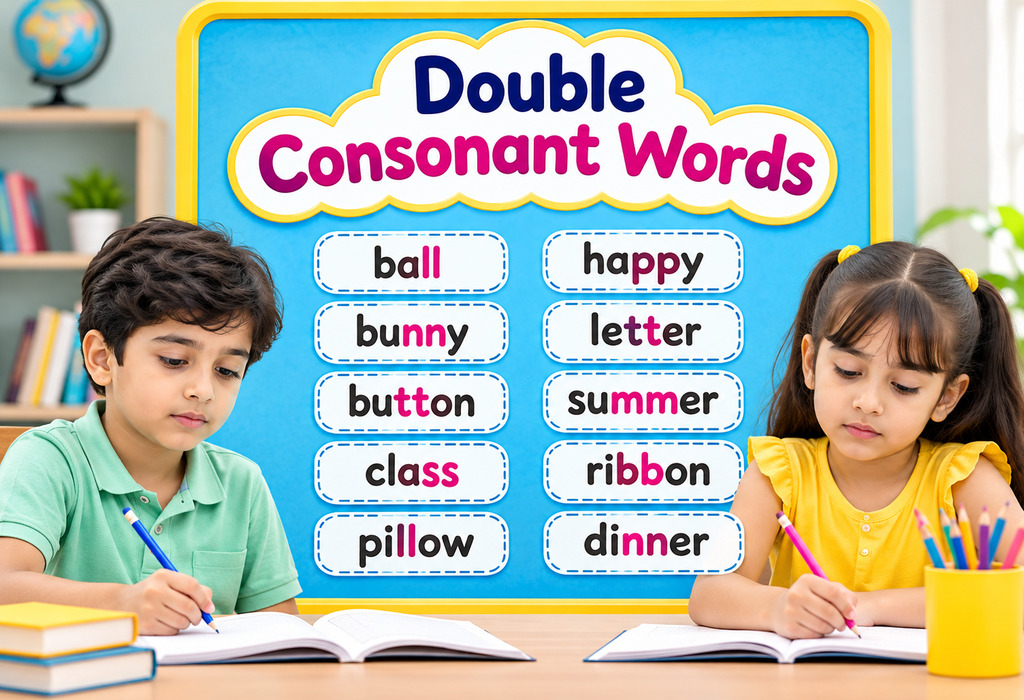
Double consonant words are words where the same consonant letter appears twice in a row, like “puppy,” “bunny,” and “balloon.” Kids meet words that have double consonants in storybooks, songs, and classroom spelling lists, yet the extra letter can feel confusing when they first learn to write. A child might spell “happy” as “hapy” because only one sound is heard. This kid friendly guide explains what double consonants are, shares the main spelling rule, and offers simple word lists that parents and teachers can use for fun, easy practice at home or school.
Double Consonant Meaning
The double consonant meaning is simple for kids to grasp: a double consonant is a pair of identical consonant letters sitting together in one word. Letters like b, d, g, l, m, n, p, r, s, t, and z are often doubled, while doubled vowels, as in “book” or “feet,” are called double vowels. A great double consonant example for children is “puppy,” where two p letters make just one sound. Doubled letters also tell kids that the vowel before them is short, so “hopping” has a short o while “hoping” has a long o. Another double consonant example is “tapping” versus “taping,” where one extra letter changes both the sound and the meaning.
The Consonant Doubling Rule
Kids can use the consonant doubling rule to decide when to double a final letter before a suffix such as “ing,” “ed,” “er,” or “y.” It applies when three conditions are all true:
- The base word has one syllable, or the stress falls on the last syllable.
- The word ends in a single vowel followed by a single consonant.
- The suffix begins with a vowel.
Take the word “run.” It has one syllable and ends in vowel plus consonant. When “ing” is added, the n is doubled and we get “running.” The same logic gives us “stopped,” “bigger,” “sunny,” and “swimming.”
The rule does not apply when a word ends in two consonants or two vowels. That is why “jump” becomes “jumping” and “rain” becomes “raining.” It also does not apply when the suffix begins with a consonant, so “sad” plus “ness” is “sadness,” and the stress rule helps with longer words. We write “beginning” with a double n because the stress falls on the last syllable, but we write “visiting” with one t because the stress falls on the first.
Three extra points are worth remembering. Words ending in w, x, or y are not doubled, so “snow” becomes “snowing” and “fix” becomes “fixing.” Words ending in a silent e drop the e instead of doubling, so “hope” becomes “hoping.” Finally, a few words follow the pattern without a suffix at all, such as “ball,” “bell,” “off,” and “buzz,” where the double letter belongs to the base word.
Double Consonant Word List for Kids
A good double consonant word list groups words by the repeated letter, so kids can see the pattern again and again. Use the lists below for reading practice, spelling tests, or word sorts.
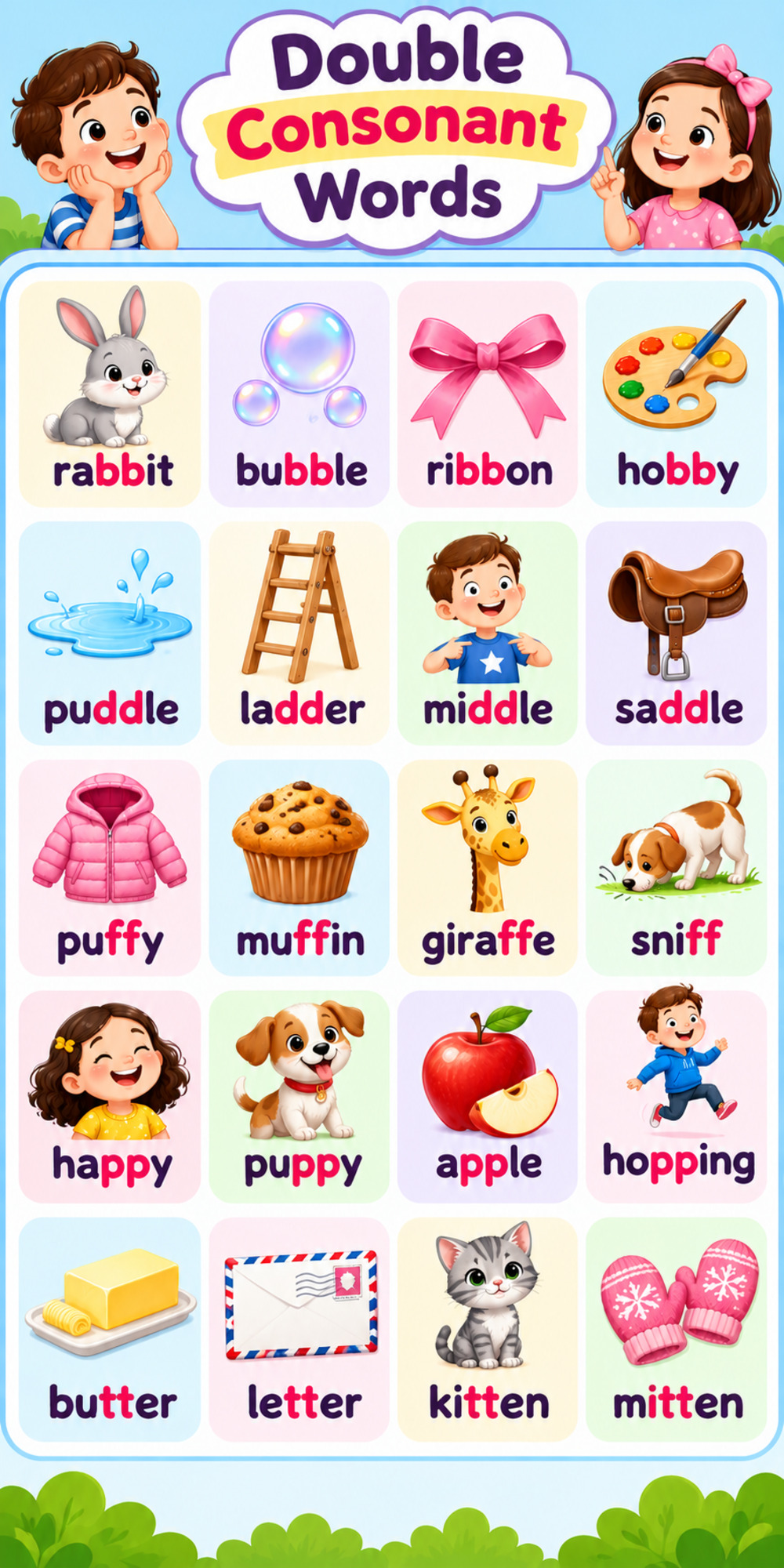
Double B: rabbit, bubble, ribbon, hobby, pebble, rubber, cabbage, crabby
Double D: puddle, ladder, middle, saddle, daddy, riddle, paddle, sudden
Double F: puffy, muffin, giraffe, sniff, cliff, stuff, waffle, office
Double G: bigger, jogging, wiggle, giggle, buggy, soggy, luggage, baggage
Double L: ball, bell, hill, doll, yellow, balloon, pillow, village
Double M: summer, hammer, swimming, dummy, lemming, mammal, grammar, comma
Double N: funny, dinner, running, bunny, tunnel, penny, cannon, sunny
Double P: happy, puppy, apple, hopping, zipper, supper, pepper, slipper
Double R: carrot, mirror, berry, sorry, merry, parrot, hurry, furry
Double S: kiss, glass, lesson, message, grass, dress, blossom, mess
Double T: butter, letter, kitten, button, mitten, bottle, little, rattle
Double Z: buzz, fizz, jazz, puzzle, dizzy, muzzle, fuzzy, pizza
Once learners are comfortable with these, they can try mixed words that contain two different double consonants. Examples include “possession,” “committee,” “address,” “bookkeeper,” and “millennium.” These longer words make a fun challenge for confident spellers and show how common double letters are in everyday English.
Tips for Teaching Kids Double Consonant Words
Spelling rules stick best when children use them in play. These simple activities work well at home and in the classroom:
- Say it, then spell it: Ask the child to say a word slowly, clap the syllables, and then write it. Point out that the double letters make one sound, such as the single z sound in “buzz.”
- Sort the words: Write words on cards and let children sort them into groups by the doubled letter. Add words that look similar but have a single letter, like “hoping” and “hopping,” so the difference is clear.
- Build with suffixes: Start with base words such as “sit,” “hug,” and “swim.” Ask the child to add “ing” and “er” and decide whether the last letter should double.
- Hunt for words: Give a short picture book to the learner and ask them to find every double consonant word on each page. Count them together and add new finds to a personal word list.
- Use rhymes and sentences: Short sentences like “The bunny hid in a hollow log” give learners a natural reason to read and spell the pattern correctly.
- Play word games: Memory matching, bingo, and word searches all turn practice into a game. Keep sessions short, around ten minutes, so the learning stays fun.
It also helps to correct mistakes gently. If a child writes “runing,” show the rule instead of just giving the answer. Ask how many syllables the word has, what kind of vowel it ends with, and whether the suffix starts with a vowel. Over time, children begin to apply the consonant doubling rule on their own, and their spelling confidence grows with every correct word.
Double consonant words are a big part of English, and learning them early makes reading and spelling much easier. The key idea is that a doubled consonant makes one sound and often signals a short vowel before it. The consonant doubling rule helps learners decide when to double a final letter before adding endings like “ing” and “ed.” Regular practice with word lists, sorting games, and short sentences turns the rule into a habit. With patience and a little fun, every child can spell words like “happy,” “running,” and “butter” with confidence.
Infographic – Double Consonant Words
Also Read:
Easy Consonant Words
Essential Spelling Words for 1st Graders
How to Teach Your Child to Spell Words
Educational Cartoons Your Child Should Be Watching