
Table of Contents
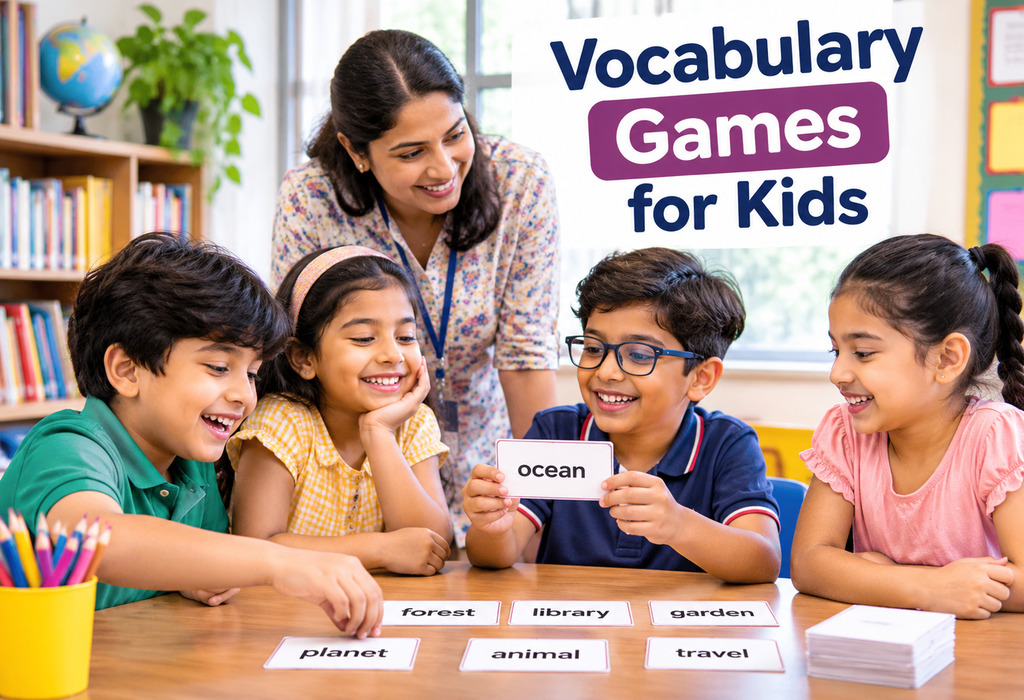
Words are the building blocks of every conversation, story, and lesson. The more words a child knows, the easier it becomes to speak clearly, read with confidence, and share ideas. The good news is that learning new words does not need flashcards or long drills. Vocabulary games for kids turn word learning into play, so children practice without even noticing. This article shares 16 simple games you can play at home or in the classroom with almost no preparation.
Why Vocabulary Games Work
Children remember words best when they see, hear, say, and use them in a meaningful way. Games give them all of these chances in one activity. Here is why they help:
- They repeat new words in a natural, low pressure way.
- They connect words with actions, pictures, and real objects.
- They build listening, speaking, and thinking skills together.
- They keep children motivated because playing feels like a reward.
Fun Vocabulary Games for Kids to Play
Each of the games below can be adjusted for different ages and group sizes. Toddlers and younger children do best with pictures and real objects, while older children enjoy word puzzles and storytelling. Start with two or three games that suit your child, then add more as their confidence grows. Most need only paper, a pen, and a little imagination.
1. Word Bingo
Create bingo cards filled with pictures or simple words. Call out a clue such as “I am yellow and I grow on trees” and let children mark the matching word. The first child to complete a row wins. This game works well for groups and builds listening skills.
2. Vocabulary Charades
Write action words like jump, giggle, or tiptoe on small slips of paper. A child picks a slip and acts out the word without speaking. Others guess the word and use it in a sentence. Moving the body helps children link meaning to the word.
3. Draw and Guess
One child draws a word on paper or a small whiteboard while the others guess. You can use nouns like castle, rocket, or umbrella. After each round, ask the group to describe the picture using new words. This game is great for visual learners.
4. I Spy
Say, “I spy something round and red.” Children look around the room and guess the object. Add describing words such as shiny, fluffy, or tiny to stretch their vocabulary. It is a perfect game for car rides and waiting rooms.
5. Word Scavenger Hunt
Give each child a list of words or clues and let them find matching objects around the house or classroom. For example, “Find something smooth” or “Find something heavy.” Children learn adjectives while moving around and exploring.
6. Memory Match
Make pairs of cards, with one card showing a picture and the other showing the word. Place them face down and let children flip two at a time to find a match. Say each word aloud when it is revealed. These are some of the best vocabulary games for preschoolers because the pictures give strong clues.
7. Rhyme Time
Say a word like cat and ask children to name as many rhyming words as they can, such as hat, bat, and mat. You can turn it into a relay by passing a soft ball to each speaker. Rhyming builds sound awareness and supports early reading.
8. Synonym Swap
Read a simple sentence like “The puppy is big.” Ask children to replace “big” with another word that means the same, such as huge or giant. Keep a chart of new word pairs on the wall. Children enjoy seeing their list grow over time.
9. Opposite Showdown
Call out a word and have children shout its opposite. Hot and cold, up and down, and happy and sad are good starters. For a challenge, move to words like ancient and modern. Pairing words helps children remember both of them.
10. Category Challenge
Pick a category such as animals, fruits, or things in the kitchen. Children take turns naming one item each until someone runs out of ideas. Older kids can try harder categories like weather words or words that describe feelings. This game sorts new vocabulary into groups, which makes it easier to recall.
11. Word Chain
Start with a word like sun. The next player must say a word that begins with the last letter, such as nest. Continue around the circle and see how long the chain can grow. It is a quick game that needs no materials.
12. Story Dice
Draw a picture or word on each side of a large cardboard cube. Children roll the dice and add a sentence to a group story using the word they land on. The silly stories that come out make this a favorite. It also teaches children to use new words in context.
13. Mystery Bag
Place small objects like a spoon, a button, or a seashell in a cloth bag. A child reaches in without looking and describes what the object feels like. The others guess what it is. This game boosts descriptive language and touch awareness.
14. Simon Says Vocabulary Edition
Play the classic game with richer action words. Try commands such as “Simon says stretch,” “Simon says wobble,” or “Simon says whisper.” Children must understand each word to follow along. It keeps energy high while building listening skills.
15. Word Detective
Read a short sentence with a tricky word, like “The enormous elephant stomped through the jungle.” Ask children to guess what enormous means using clues from the sentence. Celebrate every thoughtful guess. This game teaches context clues, an important reading skill.
16. Word of the Day Challenge
Pick one new word each morning and display it on a card. Challenge children to use it in conversation at least three times during the day. At bedtime, ask who found the funniest way to use it. Short daily practice adds up to a big vocabulary over a year.
Tips to Get the Most Out of Vocabulary Games
- Keep sessions short, about 10 to 15 minutes, so children stay interested.
- Use words from books, school lessons, and daily routines.
- Praise effort and curiosity, not just correct answers.
- Repeat favorite games often, since repetition helps words stick.
- Match the game to the child’s age and level, and add challenge slowly.
You can also keep a small word notebook where children draw or write the new words they learn after each game. Reviewing the notebook once a week reminds them of past words and shows how much progress they have made. Sharing new words with family members at dinner is another easy way to keep the learning going.
FAQs
1. What age can kids start playing vocabulary games?
Children can begin as toddlers with simple picture based games and naming activities. By ages 4 to 5, they can enjoy matching, rhyming, and guessing games. Older children can handle word chains, synonyms, and context clue games.
2. How often should children play vocabulary games?
A few short sessions each week is plenty. Daily practice of 10 minutes is even better. Regular play matters more than long sessions.
3. Do vocabulary games help with reading?
Yes, they do. Children who know more words understand stories more easily and decode new words faster. Games that include rhymes and context clues support reading directly.
Vocabulary games for kids make word learning joyful, active, and memorable. Whether you try a quick round of I Spy or a full story with dice, every game gives children a chance to hear, say, and use new words. The best results come from playing often, keeping the mood light, and celebrating each new word a child learns. Choose a few games from this list and rotate them through the week to keep things fresh. With a little play each day, your child will build the language skills they need for school and beyond.