
Table of Contents
Picture a classroom where the lesson opens with a puzzle instead of a lecture: why do some neighborhoods flood after heavy rain while others stay dry? Students start guessing, questioning, and hunting for evidence. This is question based learning, an approach that puts curiosity ahead of memorization. Inquiry based learning examples are easy to spot once you know what to look for, from a science class testing how fast an ice cube melts to a history group comparing two pandemics. This guide explains what the method is, how it works stage by stage, and how teachers and parents can bring it to life.
What Is Inquiry Based Learning?
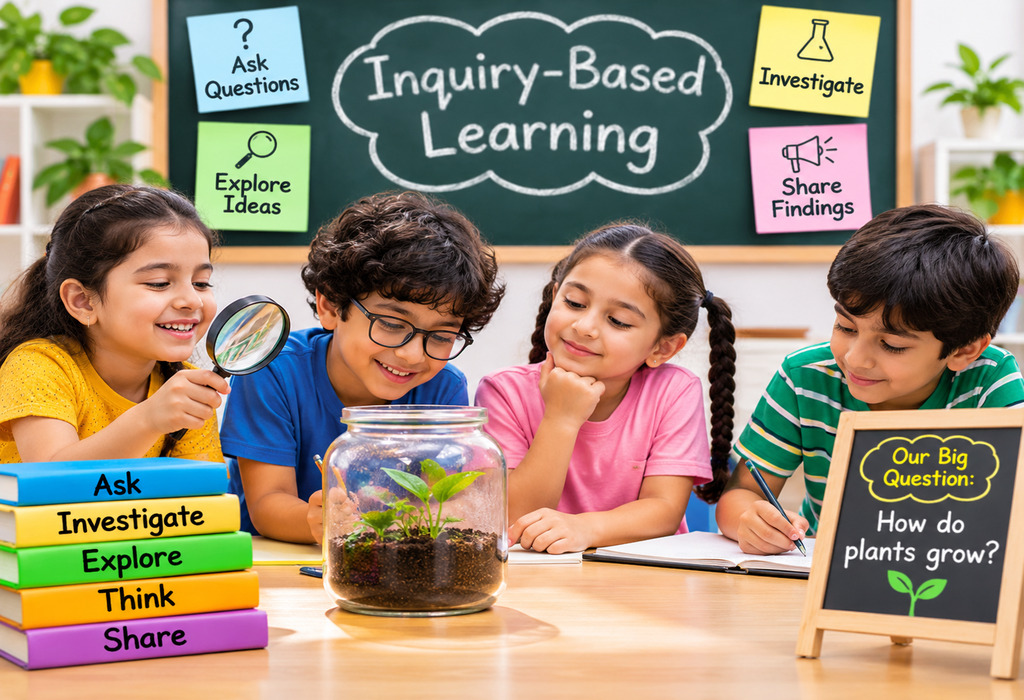
The inquiry based learning definition is a student centered way of teaching in which learners begin with a question, a problem, or a puzzling real world situation and investigate it themselves instead of being handed finished answers. The idea traces back to John Dewey, who argued that education begins with the curiosity of the learner. Students take on the role of researchers who ask good questions, find resources, and share what they discover, while the teacher acts as a guide who designs and supports the experience. Unlike project based learning, which centers on creating a finished product, inquiry always grows out of the learner’s own questions.
How Does Inquiry Based Learning Work?
Different frameworks use different labels, but most describe a similar cycle of five stages.
- Orientation: The teacher sparks interest with a short video, an unusual object, a story, or a hands on demonstration. The goal is to give students something to wonder about.
- Questioning: Students generate their own questions, make predictions, and form early guesses about what might be true. Teachers often record these questions on a chart so the class can return to them.
- Investigation: This is usually the longest stage. Students gather information, run experiments, read sources, interview people, or collect data to test their ideas.
- Conclusion: Learners study the evidence, decide whether their guesses held up, and explain what they found. Very often the answers raise fresh questions.
- Discussion and reflection: Students present findings, hear other viewpoints, and think about how they reached their conclusions and what they would do differently next time.
Notice that the cycle does not really end. A good inquiry leads to the next one, which is why teachers describe it as an ongoing habit of mind rather than a single lesson format.
The teacher’s work happens mostly before and during the cycle. Strong inquiry lessons are carefully planned: the teacher chooses a worthwhile question, gathers varied resources, and decides how much support students need. Then, during the lesson, the teacher steps back, asks probing questions, and steps in only when students are truly stuck.
The Four Types of Inquiry
Inquiry exists on a spectrum, from tightly guided to fully student driven. Knowing where a lesson sits helps teachers choose the right level of support.
- Confirmation inquiry: Students receive the question, the method, and the expected outcome. They simply confirm a concept they have already learned. It is a gentle starting point for beginners, such as growing two bean plants, one in sunlight and one in a dark closet.
- Structured inquiry: The teacher provides the question and the method, but students do not know the answer in advance. They follow the procedure and draw their own conclusions from the data, for example testing which soil type holds the most water.
- Guided inquiry: The teacher supplies the question, and students design their own way of investigating it. Asking “What affects how fast an ice cube melts?” lets groups choose which variables to test.
- Open inquiry: Students pose their own questions, plan their own investigations, and decide when they have found a good answer. This demands the most independence, so it works best after students have practiced the earlier types.
Research suggests that beginners usually do best with more guidance, and that independence should grow gradually as skills and confidence build.
Benefits of Inquiry Based Learning
When students lead the investigation, the payoff reaches well beyond a single lesson. Teachers and researchers point to the following benefits, which show up in how children think, work with others, and feel about learning.
- Stronger thinking skills: Students practice questioning, weighing evidence, and building arguments instead of simply recalling facts.
- Higher engagement: Learners care more about answers to questions they helped create.
- Deeper understanding: Students see why a rule or formula works and when to apply it, rather than just following steps.
- Better communication and teamwork: Explaining ideas, debating, and sharing findings are built into the process.
- Self direction: Students practice setting goals, managing time, and reflecting on their own progress, which are skills that matter long after school.
- Flexibility for all learners: Because every student has questions, inquiry is easy to adapt for different levels, paces, and interests.
- Insight for teachers: Watching students investigate shows how each child thinks and where they get stuck.
Inquiry Based Learning Strategies
Good inquiry rarely happens by accident. These inquiry based learning strategies help lessons run smoothly.
- Start with a strong question: It should be open enough to allow real investigation but focused enough that students know where to begin. Avoid questions with a single obvious answer.
- Match the structure to experience: If students are new to inquiry, begin with confirmation or structured tasks and release control gradually.
- Model the process: Think aloud as you wonder, question, and test ideas so students see what inquiry looks like.
- Teach key vocabulary and skills first: Students cannot investigate well if they lack the language or background knowledge for the topic.
- Offer varied resources: Provide books, data sets, videos, interviews, and hands on materials, not just a single textbook.
- Use group routines: Simple protocols such as Think Pair Share or Jigsaw give discussion a clear shape without taking ownership away from students.
- Allow productive struggle: Resist the urge to rescue students the moment they hit a wall, but step in with a short explanation when confusion is not helping.
- Build in reflection: Journals, class discussions, or short debriefs help students name what they learned and how they learned it.
- Assess the process: Look at the quality of questions, reasoning, and willingness to revise ideas, not only the final answer.
Inquiry Based Learning Activities
Here are inquiry based learning activities that work across subjects and age groups.
- Science experiments: Ask students to predict and test what happens to plant growth, melting rates, or evaporation when one factor changes.
- Math puzzles: Pose a real question, such as how much candy a class needs for a Halloween party, and let students decide what to calculate.
- History investigations: Students compare the 1918 flu with a modern pandemic using reliable sources and then present their findings.
- Wonder Walls: Create a space where students post questions as they arise, then pick some to investigate.
- Mystery boxes: Show an unusual object or phenomenon and invite questions before giving any explanation.
- KWL charts: Students record what they know, what they want to know, and later what they learned.
- Field trips and interviews: Visits and conversations with local experts let learners see real problems up close.
- Debates and Socratic seminars: Students defend positions using evidence and respond to different viewpoints.
- Gallery walks: Groups display their findings while classmates circulate and leave thoughtful feedback.
Challenges to Keep in Mind
Inquiry based learning is powerful, but it is not effortless, and it helps to know the hurdles before you begin. Planning for these challenges early makes the approach far easier to run well.
- More planning: Inquiry takes more preparation and flexibility than a scripted lesson, since teachers must design strong questions and gather varied resources.
- Classroom management: Keeping the room focused can feel harder when students work with more independence.
- Assessment: Traditional tests rarely capture the quality of a student’s questioning and reasoning, so teachers need tools such as observations, journals, and portfolios.
- Risk of overload for beginners: Completely unguided discovery can overwhelm students who lack background knowledge, so the best results come from guided inquiry with clear explanations when needed.
- Not right for every lesson: Sometimes a short direct explanation works better, so inquiry should complement other teaching methods rather than replace them.
Inquiry based learning turns students from passive listeners into active investigators who ask questions, gather evidence, and explain their thinking. It works through a repeating cycle of orientation, questioning, investigation, conclusion, and reflection, with the teacher acting as a thoughtful guide. The four types give educators a range of options, from highly structured tasks for beginners to open projects for confident learners. When paired with strong questions, varied resources, and the right amount of support, it builds engagement, critical thinking, and independence. Start small with one good question, and you may find that your learners keep asking more.