
Table of Contents
Words become much easier to remember when children learn them in pairs. Opposite words for kids are a simple and playful way to build vocabulary, because every new word arrives with a partner that has the opposite meaning. When a child knows that “hot” is the opposite of “cold,” both words stay in the mind for a long time. This guide has 100 pairs, grouped from easy to more advanced, so that parents and teachers can pick the right set for their child. You can read the pairs aloud, turn them into games, or use them as a quick revision list before a class test.
What Are Opposite Words?
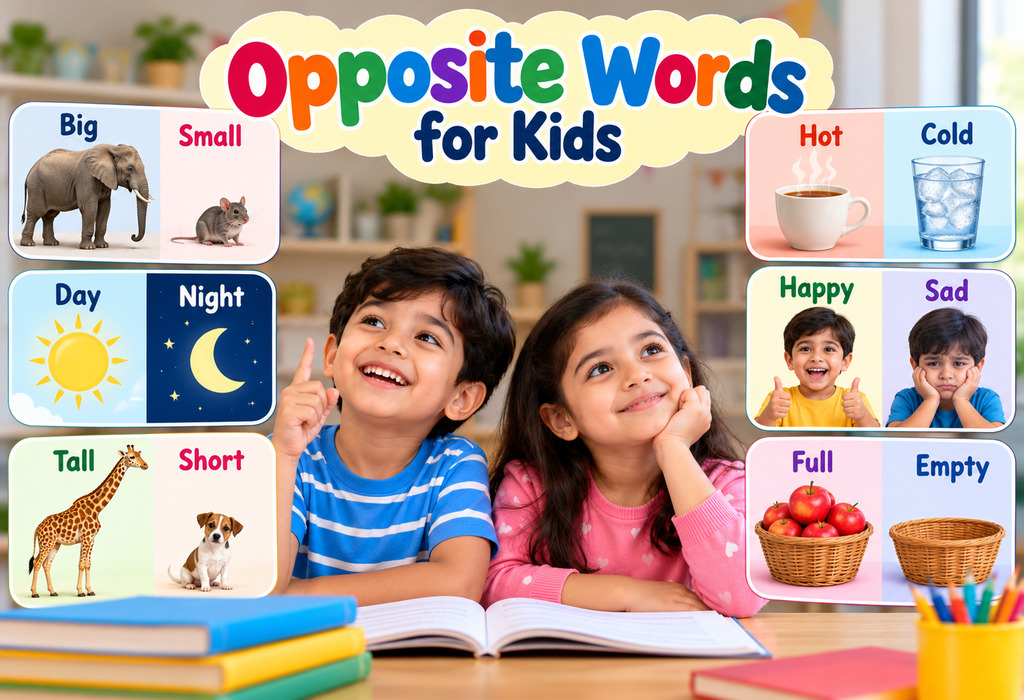
Opposite words, also called antonyms for kids, are words that have completely different meanings. “Day” and “night” are a good example, and so are “up” and “down.” Each pair shows a clear contrast, so children can understand a new word by comparing it with its partner. Because the idea is so simple, even very young learners enjoy finding opposites around them at home, in the park and at school.
Why Should Kids Learn Opposite Words?
- Learning opposites has many benefits for young learners:
- It builds a stronger vocabulary in a short time.
- It helps children describe people, places and things more clearly while speaking and writing.
- It improves understanding of stories and textbook lessons.
- It makes reading comprehension and grammar exercises easier.
- It gives children confidence, because the pairs are short, simple and fun to learn.
Types of Opposite Words
Not all opposites work in the same way, and a quick look at the main types helps children use them correctly. Some pairs show two extremes, like “hot” and “cold,” where many things can sit in the middle, such as “warm” or “cool.” Other pairs are either or choices, like “on” and “off,” where there is nothing in between. A third group shows opposite actions, like “buy” and “sell” or “push” and “pull.” You do not need to teach these names to young children. Just point out the difference with real examples, and they will understand it naturally.
Basic Opposite Words in English for Beginners
These are the basic opposite word in English pairs that children meet first. They suit little learners and work well as opposite words for class 1. Most of them describe things children see, touch and feel every day.
| Word | Opposite Word |
|---|---|
| Big | Small |
| Hot | Cold |
| Up | Down |
| In | Out |
| Day | Night |
| Happy | Sad |
| Fast | Slow |
| Tall | Short |
| Open | Close |
| Hard | Soft |
| Good | Bad |
| Old | New |
| Yes | No |
| On | Off |
| Full | Empty |
| Clean | Dirty |
| Come | Go |
| Sit | Stand |
| Wet | Dry |
| Black | White |
| Heavy | Light |
| Boy | Girl |
| Left | Right |
| Front | Back |
| Near | Far |
| Fat | Slim |
| Sweet | Sour |
| Early | Late |
| Laugh | Cry |
| Push | Pull |
Example sentences
- The elephant is big, but the ant is small.
- The tea is hot, but the ice cream is cold.
- Please open the door and close the window.
- The day is bright, but the night is dark.
Opposite Words for Class 2
Children in Class 2 are ready for pairs that describe actions, feelings and qualities. These opposite words for class 2 help them talk about their day, their friends and their surroundings in more detail. Encourage your child to say each pair aloud and then use one word in a sentence of their own.
| Word | Opposite Word |
|---|---|
| Buy | Sell |
| Give | Take |
| Start | Finish |
| Easy | Difficult |
| Strong | Weak |
| Brave | Scared |
| Inside | Outside |
| Always | Never |
| Wake | Sleep |
| Top | Bottom |
| Rich | Poor |
| Love | Hate |
| Friend | Enemy |
| Win | Lose |
| Above | Below |
| Smooth | Rough |
| Loud | Quiet |
| Thick | Thin |
| Sunny | Cloudy |
| Deep | Shallow |
| Wide | Narrow |
| Bright | Dull |
| Straight | Curved |
| Remember | Forget |
| Ask | Answer |
| Lend | Borrow |
| Arrive | Depart |
| Increase | Decrease |
| Float | Sink |
| Create | Destroy |
| Accept | Refuse |
| Cheap | Expensive |
| Safe | Dangerous |
| Fresh | Stale |
| Polite | Rude |
Example sentences
- Riya was brave, but her little brother was scared of the dark.
- The sums were easy, but the last question was difficult.
- My mother will buy fruits, and the shopkeeper will sell them.
- The music was loud in the hall, but the library was quiet.
Opposite Words for Class 3
By Class 3, children can handle longer words and bigger ideas. These opposite words for class 3 prepare them for reading comprehension, grammar exercises and school tests. They also help children write better sentences and short paragraphs.
| Word | Opposite Word |
|---|---|
| Victory | Defeat |
| Truth | Lie |
| Ancient | Modern |
| Generous | Selfish |
| Honest | Dishonest |
| Visible | Invisible |
| Possible | Impossible |
| Careful | Careless |
| Lazy | Active |
| Public | Private |
| Natural | Artificial |
| Expand | Shrink |
| Include | Exclude |
| Whole | Part |
| Native | Foreign |
| Optimist | Pessimist |
| Majority | Minority |
| Success | Failure |
| Joy | Sorrow |
| Hope | Despair |
| Wisdom | Foolishness |
| Pride | Shame |
| Peace | War |
| Guilty | Innocent |
| Real | Fake |
| Maximum | Minimum |
| Forward | Backward |
| Temporary | Permanent |
| Attract | Repel |
| Ascend | Descend |
| Beautiful | Ugly |
| Kind | Cruel |
| Calm | Angry |
| Few | Many |
| Healthy | Sick |
Example sentences
- A kind person helps others, but a cruel person hurts them.
- Honest children tell the truth and never tell a lie.
- The team celebrated its victory, while the other team felt sad about the defeat.
- Exercise keeps the body healthy, but too much junk food can make us sick.
Fun Ways to Teach Antonyms for Kids
Learning does not have to feel like homework. Here are some easy ideas to try at home or in class:
- Opposite action game: Say a word like “stand” and ask the child to do the opposite action by sitting down.
- Flashcards: Write one word on each card and ask the child to find the matching opposite.
- Picture matching: Draw or paste pictures of a tall tree and a short plant, then label them together.
- Daily use: Point out opposites during routine moments, such as “the bag is heavy and the pencil is light.”
- Story time: Read a short story and ask your child to find opposite words in it.
- Quick quiz: Say a word and let the child answer with its opposite as fast as possible.
Practice Time: Fill in the Blanks
Try these quick questions with your child and check the answers together.
- The sun is hot, but the ice is ______.
- The box is empty, but the basket is ______.
- I wake up in the morning and ______ at night.
- A feather is light, but a rock is ______.
- The road to school is near, but the market is ______.
Answers: 1. cold, 2. full, 3. sleep, 4. heavy, 5. far.
Opposite words give children a quick and enjoyable way to grow their English vocabulary. The pairs in this list move from easy words for beginners to richer words for older learners. With regular practice, games and daily conversation, children will remember these words without any pressure. Parents and teachers can use the lists as a ready guide for each class level. Keep learning playful, and your child will soon use opposite words with confidence.