
Table of Contents
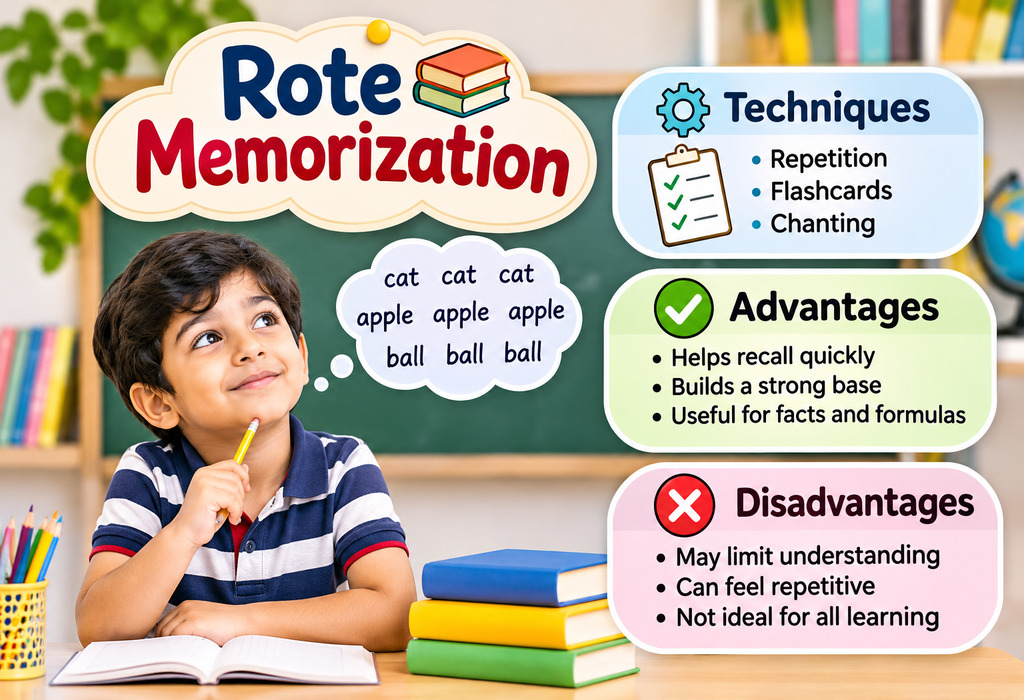
Rote memorization is a learning technique in which information is committed to memory through repetition, without necessarily focusing on deeper understanding. The learner repeats a fact, word, or sequence until it can be recalled quickly and accurately. Some common examples include number facts, spelling lists, vocabulary, and historical dates. There are several rote memorization techniques that make this process easier and more enjoyable for children. In this article, we explore how rote learning works, the best techniques to use, its strengths and limits, and how to balance it with deeper learning.
What Is Rote Memorization?
Rote memorization means learning something by heart through repeated practice. A child who recites the days of the week until they can say them without thinking is using this method. Each repetition strengthens the link to that information in the brain, so the fact moves from conscious effort to automatic recall over time. It is different from meaningful learning, where a child connects new ideas to what they already know and understands why something is true. For example, a child may remember that 7 times 8 is 56 without knowing how multiplication works. Both approaches have a role in education, and the most effective learners tend to use both.
Where Is Rote Memorization Used?
Rote learning appears in many parts of everyday school life. Some of the most familiar uses include:
- Learning the alphabet and the sounds of letters
- Counting numbers in order
- Memorizing multiplication tables and basic addition and subtraction facts
- Remembering spelling words and sight words
- Reciting poems, prayers, songs, and national anthems
- Learning the months of the year, days of the week, and the planets in order
- Recalling scientific symbols, formulas, and vocabulary in a new language
- Memorizing important dates in history
Adults rely on it too. Phone numbers, passwords, safety procedures, and the rules of the road are all things many people remember through plain repetition.
Rote Memorization Techniques
There is more than one way to practice memorization. The best rote memorization techniques make repetition active and engaging, so children stay interested instead of feeling bored. Here are some of the most useful ones.
1. Repetition and Recitation
This is the most basic technique. The child reads, hears, or says the information aloud several times. Reciting out loud works well because it uses both hearing and speaking, which gives the memory two paths to follow. Short sessions repeated through the day work better than one long session.
2. Flashcards
Flashcards are one of the most popular tools for rote learning. One side shows a question, such as a word or a math problem, and the other side shows the answer. The child looks at the question, tries to recall the answer, and then flips the card to check. This builds active recall, which is the habit of pulling information out of memory instead of simply looking at it again.
3. Spaced Repetition
Instead of practicing the same facts again and again in one sitting, spaced repetition spreads practice over time. A child might review a list on day one, again on day two, then after four days, and then after a week. Gaps between reviews help the brain hold on to information for longer. Many learning apps and flashcard systems are built on this idea.
4. Chunking
Long strings of information are hard to remember all at once. Chunking breaks them into smaller groups. A phone number is a good example, since it is easier to remember in small groups of digits than as one long line. Children can chunk a long spelling list into groups of five words and learn each group separately.
5. Songs, Rhymes, and Rhythm
Music helps memory in a powerful way. That is why so many children learn the alphabet through a song. Putting facts into a tune, a chant, or a rhyme gives them a pattern that is easy to recall. Teachers often use this for number facts, months of the year, and parts of speech.
6. Mnemonics
Mnemonics are memory aids that turn information into a phrase, a word, or an image. For example, the sentence “My Very Easy Method Just Speeds Up Naming planets” helps many learners remember the order of the planets. Acronyms and silly sentences make facts stick because they are fun and unusual.
7. Writing It Out
Writing information by hand several times helps many children remember it. Copying spelling words, writing out a poem, or filling in a multiplication grid gives the brain a physical action to attach to the fact. Handwriting slows the learner down just enough to notice details.
8. Games and Quizzes
Games turn repetition into play. Memory matching games, quick quizzes, and math races give children a reason to practice again and again without feeling it is a chore. Friendly competition and small rewards can keep motivation high.
Benefits of Rote Memorization
Despite its reputation, rote learning offers real advantages when used well. Here are the main benefits of rote memorization.
1. Builds a Strong Foundation
Many subjects rest on basic facts that must be known quickly. A child who knows number facts and letter sounds by heart can move on to harder tasks like solving word problems and reading full sentences. Without that base, every new lesson feels slower and harder.
2. Improves Speed and Fluency
When facts are stored in memory, they can be recalled in seconds. A student who instantly knows that 6 times 7 is 42 can focus on the bigger problem in front of them instead of working out each small step. This fluency saves time in homework and exams.
3. Frees Up Working Memory
The brain can only hold a limited amount of information at one time. When basic facts are automatic, the brain has more space left for reasoning, planning, and problem solving. This is one reason why memorized knowledge supports higher thinking instead of replacing it.
4. Simple and Easy to Practice
Rote learning needs no special tools. A child can practice in the car, at the dinner table, or before bed. It is also easy for parents to support, since they only need to ask questions, listen, and encourage.
5. Builds Discipline and Confidence
Memorizing something and then recalling it correctly gives children a quick sense of success. Regular practice also builds habits like focus, patience, and persistence. A child who can recite a long poem in front of the class often feels proud and more confident.
6. Useful for Exams and Language Learning
Some information simply has to be memorized, such as vocabulary in a new language, scientific terms, formulas, and key dates. In these cases, repetition is often the most direct and effective way to learn.
Disadvantages of Rote Memorization
Rote learning also has limits. Knowing the disadvantages of rote memorization helps parents and teachers use it wisely.
1. Limited Understanding
The biggest concern is that children may remember facts without understanding them. A child may recite a rule but be unable to explain it or use it in a new situation. Real learning happens when a child can explain why something works.
2. Weak Critical Thinking
Because rote learning focuses on recall, it does little to build analysis, creativity, or problem solving. Children who only memorize may struggle when a question is asked in an unfamiliar way.
3. Short Term Memory
Information learned through repetition alone can fade quickly, especially when it is crammed right before a test. Without meaning or later review, much of it may be forgotten within days or weeks.
4. Can Be Boring
Repeating the same thing over and over can feel dull. Children may lose interest, which lowers motivation and makes learning feel like a chore. When practice is not made engaging, it can create a dislike for school.
5. Pressure and Stress
When success depends mainly on remembering large amounts of material, children may feel anxious about forgetting. Fear of making mistakes can discourage them from asking questions or trying new ideas.
6. Difficulty Applying Knowledge
Memorized facts are most useful when a child can apply them. A student who has memorized formulas but never practiced using them may freeze when a real problem appears.
Rote Learning vs Meaningful Learning
| Aspect | Rote Learning | Meaningful Learning |
|---|---|---|
| Main focus | Remembering facts through repetition | Understanding ideas and connections |
| Speed | Quick for simple facts | Slower but deeper |
| Retention | Can fade without review | Usually lasts longer |
| Skills built | Recall, speed, discipline | Reasoning, creativity, problem solving |
| Best used for | Letters, numbers, tables, vocabulary | Concepts, explanations, projects |
Neither approach is better in every situation. The strongest learning combines both. A child may first memorize the multiplication tables and then use them to solve real problems, see patterns, and understand how numbers relate to one another.
How to Use Rote Memorization the Right Way
Here are some simple tips to get the best results from this method:
- Start with understanding when possible: Briefly explain what a fact means before asking a child to memorize it.
- Keep sessions short: Ten to fifteen minutes of focused practice works better than an hour of tired repetition.
- Mix up the methods: Combine songs, flashcards, writing, and games to keep things fresh.
- Review over time: Revisit older material every few days so it moves into long term memory.
- Connect facts to real life: Ask children to use what they memorized, such as using number facts while shopping or spelling words in a short story.
- Praise effort: Celebrate progress and persistence, not just perfect recall.
- Support sleep and rest: The brain strengthens memories during sleep, so a good night of rest helps learning stick.
Frequently Asked Questions
1. Is rote memorization bad for children?
No, it is not bad when used in the right amount. It works well for basic facts, but it should be combined with activities that build understanding and thinking skills.
2. At what age can children start rote learning?
Young children begin naturally with songs, rhymes, and counting. These early activities are a gentle form of rote learning.
3. Does rote memorization help with exams?
It can help with recalling facts, formulas, and definitions. However, exams that test application and reasoning also need a clear understanding of concepts.
4. How can I make memorization less boring?
Use music, movement, games, and colorful flashcards. Short sessions and small rewards also help keep children interested.
Rote memorization is a simple and time tested way to learn basic facts through repetition. It builds speed, confidence, and a strong foundation for subjects like math, reading, and languages. At the same time, it has clear limits, because remembering a fact is not the same as understanding it. Parents and teachers can get the best of both worlds by pairing repetition with explanation, play, and real life examples. When used with care, rote learning becomes a helpful tool that supports deeper thinking instead of standing in its place. With the right balance, children can remember what matters and also know how to use it.