
Table of Contents
Learning to read starts small, and 1 syllable words are the perfect place to begin. These short, single-beat words such as cat, sun and book are usually the very first ones a child learns to sound out, spell and recognise on sight. Because they contain just one vowel sound, they are easy to blend and easy to remember, which makes them ideal building blocks for early phonics practice. In this guide, we have put together word lists, themed tables, picture words and simple activities that parents and teachers can use to help children grow more confident readers, one short word at a time. Whether your child is just starting to sound out letters or is already stringing short sentences together, these lists offer a gentle, structured way to practise, and you will find plenty of ideas below for turning a simple word list into a proper daily reading habit.
What are 1 Syllable Words?
A syllable is a single, unbroken sound made when we say a word aloud. One syllable words contain only one vowel sound, so they are spoken in a single beat, with no pause or break in the middle. Words like dog, sun and hat are said in one quick sound, unlike longer words such as rabbit or elephant, which need two or more beats to say. Because they are short and simple, these words are usually the first ones children meet when they start learning to read, since there is only one sound to blend rather than several.
You can check whether a word has just one syllable by clapping it out or placing a hand under your chin as you say it. If your chin only drops once, the word has a single beat. Try it with cat, then with rabbit: the difference becomes obvious straight away, and it is a quick trick children can use themselves once they get the hang of it.
1 Syllable Word List
Here is a list of words that have 1 syllables, covering everyday objects, animals and actions that young children will already recognise from daily life.
| cat | dog | sun | moon | star |
| tree | book | fish | bird | frog |
| duck | cow | pig | hen | ball |
| cup | hat | sock | shoe | coat |
| milk | bread | cake | egg | rice |
| rain | snow | wind | cloud | leaf |
| root | seed | grass | sand | rock |
| stone | gold | gate | door | wall |
| roof | bed | chair | desk | lamp |
| clock | phone | glass | spoon | fork |
Most of these are nouns, but it is worth pointing out to children that plenty of describing words are short too. An adjective with one syllable, such as big, small, fast or bright, works in exactly the same way: one vowel sound, one beat, and easy to slot into a simple sentence like “the big dog” or “the fast car.” Mixing a few of these describing words into the list above gives children an easy way to start forming their own short phrases, well before they are ready for longer, more complicated sentences.
Alphabetical One Syllable Words List (A–Z)
Going through the alphabet is a handy way to build vocabulary, so here is an example of 1 syllable words for every letter. A few letters, such as Q, V, X, Y and Z, simply do not have many short options in English, so those rows are lighter than the rest.
| Letter | Words |
|---|---|
| A | ant, ask |
| B | bat, big |
| C | cat, cup |
| D | dog, day |
| E | egg, eat |
| F | fox, fish |
| G | go, girl |
| H | hat, hot |
| I | ice, ink |
| J | jam, jump |
| K | key, kite |
| L | leg, log |
| M | map, milk |
| N | net, nose |
| O | owl, oil |
| P | pig, pen |
| Q | quiz |
| R | rat, red |
| S | sun, sit |
| T | top, tree |
| U | up, use |
| V | van |
| W | web, wall |
| X | box |
| Y | yes |
| Z | zip |
Theme Based 1 Syllable Words List
Grouping words by theme helps children see how short words show up across everyday topics, whether it is describing a job, naming a feeling, or talking about the world outside. This also gives plenty of practice with 1 syllable verbs and other word types, so children get used to seeing 1 syllable words in english used in different ways rather than just as a single list to memorise. Working through a theme at a time, rather than a random jumble of words, also makes it easier to build simple sentences afterwards, since the child already has a small cluster of related words to draw on.
Profession
| cook | nurse |
| coach | chef |
| clerk | guard |
| judge | monk |
| maid | scout |
Emotions & Feelings
| sad | glad |
| mad | calm |
| shy | proud |
| brave | scared |
| cross | blue |
Environment
| earth | air |
| sea | sun |
| wind | rain |
| tree | rock |
| sand | cloud |
Nature
| leaf | root |
| branch | seed |
| bloom | grass |
| stone | pond |
| hill | cave |
Food
| bread | cheese |
| milk | meat |
| rice | soup |
| cake | egg |
| fish | salt |
1 Syllable Picture Words
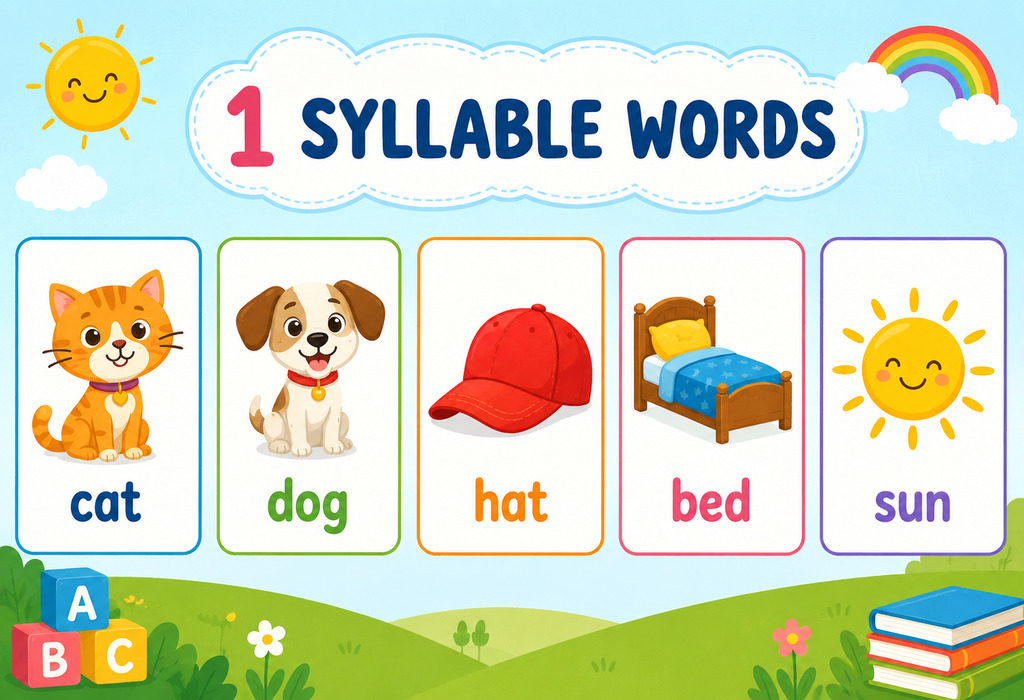
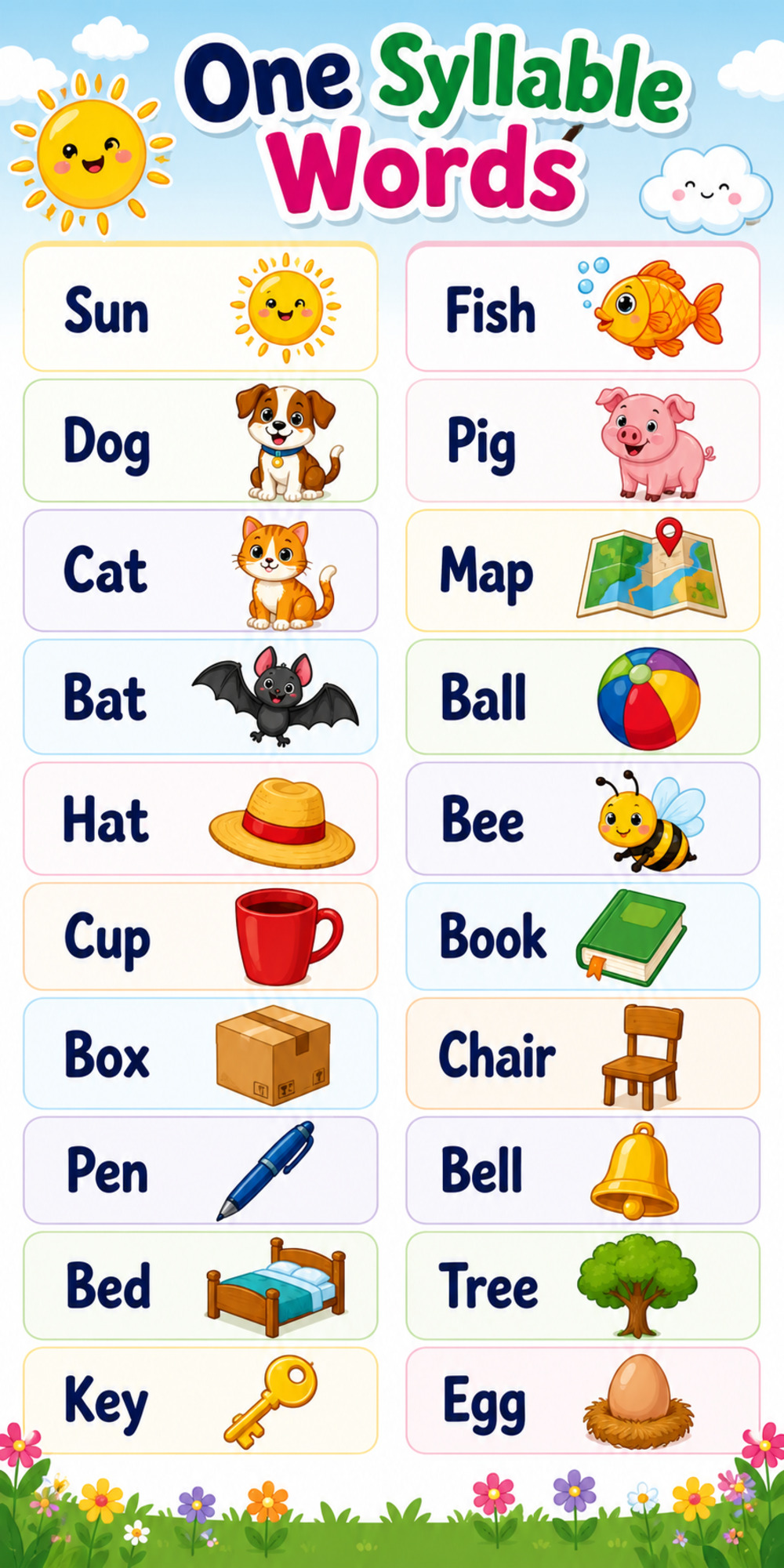
Picture association is one of the fastest ways for young children to connect a word with its meaning. Here are five simple words that work well alongside pictures on a flashcard or poster.
Benefits of Learning 1 Syllable Words for Kids
Short words give children an early win, since there is only one sound to blend before the whole word can be read aloud. That quick success builds confidence and lays a solid foundation for the trickier, multi-syllable vocabulary that comes later.
- Faster to sound out and read, since there is only one vowel sound to blend.
- Among the most common words in spoken English, so mastering them boosts everyday reading and conversation straight away.
- Easier to spell correctly, which supports early writing.
- Useful building blocks for later lessons on prefixes, suffixes and compound words.
- Quick wins keep children motivated, and a child who feels capable is far more likely to keep practising.
- Easier for parents to spot gaps early, since it is quick to notice which single sound a child is struggling with, making it simple to target extra practice exactly where it is needed.
Parent Practice Tips
A little regular practice goes a long way, and it does not need to take up much of the day. A few short, playful sessions each week will do far more than one long session that feels like a chore.
- Read a short list together each day, pointing at each word as it is sounded out loud.
- Use flashcards for quick recall games, matching a word to a picture to keep younger children engaged.
- Play simple rhyming games, such as finding other words that rhyme with cat or sun, to build pronunciation and memory.
- Practise the same list used at school, since one syllable words for kindergarten are often the very first set introduced in class, and repeating them at home reinforces the lesson.
- Keep sessions short, five or ten minutes is plenty, and end on a word the child already knows well so practice finishes on a small success.
- Mix in a favourite book, a fridge magnet set, or a simple word hunt around the house to keep practice feeling like a game rather than homework.
Short words are where reading confidence begins. With a solid word list, some themed examples and a few simple games, children can move from sounding out single letters to reading whole words with ease. Keep practice short, frequent and playful, and the step up to longer, more complex words will feel far less daunting when the time comes. Use the lists above as a starting point, revisit them often, and let your child’s growing confidence guide how quickly you move on to new words.
Also Read: Syllable Words Lists for Kids
| 1 Syllable Words | 5 Syllable Words |
| 2 Syllable Words | 6 Syllable Words |
| 3 Syllable Words | 7 Syllable Words |
| 4 Syllable Words | 8 Syllable Words |