
Table of Contents
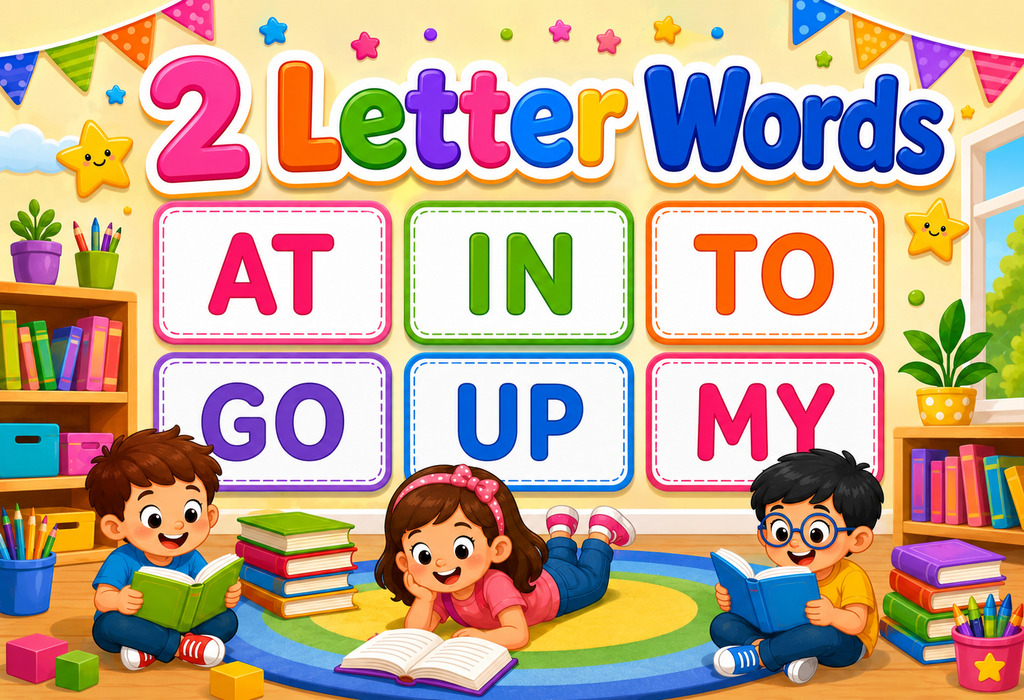
Even before children can read whole sentences, they often start with words that have two letters. These are some of the smallest building blocks in the English language, yet they carry real meaning and appear constantly in everyday speech. Words like an, go, hi and me help young readers make an early connection between sounds and meaning without feeling overwhelmed. This guide looks at what makes these tiny words special, shares practical lists and activities, and offers tips for parents and teachers guiding early readers.
What Are 2 Letter Words?
A two letter word is one of the shortest forms a word can take in English, often made up of just a vowel and a consonant, or occasionally two vowels together. Because there is so little to sound out, these words are usually among the very first that children learn to recognise on sight rather than by decoding letter by letter.
Some people also describe a word like this as a 2 alphabet word, since it is formed from only two individual letters of the alphabet. Despite their tiny size, these words carry genuine weight in a sentence, often working as pronouns, prepositions or simple verbs. Because they turn up so frequently in books, signs and conversation, mastering them gives children an early boost in reading fluency and everyday communication.
Unlike longer words, most two letter words cannot be sounded out piece by piece in a useful way, so children usually learn them as whole sight words instead. This makes them a natural early milestone, since recognising a short word instantly builds the same confidence that will later help with longer, trickier vocabulary.
Why Should Kids Learn Two Letter Words?
Two letter words might be tiny, but learning them brings real benefits for young readers.
- Building early reading confidence: Because these words are so short, children often recognise them at a glance, giving them an early and encouraging sense of success.
- Strengthening sight word recognition: Many two letter words appear so often in books that children learn to read them instantly, without sounding them out each time.
- Expanding functional vocabulary quickly: There are dozens of words with letters two that children use constantly in everyday speech, from greetings to simple instructions.
- Supporting sentence structure: Small words like an, on and to hold sentences together, helping children understand how longer sentences are built.
- Encouraging independent reading: Once these tiny words feel automatic, children can focus their attention on longer, more challenging words nearby.
- Improving listening and speech: Practising short words aloud helps children hear individual sounds clearly, supporting clearer pronunciation from an early age.
- Boosting overall reading speed: Because these words appear so often within any given text, quick recognition of them noticeably speeds up a child’s overall reading pace.
Together, these benefits make two letter words a quiet but powerful part of every child’s early reading journey.
Two Letter Words in English with Meanings
Here is a helpful list of 2 letter words in english, complete with meanings and example sentences to support early readers.
| Word | Example Sentence |
| Am | I am happy today. |
| An | She ate an apple. |
| As | He is as tall as his dad. |
| At | We met at the park. |
| Be | Try to be kind. |
| By | She sat by the window. |
| Do | Please do your homework. |
| Go | Let’s go to the shop. |
| He | He likes football. |
| Hi | She said hi to her friend. |
| If | If it rains, take an umbrella. |
| In | The toys are in the box. |
| Is | The sky is blue. |
| It | It is a small dog. |
| Me | Give the book to me. |
| My | This is my bag. |
| No | She said no to more sweets. |
| Of | A cup of milk. |
| Oh | Oh, that is a lovely picture. |
| On | The lamp is on. |
| Or | Do you want tea or juice. |
| Ox | The ox pulled the cart. |
| So | She was so tired. |
| To | We walked to school. |
| Up | The kite flew up in the sky. |
| Us | Come and join us. |
| We | We went to the beach. |
| Ah | Ah, now I understand. |
| Ha | Ha, that joke was funny. |
| Pa | Pa read us a story. |
Two Letter Words from A to Z
This two letter word a to z list gathers every common two letter word by its starting letter. English has far fewer two-letter words than three-letter ones, and several letters have none at all, so this list covers words across 18 letters rather than a full alphabet set.
| Letter | Words |
| A | am, an, as, at, ah, ax |
| B | be, by |
| D | do |
| E | eh |
| G | go |
| H | hi, ha, he |
| I | if, in, is, it |
| L | lo |
| M | me, my |
| N | no |
| O | of, oh, on, or, ox |
| P | pa |
| S | so |
| T | to |
| U | up, us |
| W | we |
| X | xi |
| Y | ye, yo |
Note: The letters C, F, J, K, Q, R, V and Z have no standard English two-letter words, which is why this list is shorter than a typical A to Z set. A few entries above, such as eh, lo, xi and ye, are less common but still recognised words.
Two Letter Words with Pictures
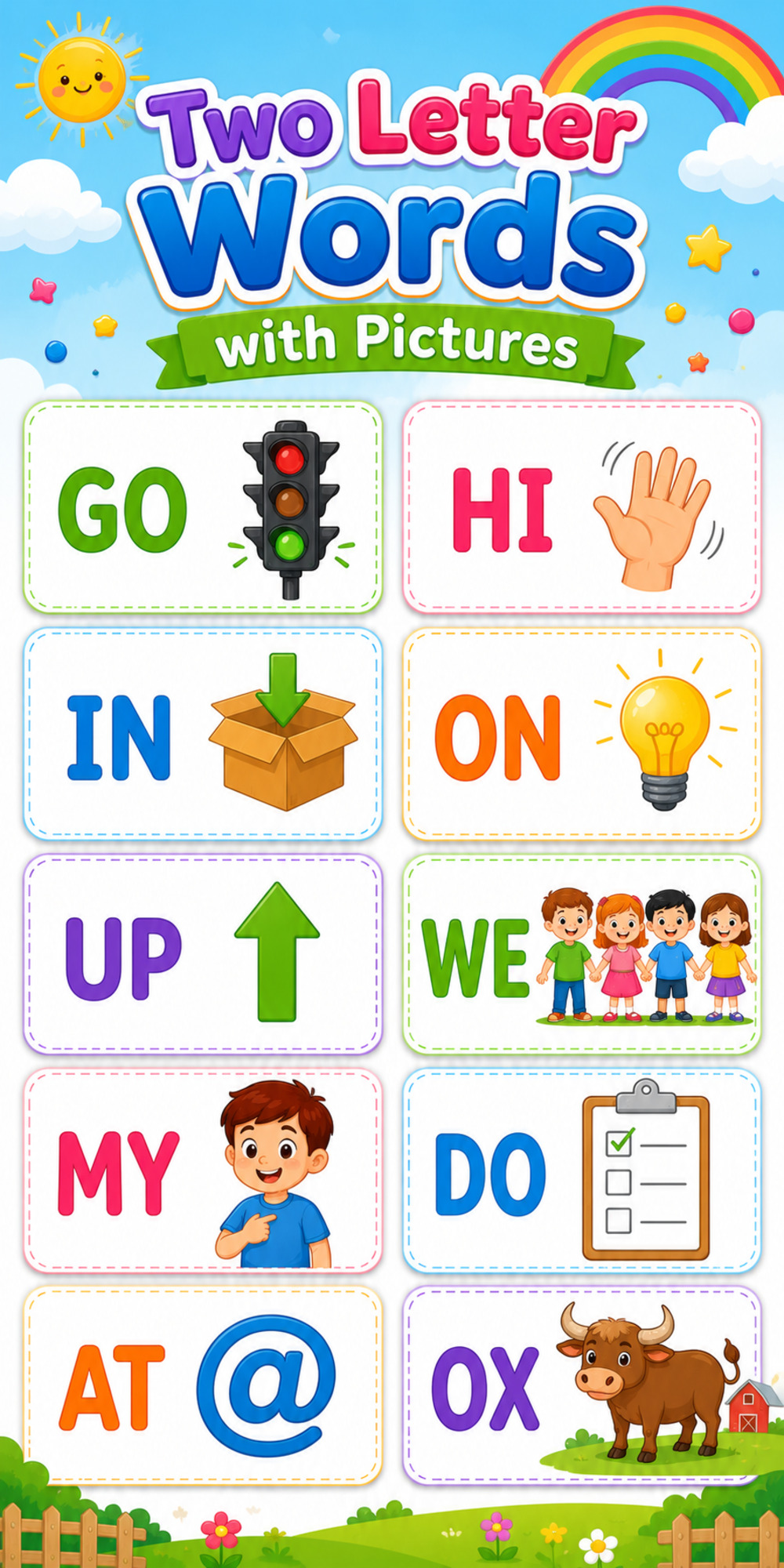
Many two letter words are connecting words, so the illustrations use simple symbols and everyday scenes to help kids understand their meaning. Each word is paired with an easy visual idea to support learning.
Two Letter Words Activities
These activities for 2 letter words are simple to set up at home or in the classroom, and they turn quick recognition practice into an engaging game.
- Letter Tile Building: Give children two letter tiles or magnets and ask them to combine them in different ways to see which combinations make real words, swapping one letter to explore new options.
- Sight Word Flash Rounds: Flip through cards showing words like an, go, or me, encouraging children to read each one within a second or two to build instant recognition and speed.
- Two Letter Word Hunt: Ask children to circle every two letter word they can find on a page from a favourite storybook or newspaper, turning reading practice into a treasure hunt.
- Action Word Charades: Call out action words such as go, up or do, and have children act them out to link meaning with movement in a lively, physical way.
- Word Chain Game: Take turns saying a two letter word and then a short sentence that uses it correctly, building confidence with practical, everyday usage.
Tips for Parents and Teachers
- Focus on everyday exposure: Point out two letter words on signs, packaging and books during daily routines, since repeated exposure in real contexts builds recognition naturally over time.
- Teach them as sight words: Rather than sounding out every letter, encourage children to recognise these short words instantly, since many are used too often to decode each time they appear.
- Link words to meaning, not just sound: Explain briefly what a word like of or by means in context, so children understand function alongside pronunciation from the start.
- Keep practice short and frequent: A few minutes of daily practice works better than occasional long sessions for building lasting recall and steady progress.
- Model correct use in conversation: Children pick up small words naturally when they hear them used correctly and often in everyday adult speech, so narrate simple actions aloud where you can.
Tiny as they are, these words carry enormous weight in helping children read and speak with confidence. By exploring two alphabet words through lists, pictures and hands-on activities, parents and teachers can help children build the quiet but essential vocabulary that holds sentences together. With regular practice and encouragement, children move quickly from recognising single small words to reading full sentences with growing fluency and confidence, setting a strong foundation for everything they will read next.
Also Read:
2 Letter Words for Kids
3 Letter Words for Kids
4 Letter Words for Kids
5 Letter Words for Kids
6 Letter Words for Kids
7 Letter Words for Kids
8 Letter Words for Kids