
Table of Contents
Learning to read starts small, and few building blocks matter more than words that have three letters. These short, simple words give children an early taste of reading success, turning letters into meaning in just three steps. From cat and dog to sun and hat, tiny words like these appear everywhere in a child’s first books and everyday conversations. This guide explores why they matter, shares fun lists and activities, and offers practical tips for parents and teachers supporting early readers at home or in the classroom.
What Are 3 Letter Words?
A three letter word is exactly what it sounds like: a word made up of three letters, usually one vowel sitting between two consonants. This simple structure, known as the CVC pattern (consonant vowel consonant), makes these words some of the easiest for young children to sound out. Words like cat, sun and dog follow this pattern closely, giving early readers a predictable rhythm to rely on.
Some people also refer to a short word like this as a 3 alphabet word, since it is built from just three individual letters of the alphabet. Whatever term is used, the idea stays the same: these compact words pack a full meaning into a handful of sounds. Because they are short, they are often among the first words children learn to read and write independently, making them a cornerstone of early literacy development.
Teachers and reading specialists often group these words by their letter patterns, since noticing similar endings, such as at, an or ot, helps children recognise families of words rather than learning each one from scratch. This pattern based approach speeds up learning considerably, as a single sound blend can unlock dozens of related words.
Why Should Kids Learn Three Letter Words?
Three letter words are the foundation of early literacy, and there are good reasons to prioritise them in a child’s learning journey.
- Building reading confidence: Short words are less intimidating than longer ones, helping children feel capable from their very first attempts at reading.
- Strengthening phonics skills: Sounding out simple consonant vowel consonant patterns teaches children how letters combine to create sounds and meaning.
- Expanding vocabulary quickly: Because there are so many words with letters three in the English language, children can grow their word bank rapidly without feeling overwhelmed.
- Supporting spelling development: Short words are easier to memorise and spell correctly, giving children an early sense of accomplishment.
- Encouraging independent reading: Once children master these basic words, they gain the confidence to tackle longer, more complex texts on their own.
- Improving listening and speech: Practising short words aloud helps children hear individual sounds clearly, which in turn supports clearer pronunciation and speech development.
Together, these benefits make short, simple words an essential stepping stone in every child’s reading journey.
Three Letter Words in English with Meanings
Here is a helpful list of 3 letter words in english, complete with meanings and example sentences to support early readers.
| Word | Example Sentence |
| Cat | The cat slept on the mat. |
| Dog | The dog ran after the ball. |
| Sun | The sun was bright today. |
| Hat | She wore a red hat. |
| Bat | He held the bat firmly. |
| Run | The children like to run outside. |
| Sit | Please sit on the chair. |
| Big | The elephant is very big. |
| Red | Her shoes are red. |
| Yes | She said yes to the plan. |
| Box | He kept his toys in a box. |
| Cup | Fill the cup with milk. |
| Pen | She wrote with a blue pen. |
| Bus | We took the bus to school. |
| Egg | We had eggs for breakfast. |
| Ant | The ant carried a leaf. |
| Bed | He jumped onto his bed. |
| Cow | The cow grazed in the field. |
| Fan | Turn on the fan, it is hot. |
| Jam | She spread jam on her toast. |
| Kit | He packed his football kit. |
| Log | They sat on a log by the fire. |
| Map | We used a map to find the park. |
| Net | The fisherman cast his net. |
| Owl | The owl hooted in the dark. |
| Pig | The pig rolled in the mud. |
| Rat | The rat scurried across the floor. |
| Top | He spun the top on the table. |
| Van | The van delivered our parcel. |
| Zip | Pull the zip to close your coat. |
Three Letter Words from A to Z
This three letter word a to z list features five words for most letters of the alphabet, giving children a broad view of short words across the whole alphabet. English has very few natural three-letter words beginning with Q or X, so this list covers 120 words across 24 letters.
| Letter | Words |
| A | ant, ate, act, arm, art |
| B | bat, bed, box, bus, big |
| C | cat, cow, cup, cap, cot |
| D | dog, dad, dig, dry, dot |
| E | egg, eat, ear, end, eye |
| F | fan, fun, fly, fat, fox |
| G | gap, gum, gym, got, gel |
| H | hat, hen, hot, hit, hop |
| I | ice, ink, imp, its, ill |
| J | jam, jet, jog, joy, jug |
| K | kit, key, kid, kin, koi |
| L | log, leg, lip, low, lit |
| M | map, mat, mud, mix, mop |
| N | net, nap, nut, now, new |
| O | owl, oak, out, off, odd |
| P | pig, pen, pot, pat, pit |
| R | rat, run, red, rug, row |
| S | sun, sit, sad, sea, six |
| T | top, ten, toy, tip, tan |
| U | use, urn, ups, ugh, uni |
| V | van, vet, vat, vow, via |
| W | web, wet, win, wig, way |
| Y | yes, yak, yam, yet, you |
| Z | zip, zoo, zap, zen, zed |
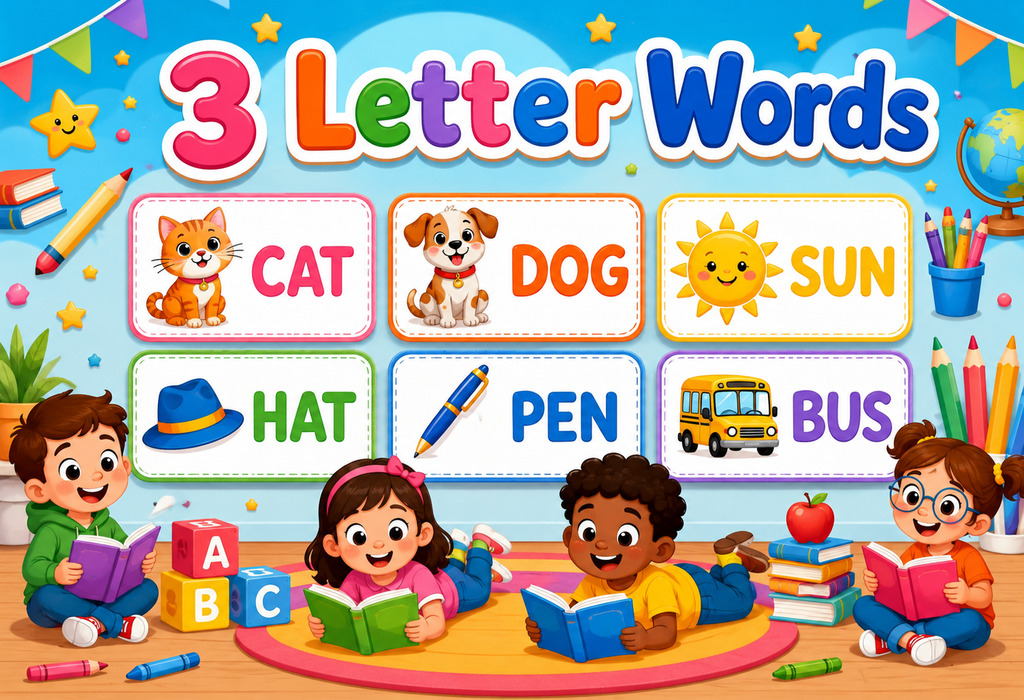
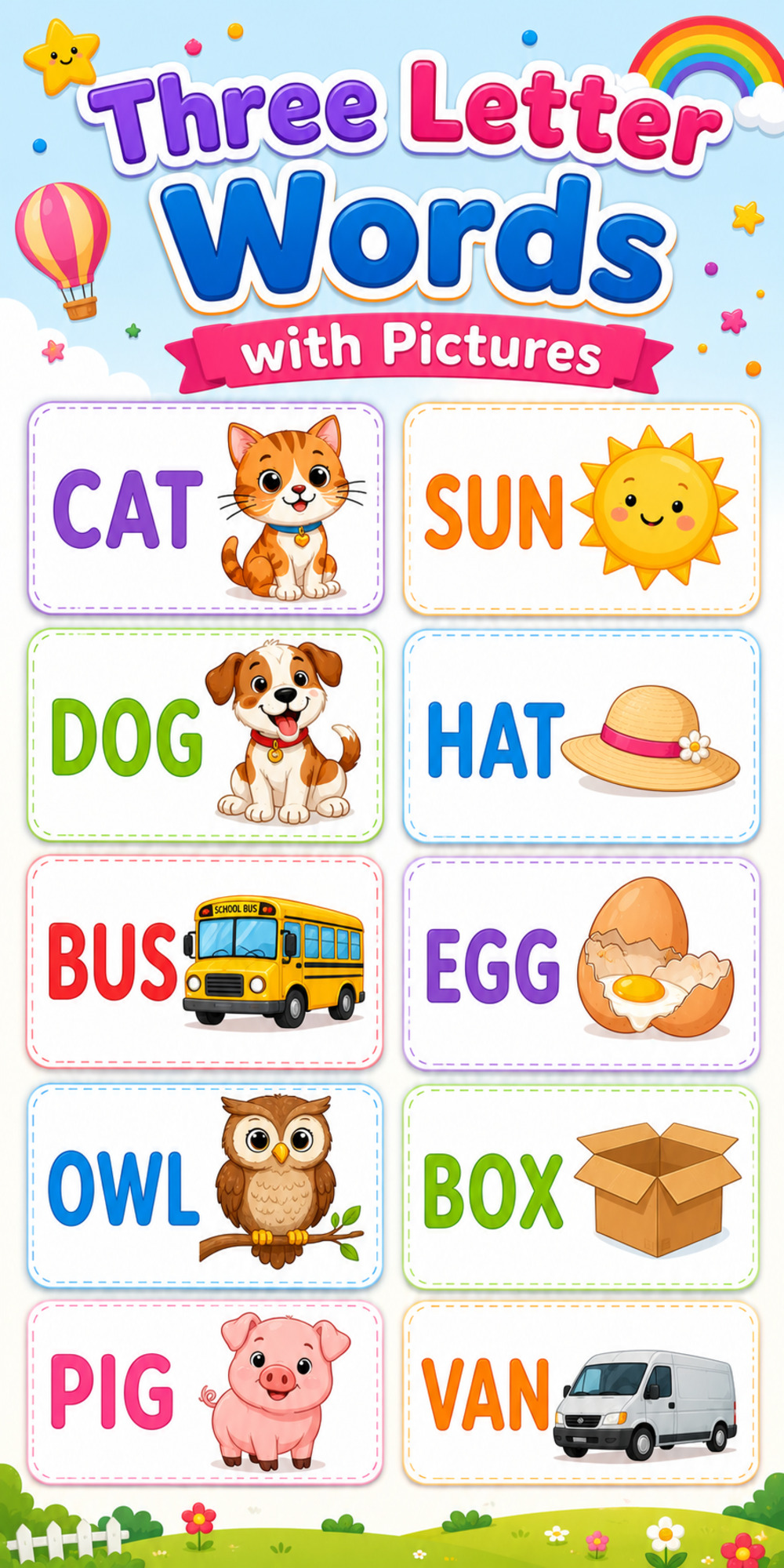
Three Letter Words with Pictures
Pictures make learning easier and more engaging for young children. Below are simple three-letter words paired with picture ideas to help kids recognize, remember, and use these words with confidence.
Three Letter Words Activities
These activities for 3 letter words are simple to set up at home or in the classroom, and they turn learning into play.
- Letter Tile Building: Give children loose letter tiles or magnets and ask them to build as many three letter words as they can find, swapping one letter at a time to create new words.
- Picture Matching Game: Pair word cards with matching picture cards, and have children sound out each word before matching it to reinforce meaning alongside spelling.
- Three Letter Word Bingo: Create bingo cards filled with short words, then call out meanings or example sentences for children to spot and mark on their cards.
- Sound-Out Scavenger Hunt: Hide word cards around a room and ask children to read each one aloud as they find it, turning practice into an active game.
- Flashcard Speed Rounds: Flip through flashcards quickly, encouraging children to read each word within a few seconds to build fluency and quick recognition.
Tips for Parents and Teachers
- Start with familiar words: Choose words connected to a child’s everyday life, such as cat, cup or bed, to build early confidence before moving on to unfamiliar ones.
- Practise little and often: Short, regular sessions of five to ten minutes work better than long, infrequent ones for building lasting reading fluency.
- Use multisensory learning: Combine sight, sound and touch by having children trace letters in sand or on paper while saying the word aloud.
- Celebrate small wins: Praise progress generously, since confidence plays a huge role in early reading success and keeps children motivated to keep trying.
- Read together daily: Sharing books that feature simple words reinforces learning in a natural, enjoyable way and strengthens the parent-child reading habit.
Short, simple words are far more than a stepping stone in early literacy; they are the very foundation on which confident reading is built. By exploring three alphabet words through lists, pictures and hands-on activities, parents and teachers can turn early reading practice into an enjoyable daily habit. With regular exposure and a little encouragement, children quickly move from sounding out single words to reading full sentences with confidence and joy.
Also Read:
2 Letter Words for Kids
3 Letter Words for Kids
4 Letter Words for Kids
5 Letter Words for Kids
6 Letter Words for Kids
7 Letter Words for Kids
8 Letter Words for Kids