
Table of Contents
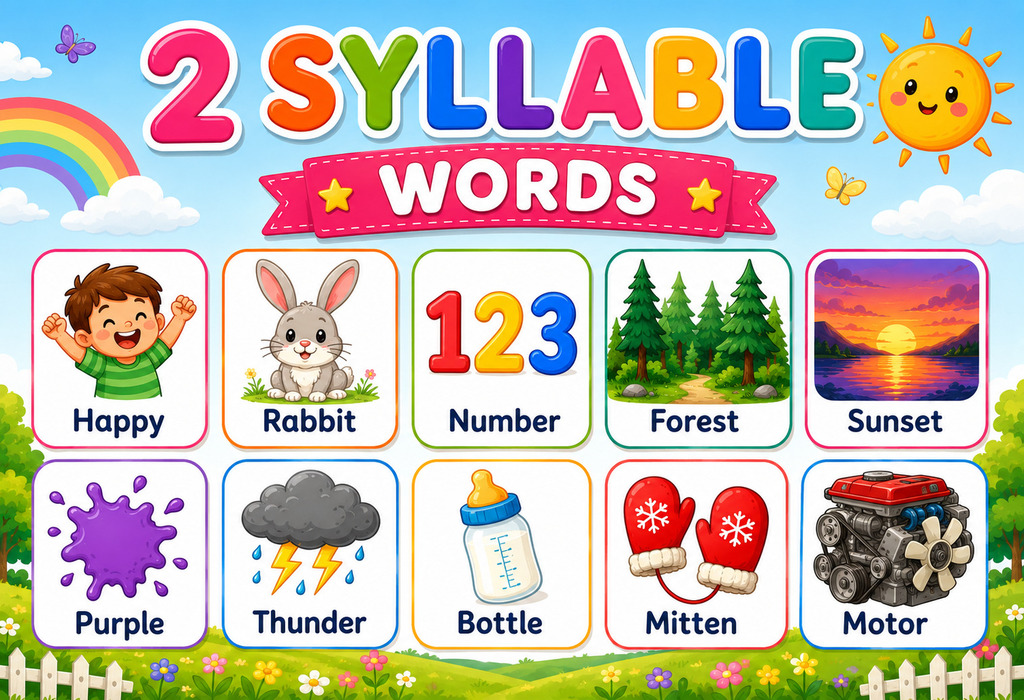
Learning to break words into beats is one of the first big steps on the road to confident reading, and 2 syllable words are the perfect place to start once your child has mastered single-beat words. They are short enough to sound out easily, yet long enough to build real rhythm and phonemic awareness. In this guide, you will find a broad word list, an alphabetical reference from A to Z, themed tables covering everyday topics, a picture-word infographic, and practical tips for building this skill at home. Whether you are a parent, carer, or teacher, this resource gives you everything needed to make two-beat words fun to learn.
What are 2 Syllable Words?
A syllable is a single, unbroken sound made when we speak, and most English words are built from one or more of these beats strung together. Two syllable words contain exactly two of these beats, such as “gar-den” or “pen-cil”, and clapping or tapping out each part is one of the simplest ways for children to notice the pattern. Once a child can hear that a word has two claps rather than one, they begin to recognise syllable boundaries in longer, more complex words too, which makes decoding unfamiliar vocabulary far less daunting. This is why teachers so often use two-beat words as the bridge between simple one-syllable reading and the multi-syllable words children will meet later in school.
2 Syllable Word List
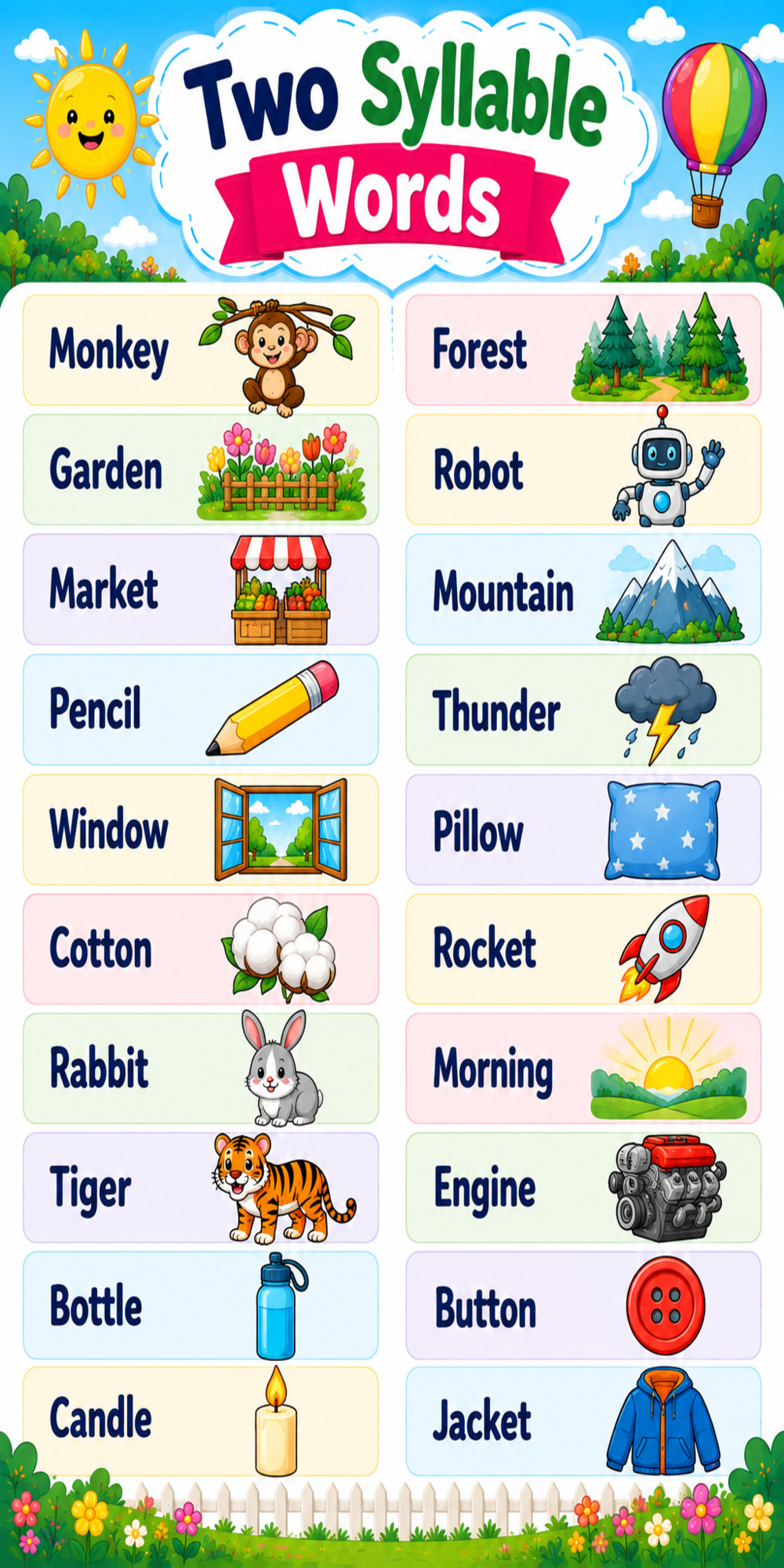
Here are common words that have two syllables, useful for reading practice, spelling lists, or simple clapping games at home.
| happy | monkey | picture | ladder | tractor |
| garden | rabbit | letter | hammer | rocket |
| market | tiger | number | needle | planet |
| pencil | forest | paper | button | comet |
| window | ocean | pillow | zipper | robot |
| moment | mountain | blanket | jacket | engine |
| purple | thunder | bottle | mitten | motor |
| silver | rainbow | candle | sandal | tunnel |
| cotton | sunset | basket | wallet | bridge |
| dinner | morning | evening | wagon | castle |
Several of these double up as a handy adjective with Two syllables in everyday sentences, including “happy”, “silver”, and “purple”, so children can practise using them descriptively as well as reading them aloud.
Alphabetical Two Syllable Words List (A–Z)
This list offers a clear example of 2 syllable words for almost every letter of the alphabet, making it useful for spelling games, flashcards, or A-to-Z classroom displays.
| Letter | Words |
|---|---|
| A | apple, artist |
| B | baby, butter |
| C | candy, carpet |
| D | dragon, dolphin |
| E | eagle, engine |
| F | farmer, feather |
| G | garden, giant |
| H | hammer, harvest |
| I | insect, island |
| J | jacket, journal |
| K | kitchen, kitten |
| L | ladder, lantern |
| M | monkey, mountain |
| N | napkin, needle |
| O | ocean, orange |
| P | pencil, picture |
| Q | quiet, quota |
| R | rabbit, rocket |
| S | silver, sunset |
| T | tiger, turtle |
| U | uncle, upset |
| V | valley, velvet |
| W | wagon, window |
| Y | yellow, yogurt |
| Z | zebra, zipper |
Theme Based 2 Syllable Words List
Grouping words by topic helps children connect vocabulary to the world around them, and it is also a natural way to introduce 2 syllable verbs alongside nouns as part of a wider set of 2 syllable words in english. The five tables below cover professions, feelings, the environment, nature, and food.
Profession
| Word | Syllable Break | Example Sentence |
|---|---|---|
| Doctor | doc-tor | The doctor checked my ears. |
| Farmer | farm-er | Our farmer grows carrots and peas. |
| Teacher | teach-er | My teacher reads us a story every day. |
| Artist | art-ist | The artist painted a bright sunset. |
| Dancer | danc-er | The dancer spun across the stage. |
Emotions & Feelings
| Word | Syllable Break | Example Sentence |
|---|---|---|
| Happy | hap-py | She felt happy on her birthday. |
| Angry | an-gry | He was angry when his tower fell. |
| Joyful | joy-ful | The puppy looked joyful in the park. |
| Upset | up-set | The baby was upset about the loud noise. |
| Hopeful | hope-ful | We felt hopeful about the sunny weekend. |
Environment
| Word | Syllable Break | Example Sentence |
|---|---|---|
| Forest | for-est | Deer live in the quiet forest. |
| Ocean | o-cean | Whales swim in the deep ocean. |
| Desert | des-ert | Cacti grow well in the dry desert. |
| Jungle | jun-gle | Parrots fly through the green jungle. |
| Rainfall | rain-fall | Heavy rainfall filled the pond. |
Nature
| Word | Syllable Break | Example Sentence |
|---|---|---|
| Sunset | sun-set | The sky turned pink at sunset. |
| Rainbow | rain-bow | A rainbow appeared after the storm. |
| Thunder | thun-der | The thunder made the dog hide. |
| Autumn | au-tumn | Leaves fall from the trees in autumn. |
| Flower | flow-er | A bee landed on the yellow flower. |
Food
| Word | Syllable Break | Example Sentence |
|---|---|---|
| Butter | but-ter | Spread butter on your toast. |
| Apple | ap-ple | She packed an apple for lunch. |
| Cookie | cook-ie | We baked a cookie for grandad. |
| Yogurt | yog-urt | He ate yogurt with berries. |
| Mango | man-go | The mango was sweet and juicy. |
2 Syllable Picture Words
Pairing a word with a picture is one of the fastest ways for young children to link sound, spelling, and meaning. The infographic below highlights five easy two-beat words, apple, monkey, candle, rocket, and rainbow, each broken into its syllables for quick visual practice.
Benefits of Learning 2 Syllable Words for Kids
Two-beat words sit at a sweet spot in early reading development, challenging enough to build real skill but simple enough to avoid frustration. Practising them regularly supports several areas of a child’s growth at once:
- Strengthens phonemic awareness by training the ear to hear distinct beats within a word.
- Builds reading fluency and confidence before children tackle longer, multi-syllable vocabulary.
- Improves spelling accuracy, since breaking a word into parts makes it easier to sound out each section.
- Expands vocabulary across everyday topics like feelings, food, and nature.
- Supports clearer speech and pronunciation through rhythmic practice.
- Prepares children for classroom phonics assessments that often test syllable counting.
Parent Practice Tips
You do not need a classroom or special equipment to help your child practise at home. A few short, playful sessions each week can make a lasting difference. Try these simple approaches:
- Clap or tap out each syllable together while saying the word aloud.
- Turn practice into a rhyme or chant, since rhythm helps memory stick.
- Keep sessions short and end on a success, especially when introducing Two syllable words for kindergarten age children who tire quickly.
- Play a syllable hop, where your child jumps once for each beat as they say a word from the list.
- Set up a syllable sorting basket, with two labelled bins and picture cards to drop in as “one clap” or “two clap”.
- Try a syllable scavenger hunt around the house, spotting objects whose names have two beats, such as pillow, window, or blanket.
- Play a memory match game, pairing picture cards with their matching two-syllable word cards.
Two-syllable words offer young learners a gentle but meaningful step forward in their reading journey, building the rhythm, confidence, and vocabulary they need for more advanced words ahead. With the lists, themed tables, and practice tips in this guide, parents and teachers have everything required to turn syllable learning into an enjoyable, everyday habit.
Also Read: Syllable Words Lists for Kids
| 1 Syllable Words | 5 Syllable Words |
| 2 Syllable Words | 6 Syllable Words |
| 3 Syllable Words | 7 Syllable Words |
| 4 Syllable Words | 8 Syllable Words |