
Table of Contents
Learning to break words into syllables is one of the building blocks of early reading, and 3 syllable words sit right in the sweet spot for young learners moving beyond simple two-beat words. They are long enough to build confidence in clapping out syllables, yet short enough to stay manageable for a five or six year old. In this guide, you will find themed word lists, an alphabetical reference, a picture-based activity, and practical tips to help your child recognise and use these words with ease.
What are 3 Syllable Words?
A syllable is a single, unbroken sound in a word, usually built around one vowel sound, and three syllable words are simply words that contain exactly three of these beats when spoken aloud, such as “banana” (ba-na-na) or “elephant” (el-e-phant). Children usually learn to count syllables by clapping once for each beat, which turns an abstract grammar concept into something physical and easy to grasp. Recognising these patterns helps kids decode unfamiliar words, improves their spelling accuracy, and builds a bridge towards longer, more complex vocabulary as their reading skills mature.
3 Syllable Word List
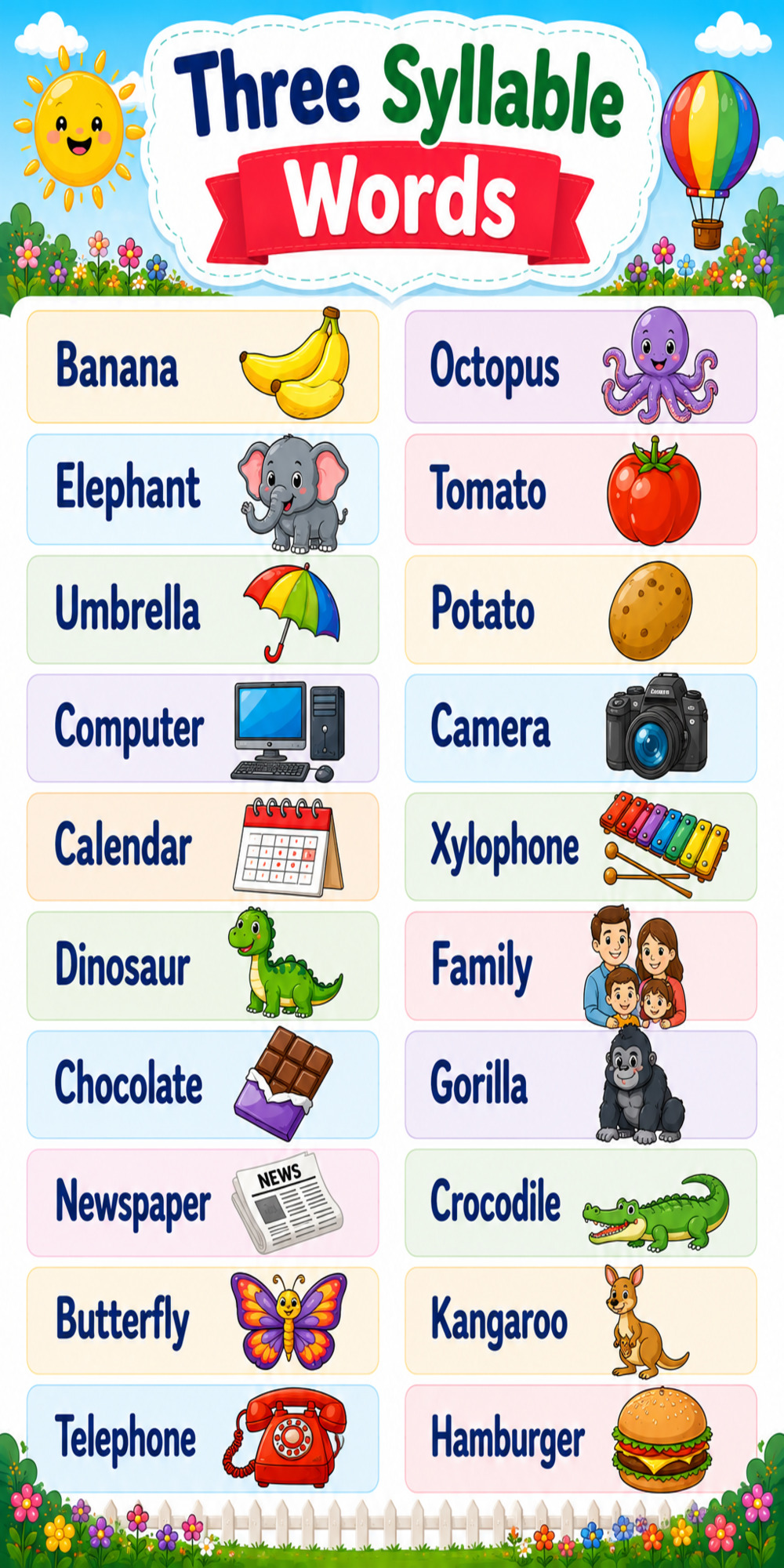
Below is a general list of common three-beat words that children encounter often in books, conversation, and school. The list includes a mix of everyday nouns, and it is a handy reference whenever you need words that have 3 syllables for a spelling test, a reading exercise, or simply to demonstrate an adjective with three syllables such as “beautiful” or “wonderful” in a sentence.
| Banana | Octopus | Newspaper | Happiness | Scientist |
| Elephant | Tomato | Adventure | Library | Strawberry |
| Umbrella | Potato | Beautiful | Mystery | Symphony |
| Computer | Camera | Important | National | Terrible |
| Calendar | Animal | Wonderful | Orchestra | Vitamin |
| Dinosaur | Family | Carnival | Paradise | Volcano |
| Chocolate | Holiday | Gorilla | Popular | Xylophone |
| Hospital | Alphabet | Crocodile | President | Yesterday |
| Butterfly | Kangaroo | Enormous | Remember | Personal |
| Telephone | Hamburger | Favourite | Restaurant | History |
Alphabetical Three Syllable Words List (A–Z)
This alphabetical reference offers an example of three-syllable words for nearly every letter, making it useful for spelling games or “word of the day” activities. A few letters, particularly Q, X, and Y, have naturally fewer common three-beat words in English, so coverage for those is lighter than the rest.
| Letter | Word |
| A | animal, adventure |
| B | banana, beautiful |
| C | computer, calendar |
| D | dinosaur, delicious |
| E | elephant, enormous |
| F | family, favourite |
| G | gorilla, generous |
| H | hospital, holiday |
| I | idea, immigrant |
| J | jealousy, jubilant |
| K | kangaroo, kerosene |
| L | library, liberty |
| M | mystery, memory |
| N | national, newspaper |
| O | octopus, orchestra |
| P | potato, popular |
| Q | quality, quantity |
| R | restaurant, remember |
| S | scientist, strawberry |
| T | telephone, terrible |
| U | umbrella, uniform |
| V | vitamin, volcano |
| W | wonderful, wilderness |
| X | xylophone |
| Y | yesterday, yellowish |
| Z | zucchini |
Theme Based 3 Syllable Words List
Grouping words by theme gives children context for how these words are actually used, which helps with both memory and comprehension. The tables below also include a few 3 syllable verbs, such as “remember” and “recycle,” alongside nouns, giving a fuller picture of three syllable words in English across different parts of speech.
Profession
| Word | Syllables |
|---|---|
| Scientist | sci-en-tist |
| Carpenter | car-pen-ter |
| Musician | mu-si-cian |
| Mechanic | me-chan-ic |
| Detective | de-tec-tive |
| Professor | pro-fes-sor |
| Reporter | re-por-ter |
| Architect | ar-chi-tect |
| Attorney | at-tor-ney |
| Director | di-rec-tor |
Emotions & Feelings
| Word | Syllables |
|---|---|
| Curious | cu-ri-ous |
| Jealousy | jeal-ous-y |
| Confident | con-fi-dent |
| Terrified | ter-ri-fied |
| Exhausted | ex-haust-ed |
| Embarrassed | em-bar-rassed |
| Delighted | de-light-ed |
| Sorrowful | sor-row-ful |
| Joyfulness | joy-ful-ness |
| Generous | gen-er-ous |
Environment
| Word | Syllables |
|---|---|
| Pollution | pol-lu-tion |
| Recycling | re-cy-cling |
| Atmosphere | at-mo-sphere |
| Rainforest | rain-for-est |
| Wilderness | wil-der-ness |
| Hurricane | hur-ri-cane |
| Tsunami | tsu-na-mi |
| Avalanche | av-a-lanche |
| Erosion | e-ro-sion |
| Habitat | hab-i-tat |
Nature
| Word | Syllables |
|---|---|
| Waterfall | wa-ter-fall |
| Blueberry | blue-ber-ry |
| Raspberry | rasp-ber-ry |
| Buttercup | but-ter-cup |
| Ladybird | la-dy-bird |
| Sunflower | sun-flow-er |
| Evergreen | ev-er-green |
| Butterfly | but-ter-fly |
| Dragonfly | drag-on-fly |
| Coconut | co-co-nut |
Food
| Word | Syllables |
|---|---|
| Tomato | to-ma-to |
| Potato | po-ta-to |
| Chocolate | choc-o-late |
| Banana | ba-na-na |
| Spaghetti | spa-ghet-ti |
| Pineapple | pine-ap-ple |
| Broccoli | broc-co-li |
| Lemonade | lem-on-ade |
| Cucumber | cu-cum-ber |
| Vanilla | va-nil-la |
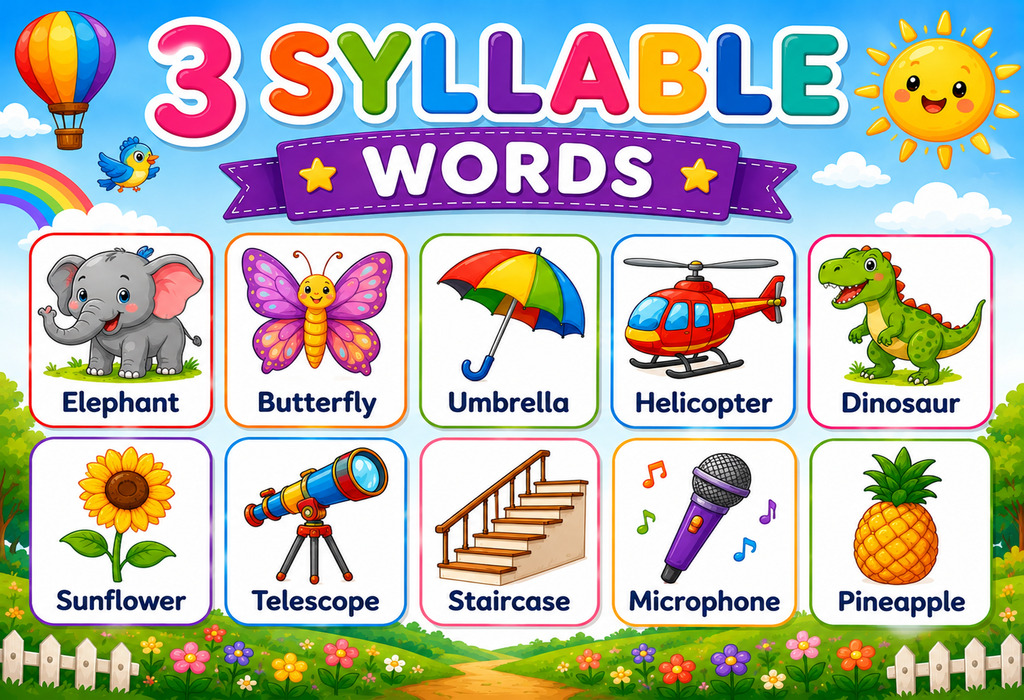
3 Syllable Picture Words
A picture-word activity is one of the simplest ways to reinforce syllable counting for visual learners, pairing an everyday image with its spoken beats. Here are five words well suited to a printable or flashcard-style.
Benefits of Learning 3 Syllable Words for Kids
Working with longer, multi-beat vocabulary gives children a manageable step up from simple words without overwhelming them. It sharpens several skills at once, from listening to spelling, while keeping practice light and playful.
- Strengthens phonemic awareness by training the ear to hear distinct beats within a word.
- Builds reading fluency, since breaking longer words into syllables makes decoding faster and less frustrating.
- Improves spelling accuracy by helping children map sounds to letter patterns in manageable chunks.
- Expands vocabulary naturally, as many three-beat words introduce new concepts in science, nature, and emotions.
- Boosts confidence, since mastering longer words feels like a genuine achievement for early readers.
- Supports classroom readiness, as syllable counting is a core early-literacy skill taught in most reception and primary curriculums.
- Encourages careful listening, since spotting each beat requires children to slow down and focus on sound rather than rushing through a word.
Parent Practice Tips
Learning sticks best when it feels like play rather than a lesson, so keep sessions short and hands-on. A few simple routines at home can turn syllable practice into a daily habit rather than a chore.
- Clap or tap out each syllable together while saying the word slowly.
- Play a syllable scavenger hunt, hunting the house for objects whose names have three beats.
- Sort flashcards into piles by syllable count as a quick sorting game.
- Use three syllable words for kindergarten in simple sentence-building exercises to link sound and meaning.
- Turn mealtime into practice by naming three-beat foods on the plate, such as “tomato” or “banana.”
- Sing simple syllable chants or rhymes to make the rhythm memorable.
- Build a weekly word jar, adding one new three-beat word each day and reviewing the collection together at the weekend.
- Turn bedtime stories into a light game by pausing on a longer word and counting its beats before turning the page.
These longer, multi-beat words offer a natural next step for children building their reading and spelling skills, striking a balance between challenge and confidence. They appear everywhere, from storybooks to dinner table conversation, which makes practice easy to fold into daily routines rather than treating it as a separate lesson. With themed lists, an alphabetical reference, and a handful of playful habits at home, parents have everything they need to help their child grow more comfortable with longer vocabulary at their own pace.
Also Read: Syllable Words Lists for Kids
| 1 Syllable Words | 5 Syllable Words |
| 2 Syllable Words | 6 Syllable Words |
| 3 Syllable Words | 7 Syllable Words |
| 4 Syllable Words | 8 Syllable Words |