
Table of Contents
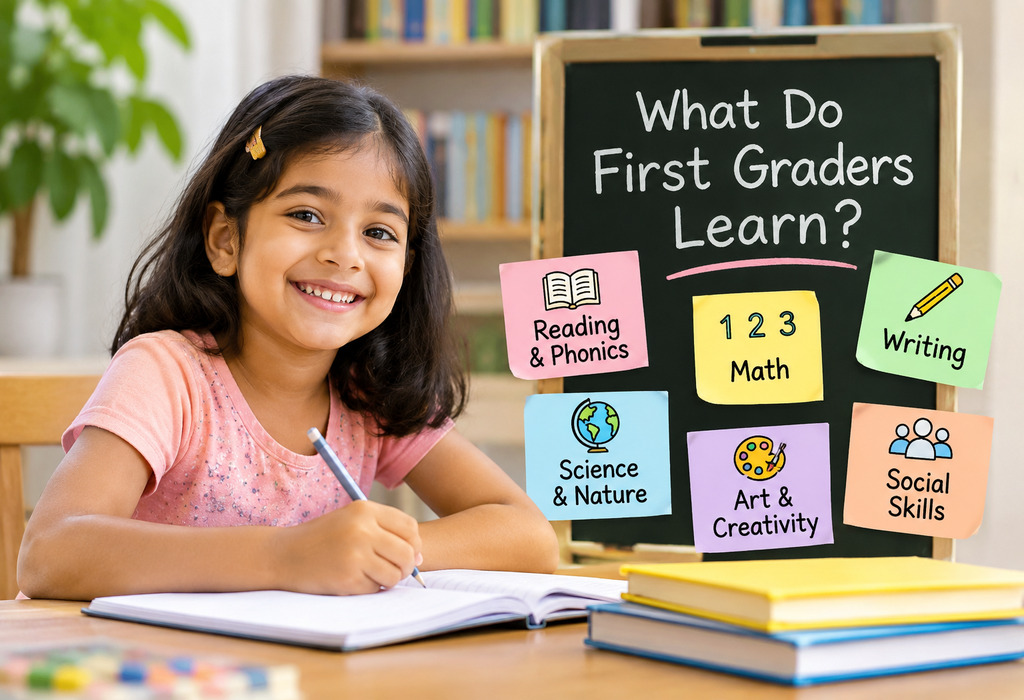
First grade is a big step up from kindergarten. Parents often ask, what do first graders learn, and how can I help at home? If you are wondering what do 1st graders learn, the answer covers reading, writing, math, science, social studies, and a good deal of social growth. Many families also want to know what do kids learn in first grade before the school year begins, so they can feel confident and prepared. This guide walks through the first grade curriculum subject by subject, along with the daily habits teachers expect.
Why First Grade Matters
First grade is often called the reading year because literacy skills take off. Children also move from simple counting to real problem solving, and they begin to explore the world beyond their own home. Teachers also expect more responsibility. Kids follow classroom routines, work independently for short stretches, and manage their own belongings. Every child grows at a different pace, so it is normal for skills to vary from one student to the next.
Reading in First Grade
Reading is the heart of the first grade year. Many children start by sounding out simple three letter words such as “cat.” By the end of the year, most are reading grade level text with accuracy and expression. Key reading skills include:
- Blending and segmenting single syllable words, such as stretching “c a t” and blending the sounds back together
- Learning common blends and digraphs like bl, st, sh, ch, and th
- Changing individual sounds to make new words, such as swapping the first sound in “bat” to make “cat”
- Reading long vowel words, including silent e words like “cake” and “bike”
- Counting syllables by clapping or tapping
- Recognizing sight words such as “the,” “and,” and “said,” often from Dolch or Fry lists
- Spotting root words and endings, like “play” and “playing”
Comprehension grows too. First graders answer questions about key ideas, retell stories, and describe characters, settings, and major events. They also use pictures and details in a text to talk about what they read.
Writing in First Grade
Writing moves from single words to full sentences and short paragraphs. Many students learn to write a topic sentence, add supporting details, and finish with a closing sentence. Teachers often use journals, story writing, and simple fact projects to build confidence. Children are allowed to use inventive spelling at first while they also learn to spell basic words correctly.
Common writing tasks include:
- Narratives about real or imagined events told in order
- Opinion pieces that give reasons, such as why a favorite food is the best
- Informational writing that introduces a topic, shares facts, and wraps up
- Simple how to texts, like how to make a sandwich
Grammar Basics
Grammar helps children express their ideas clearly. First graders learn to begin sentences with capital letters and to use end punctuation such as periods and question marks. They also meet the main parts of speech, including nouns, verbs, adjectives, pronouns, and conjunctions like “and,” “but,” and “because.” Verbs help them show a sense of time, such as “played,” “play,” and “will play.”
Math in First Grade
First grade math builds directly on kindergarten and focuses on number sense and problem solving. Important skills include:
- Counting to 120, starting from any number
- Understanding that two digit numbers are made of tens and ones, so 34 is three tens and four ones
- Comparing two digit numbers by looking at the tens and ones digits
- Adding and subtracting within 20 using strategies like counting on, making ten, and number lines
- Mentally finding ten more or ten less than a number
- Naming and describing shapes, then combining them to make new shapes
- Splitting circles and rectangles into halves and quarters
- Ordering objects by length
- Telling time to the hour and half hour on analog and digital clocks
- Learning about money and reading simple graphs
Teachers often use base ten blocks, number lines, hundreds charts, clocks, and counters so children can see and touch the math.
Science in First Grade
Science asks children to notice patterns in the natural world. Topics often include magnets, animals, and plants. Students may follow the life cycle of an insect such as a butterfly, study weather, and learn how the water cycle supports life. Some classes also explore motion by testing how pushing and pulling change the way objects move.
Social studies helps children understand where they fit in the world. They learn about families, schools, and communities, and how neighborhoods make up cities, cities make up states, and states make up nations. A popular field trip is a visit to the local library, where students learn how it works and how to borrow a book on their own. Many classrooms also include creative arts and physical education, which give children a chance to move, make, and express themselves.
Academic growth is only part of the picture. First graders practice listening and following directions, sharing and taking turns, and expressing their needs respectfully. They also build independence by packing their backpacks, using the bathroom on their own, and following daily routines. These habits help children feel secure and ready to learn.
Fine and Gross Motor Skills
Small muscle skills matter in first grade. Children practice holding a pencil with a comfortable grip, cutting along lines with scissors, and sometimes tying their own shoes. Big muscle skills such as running, jumping, climbing, and balancing support confidence on the playground and in physical education class.
How to Support Learning at Home
If you are asking what to teach a first grader at home, start with simple daily habits instead of long lessons. Small, steady practice works better than occasional cramming.
- Read together for 10 to 15 minutes every day and let your child choose books
- Play sound games, such as asking what sound starts the word “ball”
- Practice sight words with flashcards or a memory game
- Count objects around the house and look for numbers on clocks and price tags
- Encourage writing through journals, grocery lists, and letters to family
- Give two and three step directions so your child builds listening skills
- Check in with the teacher if you have questions about progress
First grade is a year of rapid growth, and children learn to read, write, add, subtract, and explore their world with new confidence. Now that you know what first graders learn, you can spot where your child shines and where a little extra practice may help. Reading daily, counting during everyday routines, and encouraging writing are simple ways to support the curriculum at home. Remember that every child moves at a different pace, so patience and encouragement matter as much as any skill. With steady support from home and school, your child can finish first grade ready and excited for what comes next.