
Table of Contents
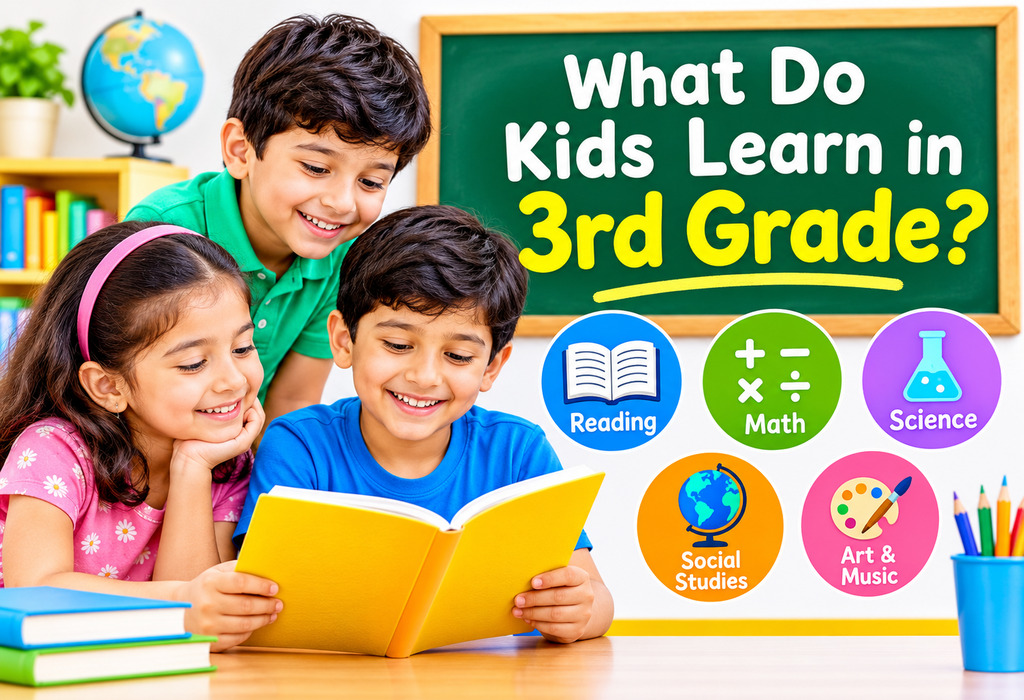
Third grade often feels like a turning point for kids and parents alike. Homework gets longer, books get thicker, and new math ideas show up almost every week. So, what do you learn in 3rd grade? In short, children move from learning basic skills to using those skills to learn new things in every subject. This guide walks through math, reading, writing, science, social studies, and the habits that help kids succeed, so you know exactly what to expect from the year ahead.
Why Third Grade Is Such an Important Year
Up to second grade, most of the work focuses on building foundations. Children learn to sound out words, count, add, and subtract. In third grade, the focus shifts. Teachers often describe it as the year kids stop learning to read and start reading to learn.
That shift touches every subject. A science chapter needs strong reading skills. A math word problem needs careful reading and clear thinking. Kids are also expected to work more on their own, follow directions with several steps, and manage their homework. Many states begin yearly tests in this grade, which is another reason the skills below matter.
Math in 3rd Grade
Math is where parents usually notice the biggest change. If you have wondered what should a 3rd grader know in math, the short answer is multiplication, division, and fractions.
Multiplication and division: Kids start by seeing multiplication as equal groups. Four bags with six apples each is 4 x 6. They also use arrays, which are rows and columns of objects, to see how the numbers connect. By the end of the year, most students are expected to multiply and divide within 100 and recall their times tables quickly. Division is taught as the other side of multiplication. If 7 x 8 = 56, then 56 divided by 8 must be 7.
Addition and subtraction: Third graders add and subtract numbers within 1,000. They break numbers into hundreds, tens, and ones, and they practice regrouping, which many parents remember as carrying and borrowing. They also round numbers to the nearest 10 or 100.
Fractions: Fractions start in earnest this year. Children learn that a fraction names equal parts of a whole, such as 1/4 or 3/4. They place fractions on a number line, spot simple equivalent fractions like 1/2 and 2/4, and compare fractions that share a numerator or denominator. A paper pizza cut into equal slices is a favorite way to teach this.
Measurement, time, and data: Students tell time to the nearest minute and solve problems about how much time has passed. They measure length, weight, and liquid volume with both customary and metric units. They also read and make bar graphs and picture graphs that use a scale.
Area and perimeter: Kids discover that area is the space inside a shape and perimeter is the distance around it. They first count unit squares and then learn to multiply side lengths, which ties geometry back to multiplication.
Word problems: Third graders solve problems that need more than one step and more than one operation. They learn to decide what the question is asking, choose the right operation, and check whether the answer makes sense.
Reading in 3rd Grade
Reading is the heart of the year. Children read longer chapter books and more nonfiction, and they are expected to read smoothly and with expression. Here is what do kids learn in 3rd grade when it comes to reading skills:
- Reading grade level text fluently and using context clues to work out new words
- Asking and answering questions about a text and pointing to evidence for their answers
- Finding the main idea and key details in a passage
- Retelling stories, fables, and folktales and explaining the lesson or message
- Describing how a character’s actions and feelings move the story forward
- Comparing and contrasting two books, characters, or topics
- Using text features such as headings, captions, glossaries, and diagrams
- Understanding different points of view, including their own compared with the narrator’s
Kids also build vocabulary by studying prefixes, suffixes, and root words. Knowing that “un” means not, or that “ful” means full of, helps them figure out unfamiliar words on their own. They meet figurative language too, such as similes and metaphors, and begin to notice how authors choose words for effect.
Writing and Grammar in 3rd Grade
Writing grows from single sentences into organized paragraphs. Teachers guide students through the full writing process: planning, drafting, revising, editing, and sharing. Students use graphic organizers, such as webs and charts, to gather ideas before they write.
Third graders usually practice three main types of writing:
- Opinion writing: stating a view on a topic, giving reasons, and using linking words such as “because” and “for example”
- Informative writing: explaining a topic with facts, definitions, and details
- Narrative writing: telling a real or imagined story with a clear beginning, middle, and end, plus dialogue and descriptive details
Grammar gets more attention this year. Children learn nouns, verbs, adjectives, adverbs, and pronouns. They practice regular and irregular plural nouns, past tense verbs, and subject and verb agreement. They also learn to use commas in dates and addresses, quotation marks in dialogue, and apostrophes in possessives. Many schools also introduce or continue cursive handwriting, and spelling lists grow to include homophones and words with common endings.
Science in 3rd Grade
Science is hands on and full of questions. Exact topics depend on your state and school, but many classrooms cover these areas:
- Forces and motion: pushes, pulls, and how magnets work without touching an object
- Life cycles and traits: how plants and animals grow and change, and how traits pass from parents to young
- Habitats and ecosystems: how living things depend on their surroundings and on each other
- Weather and climate: reading weather data and comparing climates in different places
- Matter and energy: solids, liquids, and gases, and simple ideas about light and sound
- Earth and space: rocks, soil, the water cycle, and the solar system
Students also learn to work like scientists. They make predictions, run simple experiments, measure carefully, record observations, and use evidence to draw conclusions.
Social studies helps children understand their community and the wider world. Topics vary by state, but third graders commonly learn about:
- Rules, laws, and what it means to be a good citizen at home, at school, and in the community
- Map and globe skills, including reading symbols, using a compass rose, and finding continents and oceans
- Local and state government and how leaders are chosen
- Basic economics, such as goods, services, needs, wants, and trade
- Cultures, traditions, and communities around the world
- Early American history, including Native American peoples, explorers, and colonies
Kids also compare primary sources, like photographs or letters, with books written later, which builds early research skills.
Learning in third grade is not only about core subjects. Students keep exploring drawing, painting, and sculpture. They sing, learn simple musical terms, keep a steady beat, and may try dance or drama. Physical education adds teamwork and healthy habits.
Social and emotional growth matters just as much. Eight and nine year olds learn to listen carefully, share ideas in group work, solve disagreements kindly, and take responsibility for their materials and homework. They also begin to manage bigger feelings, since schoolwork can sometimes feel harder than it did last year.
What Should a Third Grader Know by the End of the Year?
Parents often ask what should a third grader know before moving on to fourth grade. Here is a simple checklist you can use at home:
- Read a grade level book aloud smoothly and tell you what happened
- Know most multiplication facts and related division facts
- Add and subtract within 1,000
- Explain a simple fraction, such as why 1/3 of a pizza is more than 1/4 of the same pizza
- Tell time to the minute and measure with a ruler
- Find the area and perimeter of a rectangle
- Write a clear paragraph with a topic sentence and supporting details
- Use basic punctuation and capital letters correctly
- Ask questions, make predictions, and explain their thinking
- Follow multiple step directions and finish homework with growing independence
Remember that children grow at different speeds. Being a little behind in one area is common and usually easy to fix when you catch it early.
How Parents Can Support Learning at Home
You do not need to be a teacher to help. Small daily habits make a big difference:
- Read together every day: Take turns reading aloud, then talk about the story. Ask what might happen next and why a character made a certain choice.
- Practice math facts in short bursts: Five to ten minutes a day works better than one long session. Games, flashcards, and songs keep it fun.
- Use real life: Cooking teaches fractions, shopping teaches money, and a trip teaches time and distance.
- Create a calm homework routine: Pick a regular time and a quiet spot, and take short breaks.
- Talk with the teacher: Ask which skills your child is working on and where extra practice would help.
- Praise effort: Celebrate persistence and good thinking, not just correct answers.
Third grade is a big step because children begin using their skills to learn about the whole world. They master multiplication, division, and fractions, read longer books with deeper understanding, and write clear paragraphs in several styles. Science and social studies give them new ways to ask questions and find answers. With steady practice at home and open talks with teachers, most children grow confident and ready for the challenges of fourth grade. Cheer on your child’s effort, keep learning fun, and enjoy watching their curiosity grow all year long.