
Table of Contents
- What Is Cooperative Play?
- When Does Cooperative Play Start?
- Why Is Cooperative Play Important?
- Benefits of Cooperative Play
- Examples of Cooperative Play
- Cooperative Play for Preschoolers
- Cooperative Play Activities for Preschoolers
- Common Challenges During Cooperative Play
- How Parents and Teachers Can Encourage Cooperative Play
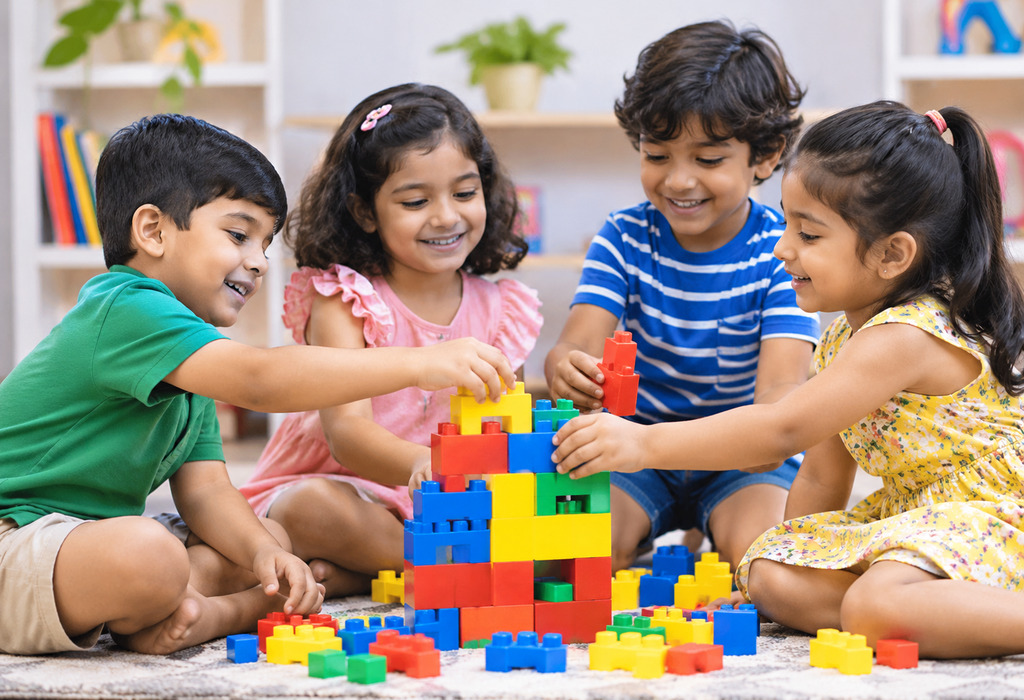
Watch a group of children building a block tower together, and you will see cooperative play in action. It is an important milestone in your child’s social growth. So, what is cooperative play, and why is cooperative play important for little ones? It is a type of play where children work together toward a shared goal, sharing ideas, taking turns, and solving problems as a team. This guide explains what it means, when it begins, how it helps, and which activities you can try at home or in the classroom.
What Is Cooperative Play?
Cooperative play is the stage of play in which children join forces to reach a common aim. Unlike earlier stages where kids play alone or beside each other, here every child has a role and the group depends on one another to finish the game or project. Psychologist Mildred Parten described six stages of play in the 1930s, moving from unoccupied, solitary, and onlooker play to parallel play, associative play, and finally cooperative play. It is the last and most advanced stage because it asks children to combine many skills at once. They must talk, listen, share, plan, and handle disagreements. You can spot it when children assign roles, such as “You be the doctor and I will be the nurse,” agree on simple rules, adjust their plan together, and feel proud of what the whole group achieved.
When Does Cooperative Play Start?
Parents often ask, “When does cooperative play start?” Most children begin showing early signs between the ages of three and four. By four to five years, many children can sustain a group game for a good stretch of time. Every child grows at their own pace, so some may reach this stage a little earlier or later.
Before this stage, toddlers usually enjoy parallel play. Two children may sit side by side with their own toys, aware of each other but not truly interacting. Around age three, they move into associative play, where they share materials and chat but do not yet follow a common goal. Soon after, the common goal appears, and cooperative play begins.
You can support this shift by giving your child regular chances to be around other children. Playdates, playgroups, preschool, and park visits all help. If your child seems to prefer solo play, there is no need to worry. Some children are naturally quieter and warm up slowly. Gentle encouragement works better than pressure.
Why Is Cooperative Play Important?
Cooperative play is the place where children practise the skills they will use for the rest of their lives. They learn that other people have different ideas, that sharing can lead to better results, and that a team can achieve things one person cannot. These lessons shape friendships, school success, and later teamwork at work and in the community.
It also gives children a safe space to experience big feelings. When a friend wants to change the game, a child must decide whether to argue, give in, or find a middle path. Each small choice builds emotional strength.
Benefits of Cooperative Play
The benefits of cooperative play reach almost every area of development. Here are the main ones.
1. Stronger Communication Skills
Children must explain their ideas, ask questions, and listen to others. This builds vocabulary, sentence structure, and the confidence to speak in a group.
2. Better Social Skills
Taking turns, sharing materials, and respecting a friend’s point of view all come naturally during group play. Children learn what it means to be a good friend and a good team member.
3. Problem Solving and Critical Thinking
Whether the group is deciding how to make a bridge for toy cars or how to share a limited number of crayons, kids learn to look at a problem, suggest solutions, and test them out.
4. Emotional Growth
Cooperative play teaches empathy, patience, and self control. Children notice how their actions make others feel and learn to manage frustration when things do not go their way.
5. Cognitive Development
Planning a game, remembering rules, and following a story all exercise memory, attention, and imagination. Pretend scenarios in particular stretch creative thinking.
6. Physical Development
Many cooperative games involve moving, lifting, building, or running. These activities improve both gross motor and fine motor skills while keeping children active.
7. A Sense of Belonging
Being part of a group where your contribution matters is a wonderful boost to self esteem. Children feel valued, included, and capable.
Examples of Cooperative Play
Cooperative play can look different depending on the setting. Here are some everyday examples:
- Building a large fort from pillows and blankets, with each child handling a different part.
- Playing house, where one child is the parent, one is the baby, and one is the pet.
- Setting up a pretend shop with a cashier, a shopkeeper, and customers.
- Playing a team sport such as football or relay races.
- Putting on a puppet show, with some children making the puppets and others performing.
- Completing a big floor puzzle together.
- Making a mural or group painting on a long sheet of paper.
In each of these, children rely on one another and share a goal, which is the heart of cooperative play.
Cooperative Play for Preschoolers
Cooperative play for preschoolers is especially valuable because this is the age when the skill truly blossoms. Preschool classrooms are designed with this in mind, offering block corners, dramatic play areas, art tables, and outdoor spaces where groups naturally form.
At this age, children are curious about friends and eager to be part of a team. Their play becomes more detailed, with storylines, rules, and roles. They may still need an adult to step in when conflicts arise, but they are learning to resolve small problems on their own. Short, simple group tasks work best, since preschoolers have limited attention spans. Ten to twenty minutes of focused group play is a great start.
Cooperative Play Activities for Preschoolers
If you are looking for cooperative play activities for preschoolers, these simple options need very little preparation and work well at home or in a classroom.
1. Group Block Building
Give a small group a big set of blocks and a challenge, such as building the tallest tower or a zoo for toy animals. Children must decide who places which blocks and how to keep the structure steady.
2. Parachute Play
Have children hold the edges of a large cloth or sheet and lift it up and down together. Place a soft ball on top and try to keep it bouncing without letting it fall. Everyone must move as one.
3. Pretend Restaurant
Set up a small table with play food, menus drawn by the children, and aprons. Let them choose to be the chef, waiter, or customer. This activity builds communication and role taking.
4. Team Puzzle Challenge
Choose a large floor puzzle with big pieces. Ask the group to complete it together, with each child finding and placing pieces. Celebrate when it is finished.
5. Group Mural
Roll out a long sheet of paper and give each child a different colour of paint or crayon. Invite them to create a shared picture, such as a garden or an underwater world.
6. Obstacle Course Teamwork
Build a simple course using cushions, hoops, and tunnels. Pair children so they must help each other through, for example by holding a hand or passing a toy along.
7. Planting a Garden Together
Give each child a job, such as filling pots with soil, planting seeds, or watering. Watching the plants grow gives the group a shared sense of achievement.
8. Musical Band
Hand out simple instruments like shakers, drums, and bells. Let the children practise playing a song together, learning to listen to each other and keep a steady beat.
Common Challenges During Cooperative Play
Even in this advanced stage, group play is not always smooth. Children may argue over a favourite toy, insist on being the leader, or feel left out when the group has already chosen roles. These moments are a normal part of learning. They give children real practice in negotiating, compromising, and expressing feelings in words instead of actions.
When conflict appears, stay calm and guide rather than solve. You can ask open questions such as “What could we do so both of you get a turn?” or “How do you think your friend feels right now?” Offering a simple tool, like a sand timer for turn taking, can also help. If a child often hangs back, invite them into a small role, such as helper or messenger, so they can join in without feeling overwhelmed. Over time, these small steps build confidence and make teamwork feel natural.
How Parents and Teachers Can Encourage Cooperative Play
Adults play a big role in helping children enjoy teamwork. Here are a few simple tips:
- Offer open ended toys such as blocks, play dough, and dress up clothes that invite group play.
- Set up play spaces large enough for several children.
- Model sharing and kind words in your own behaviour.
- Praise teamwork, saying things like “I love how you helped each other build that.”
- Step back when you can. Let children try to settle small disagreements first, and step in only when needed.
- Keep groups small at the start. Two to four children is a manageable number for new players.
Cooperative play is a joyful and powerful stage in a child’s growth, where friendship, communication, and teamwork come together. It usually begins around three to four years of age and grows stronger through the preschool years. By offering simple activities, safe spaces, and gentle guidance, parents and teachers can help children build skills that last a lifetime. Remember that every child moves at their own pace, so patience and encouragement matter more than rushing. Start with a small group game today, and enjoy watching your little ones learn to play, share, and succeed together.