
Table of Contents
Five Little Ducks Song Lyrics
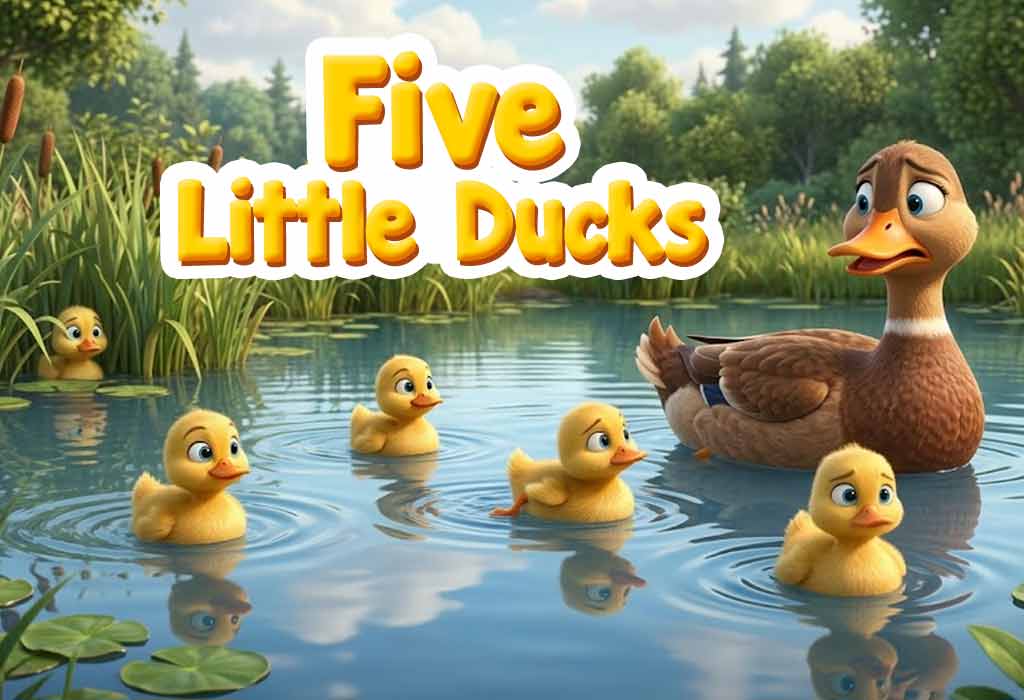
A cheerful rhyme that children love to sing along with, these Five Little Ducks words are easy to remember and fun to act out.
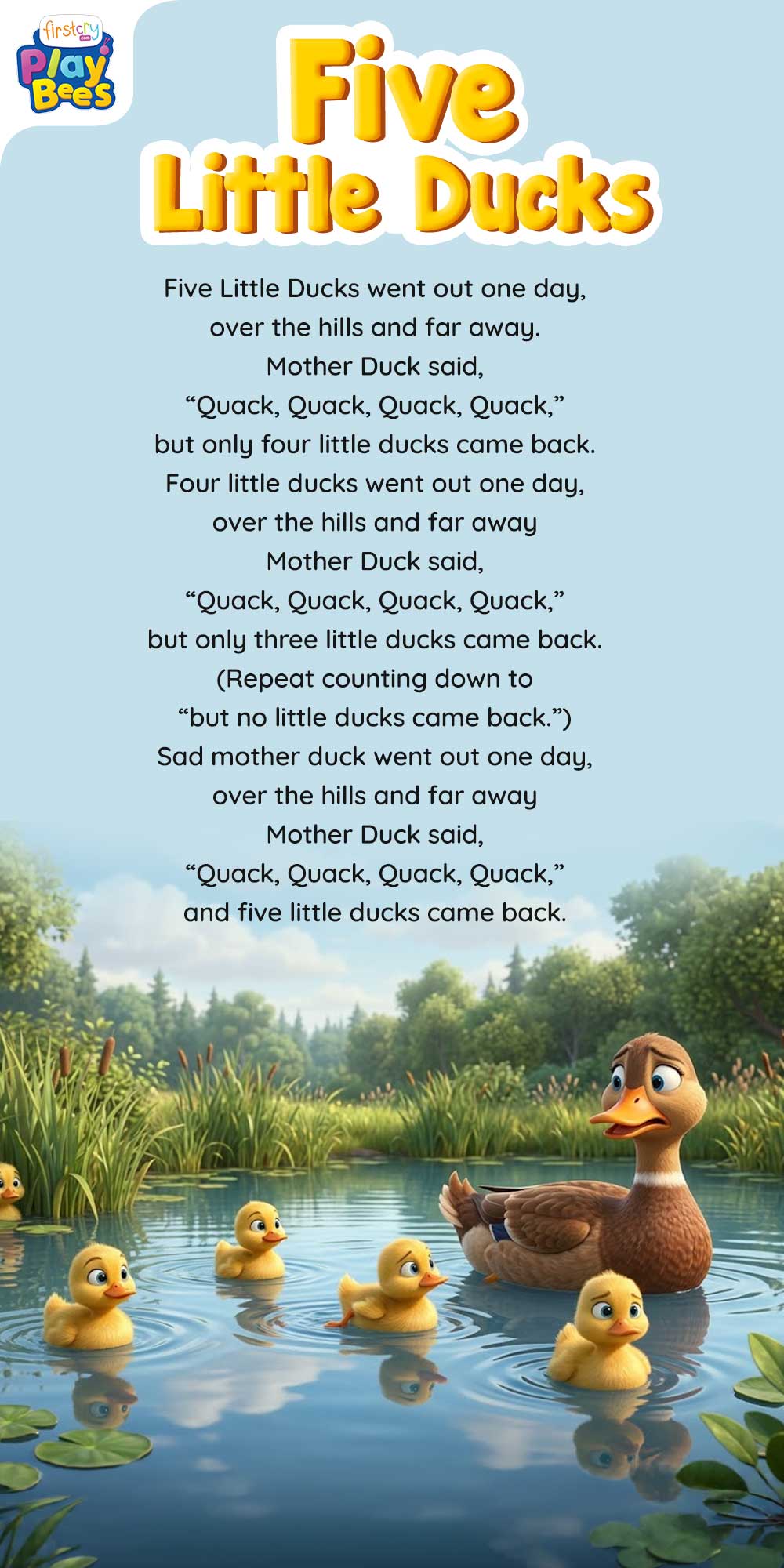
Five Little Ducks went out one day, over the hills and far away.
Mother Duck said, “Quack, Quack, Quack, Quack,” but only four little ducks came back.
Four little ducks went out one day, over the hills and far away
Mother Duck said, “Quack, Quack, Quack, Quack,” but only three little ducks came back.
(Repeat counting down to “but no little ducks came back.”)
Sad mother duck went out one day, over the hills and far away
Mother Duck said, “Quack, Quack, Quack, Quack,” and five little ducks came back.
Other Versions of Five Little Ducks Song
Many playful variations of this rhyme exist, adding new twists while keeping the same catchy tune and learning value.
- Five Little Ducks with Different Endings – In some versions, all the ducks return happily at the end instead of one staying behind, making it more reassuring for very young children.
- Counting Forward Version – Instead of counting down, a few versions begin with one duck and add more ducks in each verse to help children learn addition.
- Animal Substitution Version – Some adaptations replace ducks with frogs, fish, or other animals to make the rhyme feel fresh and engaging.
- Action-Based Classroom Version – Teachers often include extra lines with clapping, jumping, or spinning to make it more interactive for groups.
Gestures – How to Teach Five Little Ducks to Kids
Adding simple actions makes this rhyme more engaging and helps children remember the sequence better. These gestures also support movement and coordination while learning.
- Hold up five fingers at the start to represent the five ducks and show the number clearly to children.
- Move your hand in a waddling motion to mimic ducks walking away over the hills.
- Place your hand near your mouth and pretend to call out “quack, quack, quack” like the mother duck.
- Lower one finger after each verse to show that one duck has not returned.
- Shrug your shoulders or make a “sad” face when fewer ducks come back to express emotion.
- At the end, raise all five fingers again and smile widely to show all ducks returning happily.
History & Quick Facts
“Five Little Ducks” is a traditional nursery rhyme with roots in English-speaking countries, though its exact origin and author are unknown. Like many folk rhymes, it was passed down orally through generations before appearing in printed collections during the 20th century. The rhyme gained popularity in preschools and early learning settings because of its simple counting pattern and engaging storyline. Over time, it became widely recognized through children’s books, music albums, and educational videos. Its repetitive structure and emotional element have helped it remain a favorite among parents and teachers worldwide.
Interesting Facts
- The rhyme is often used as a counting song to teach children how to subtract numbers in a fun and easy way.
- It has been translated into many languages, allowing children around the world to enjoy and learn from it.
- The tune is simple and repetitive, making it easy for young children to memorize and sing independently.
- Many animated videos and classroom performances have helped boost its popularity in modern times.
- The mother duck’s call “quack, quack, quack” is one of the most recognizable and fun parts for kids.
- Some versions include hand puppets or props, making storytelling more interactive and exciting.
Suitable age & Learnings
This rhyme is best suited for children aged 2 to 5 years, as it matches their early learning stage and attention span. It supports both language development and basic math skills in a playful way.
- Children learn counting and simple subtraction as the number of ducks decreases in each verse.
- The rhyme helps improve listening and memory skills through repetition and rhythm.
- Kids build vocabulary by learning words like “duck,” “hill,” “away,” and “quack.”
- It encourages emotional understanding as children notice the mother duck’s concern and happiness.
- The actions used with the rhyme improve motor skills and hand-eye coordination.
- Singing together promotes social interaction and confidence in group settings.
FAQs
1. What is the rhyming scheme of Five Little Ducks?
The rhyme follows a simple and repetitive rhyming pattern, often using AABB style, which makes it easy for children to predict and remember.
2. Why is Five Little Ducks good for toddlers?
It combines counting, repetition, and storytelling, which helps toddlers learn basic math and language skills in an enjoyable way.
3. Can this rhyme be used in classroom activities?
Yes, it is widely used in classrooms with actions, props, and group singing to make learning interactive and fun.
Simple rhymes like “Five Little Ducks” continue to hold a special place in early childhood learning. Its gentle story, combined with rhythm and repetition, makes it easy for children to follow and enjoy. Through singing and actions, kids naturally pick up counting skills, new words, and emotional understanding. Parents and teachers can use it as a fun daily activity that blends learning with play. The rhyme also creates opportunities for bonding as children sing along with adults or friends. Over time, it becomes more than just a song, turning into a cherished part of a child’s learning journey.
Explore Other Rhymes for Kids:
Alle meine Entchen Nursery Rhyme With Lyrics
Ten Little Indians Nursery Rhyme With Lyrics
Five Little Speckled Frogs Nursery Rhyme With Lyrics