
Table of Contents
Ask a five-year-old to sound out “cake” and you will often hear them stall right at the vowel. Should it sound like the “a” in “cat”, or something else entirely? That pause is completely normal, because English vowels behave differently depending on the letters around them, and working out when a vowel says its own name is one of the trickier steps in early reading. This is exactly where long vowel sounds come in. Once a child learns to spot the patterns, words that once looked confusing start to make sense on their own. This guide breaks down what long vowel sounds are, how they differ from short vowels, and which spelling patterns show up most often in everyday words, so you can help your child move past the guessing stage and read with real confidence.
What Long Vowels Actually Are
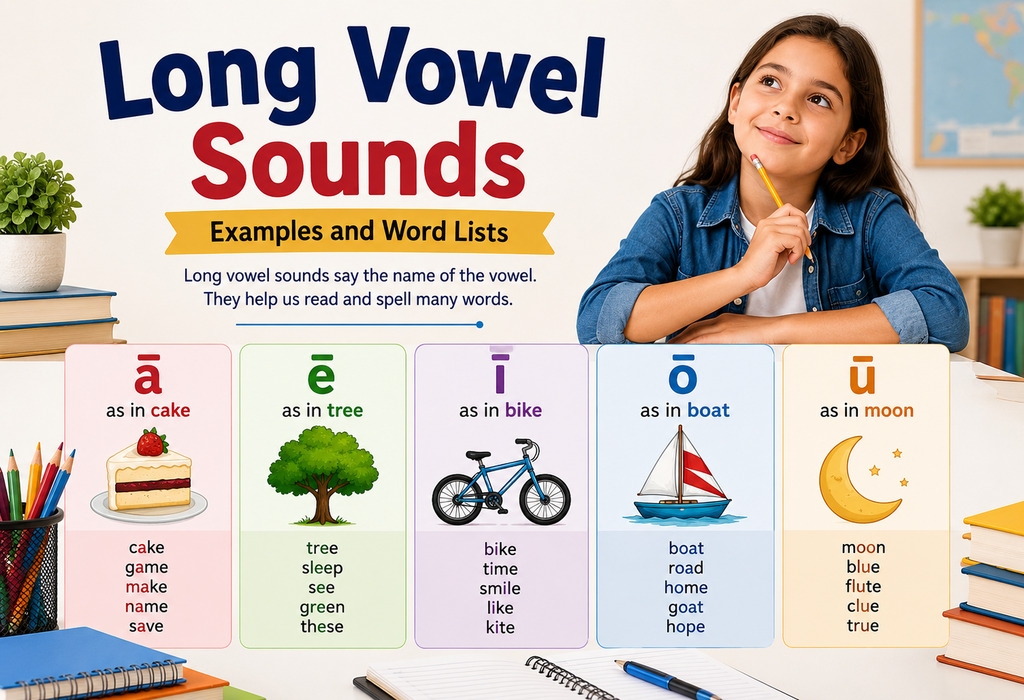
A long vowel is one that sounds like the name of the letter itself. When a child says “a” as in “rain”, “e” as in “tree”, “i” as in “kite”, “o” as in “boat” or “u” as in “cube”, they are producing a long vowel.
This is different from a short vowel sound, where the letter makes a quicker, clipped sound, as in “cat”, “bed”, “sit”, “hot” and “cup”. Short vowels are usually the first sounds children learn, since they appear in simple three-letter words like “cat” and “dog”. Long vowels get introduced once a child is comfortable blending those short, simple words.
Here is a quick side-by-side comparison that many teachers use when introducing the concept:
| Vowel | Short sound example | Long sound example |
|---|---|---|
| A | cat | cake |
| E | bed | tree |
| I | sit | kite |
| O | hot | boat |
| U | cup | cube |
Notice that the spelling, not just the sound, changes between each pair. That link between spelling and sound is the real skill children are building.
Common Long Vowel Patterns
There isn’t one single rule that covers every case. Instead, below is an example long vowel sounds breakdown showing the handful of recognisable spelling patterns children encounter most often. Learning to spot these patterns, rather than memorising each word individually, is what helps children read unfamiliar words fluently.
1. The Silent E Pattern
Also known as the “magic e” or “silent e” rule, this pattern appears when a word ends in a vowel, a consonant and then an e. The final e is silent, but it changes the vowel before it into a long sound.
Examples: cake, bike, rope, cute, these.
2. Vowel Teams
A vowel team is a pair of vowels sitting together, where the first vowel says its long sound and the second is silent. A well-known classroom saying for this is “when two vowels go walking, the first one does the talking”.
Examples: rain, boat, pie, seat, blue.
3. Open Syllables
An open syllable ends in a vowel with no consonant after it, and the vowel is usually long as a result. This pattern is common in words like “go”, “me”, “hi” and “flu”, as well as in the first syllable of longer words such as “baby” and “tiger”.
4. R-Controlled and Y Endings
Some long vowels also appear when a word ends in a “y” that sounds like a long e or long i, as in “baby” or “fly”. These are worth introducing once your child feels steady with the three patterns above.
List of Long Vowel Sound Words
A varied word list gives children plenty of practice spotting each pattern in real words. Here is a list of long vowel sound words grouped by vowel, mixing silent e, vowel team and open syllable examples so your child sees the pattern in different forms.
Long A: cake, rain, day, gate, snail, tray, plate, wait
Long E: tree, bee, seat, key, we, please, sleep, chief
Long I: kite, pie, fly, night, hi, mice, tie, light
Long O: boat, go, rope, snow, toe, coat, home, so
Long U: cube, blue, tune, glue, mule, fruit, huge, suit
Reading these lists aloud, then asking your child to sort them by pattern rather than by letter, turns a simple worksheet into genuine practice with cause and effect between spelling and sound.
English Long Vowel Sounds in Everyday Reading
Once a child recognises long vowels in single words, the next step is spotting them inside sentences and short stories. English long vowel sounds turn up constantly in everyday reading material, from picture books to street signs, so real-world reading is some of the best extra practice available.
A useful approach many parents use at home is the “hunt and highlight” method. Choose a short paragraph from a favourite book, and ask your child to circle every long vowel word they can find. This works particularly well because it shows children that these patterns are not confined to a workbook. They are everywhere, in every book on the shelf.
Long Vowel Words With Pictures
Pairing long vowel words with a matching picture is one of the most effective ways to help younger children hold onto a new pattern, because it links the sound directly to something familiar rather than an abstract rule.
A simple picture-matching set could include:
- A slice of cake next to the word “cake”, highlighting the silent e pattern.
- A boat on water next to the word “boat”, highlighting the oa vowel team.
- A kite flying in the sky next to the word “kite”, highlighting the silent e pattern again in a different vowel.
- A tree with leaves next to the word “tree”, highlighting the ee vowel team.
- A cube of ice next to the word “cube”, showing the long u sound.
You can recreate this at home with flashcards, magazine cut-outs, or simple drawings. The goal is not artistic quality. It is repetition, so the child begins to predict the sound before they even finish reading the word.
Simple Ways to Practise at Home
A few short, playful activities go a long way toward building this skill without turning it into a chore.
- Sorting games: Write a mix of long and short vowel words on cards and ask your child to sort them into two piles.
- Rhyme hunts: Ask your child to think of another word that rhymes with a long vowel word, such as “cake, lake, make”.
- Silent e swap: Show pairs like “cap” and “cape”, or “kit” and “kite”, so children see how adding one letter changes the entire sound.
- Read aloud together: Choose books with plenty of long vowel words and pause briefly whenever one appears, asking your child to name the pattern.
Keeping these sessions short, around ten minutes, tends to hold a young child’s attention far better than one long sitting.
A Few Things Parents Often Overlook
Many parents focus only on the silent e rule because it is the easiest to explain, but vowel teams appear just as often in early reading books, so both deserve equal attention. It also helps to know that not every long vowel word follows a tidy pattern. Words like “eye”, “sew” and “great” are common exceptions that simply need to be learned by sight, and pointing this out early prevents frustration later. Finally, confusing long and short vowels is a completely typical part of learning to read, not a sign that something is wrong, so patience and repetition usually resolve it within a few months of regular practice.
Long vowels might seem like a small detail in the bigger picture of learning to read, but recognising them unlocks a huge share of the English language for a young reader. Once your child can spot a silent e, a vowel team or an open syllable, unfamiliar words stop feeling like guesswork and start feeling like puzzles they already know how to solve. With a mix of word lists, pictures and short daily practice, most children pick up these patterns steadily, and the confidence that comes with it tends to carry over into every other part of their reading journey.
Also Read: