
Table of Contents
Learning new vocabulary is one of the best ways for children to grow their reading and writing skills, and one of the easiest ways to start is by exploring words that begin with In. The letters “in” appear at the start of hundreds of English words, from tiny two-letter words to longer ones used in school and everyday conversation. This article breaks these words down by length and by meaning, so children can build their vocabulary step by step while having fun along the way.
What Does the Prefix “In” Mean?
Before diving into the word lists, it helps to understand why so many English words starting with In prefix look and sound similar. The prefix “in-” usually carries one of two meanings. In many cases, it means “not” or “the opposite of”, turning a word into its negative form. For example, “active” becomes “inactive” (not active), and “complete” becomes “incomplete” (not complete). Other common negative examples include “correct” becoming “incorrect” and “visible” becoming “invisible”. In other cases, “in-” means “into” or “within”, showing movement or position, as in “inhale” (breathe in) or “inside” (within something). This second sense also appears in words like “insert” (put into) and “inject” (force into). Knowing this simple pattern can help children guess the meaning of a new word even before looking it up, which makes reading unfamiliar text far less daunting.
Common Words That Start With In (Words With Meaning)
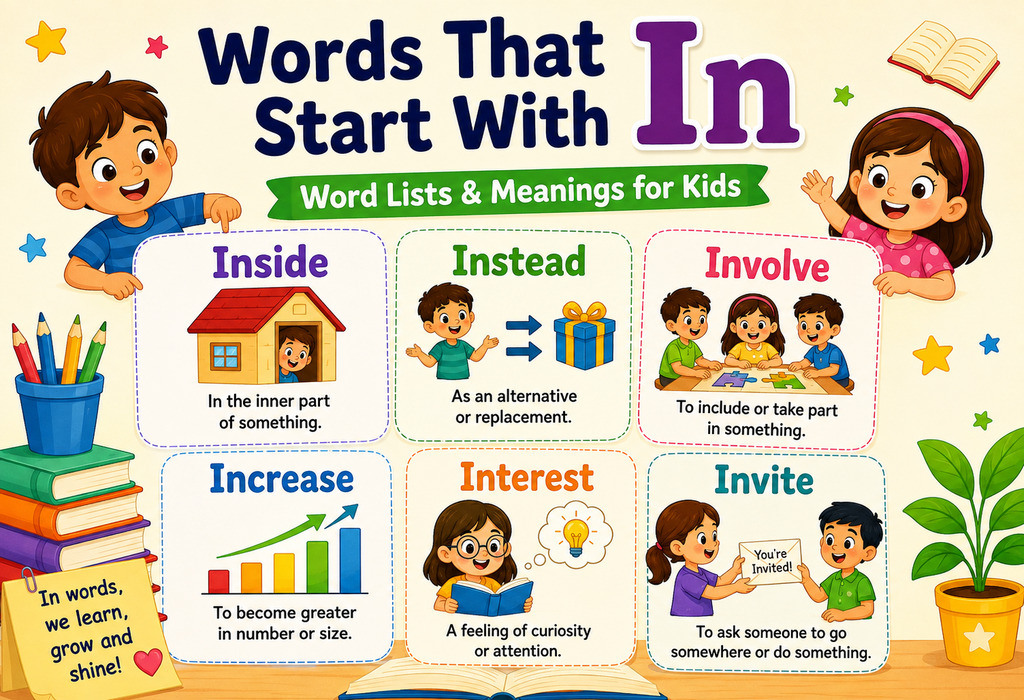
Here are 25 common In words that children are likely to come across in books, school, and daily conversation, including several positive words that start with In that are great for building confidence and encouragement. Reading through this list together is a simple way to start a conversation about kindness, motivation, and self-belief, since many of these words describe qualities worth celebrating in a child.
- Inside – in or within something
- Into – moving to the inside of something
- Instead – in place of
- Inform – to tell someone something
- Instant – happening right away
- Involve – to include as a part of something
- Include – to have as part of a group
- Increase – to become bigger or more
- Indoor – inside a building
- Install – to set something up for use
- Instruct – to teach or direct someone
- Interest – curiosity about something
- Invite – to ask someone to join
- Inspire – to encourage or motivate someone
- Innovate – to create something new
- Incredible – amazing or hard to believe
- Independent – able to do things on your own
- Intelligent – smart or quick to learn
- Inclusive – welcoming everyone
- Ingenious – clever and inventive
- Insightful – showing deep understanding
- Invaluable – extremely useful or precious
- Inventive – good at creating new ideas
- Injury – a hurt or wound
- Index – a list used to find information
Short In Words
Short words are a great starting point for younger readers who are just beginning to sound out letters, since fewer letters usually means simpler sounds to blend together. The sections below sort words by exactly how many letters they contain, moving from the very shortest possible example up to five-letter words.
2 Letter In Words
There is genuinely only one common English word made up of just the letters “in”, since those two letters are the prefix itself and there is no room left for anything else once the prefix is written out. Rather than stretch the list with 2 letter words starting with In that do not really exist, here is the one true example, which is still a perfect first word for very young readers to practise:
- In – inside or within something
3 Letter In Words
Three-letter words are also limited, since only a handful of real English words fit this length. Instead of padding the 3 letter words starting with In list with made-up or overly obscure entries, here are the genuine, everyday ones that children will actually encounter in books and conversation:
- Ink – the coloured liquid used for writing or printing
- Inn – a small hotel, often in the countryside
4 Letter In Words
Genuine four-letter In words are a little easier to find, though the list is still shorter than ten once obscure or overly technical terms are set aside. Here are the solid, kid-friendly 4 letter words starting with In that are worth learning first:
- Inch – a small unit of length
- Info – short for information
- Inky – covered in or resembling ink
- Inns – more than one inn
- Into – moving to the inside of
5 Letter In Words
From five letters onward, there are plenty of everyday words to choose from, and this collection of 5 letter words starting with In includes several that children will recognise from school and technology.
- Inbox – where emails or messages are received
- Incur – to bring something upon yourself
- Index – a list used to find information
- Infer – to work something out from clues
- Ingot – a block of shaped metal
- Inlay – decoration set into a surface
- Inner – on the inside
- Input – information put into something
- Inset – something set into a larger item
- Inept – not skilled at something
Long In Words
Longer words often carry more detailed meanings and are useful for children building up to secondary-school vocabulary. As words get longer, they tend to describe more specific actions, feelings, or ideas rather than simple objects.
6 Letter In Words
The 6 letter words starting with In below cover everything from breathing to travel, giving children a taste of how varied this word family can be.
- Indeed – in fact, truly
- Inhale – to breathe in
- Inject – to force liquid into something
- Inland – away from the coast
- Inmate – a person kept in a prison
- Insect – a small creature with six legs
- Intact – whole and undamaged
- Intake – the amount taken in
- Invade – to enter by force
- Invite – to ask someone to join
7 Letter In Words
These 7 letter words starting with In often appear in school subjects such as maths, science, and reading comprehension.
- Initial – happening at the beginning
- Insight – a clear understanding of something
- Inspect – to look at closely
- Install – to set up for use
- Instant – happening immediately
- Involve – to include as part of something
- Inhabit – to live in a place
- Include – to have as part of a group
- Inflate – to fill with air
- Integer – a whole number
8 Letter In Words
The 8 letter words starting with In tend to be the most advanced on this list, and are well suited to older primary-school children who are ready for a challenge.
- Indicate – to point out or show
- Infinite – having no end
- Innocent – not guilty of doing wrong
- Insomnia – trouble sleeping
- Instinct – a natural way of behaving
- Intimate – close and personal
- Involved – taking part in something
- Incident – an event that happens
In Words by Grade Level
Vocabulary lists are more useful when matched to a child’s reading level. Below is a simple example of how an English word start with In can be grouped by school grade, moving from the easiest words to slightly more advanced ones. These groupings are only a general guide, since every child learns at their own pace, but they offer a useful starting point for parents and teachers planning spelling or reading practice.
Grade 1
Grade 1 children are usually just starting to blend sounds together, so the shortest and most familiar words work best.
- In
- Ink
- Inn
- Into
- Inch
Grade 2
By Grade 2, most children can handle slightly longer words with more complex sounds and beginning technology or nature vocabulary.
- Index
- Input
- Inner
- Inbox
- Insect
Grade 3
Grade 3 children are usually ready for words with multiple syllables that carry more abstract meanings, such as instructions or comparisons.
- Include
- Inspect
- Install
- Indicate
- Increase
From the single true two-letter example to longer words used in school and beyond, Words That Start With In for Kids offer a simple but rich way to build vocabulary. Starting small with words like “in” and “ink”, and working up to longer words like “indicate” and “innocent”, helps children see how the same starting letters can lead to very different meanings. Along the way, understanding the prefix itself, whether it signals “not” or “into”, gives children a tool they can reuse with countless other words beyond this list. With regular practice, some simple spelling games, and a little curiosity about prefixes, these words can quickly become a natural part of a child’s everyday reading, writing, and conversation.