
Table of Contents
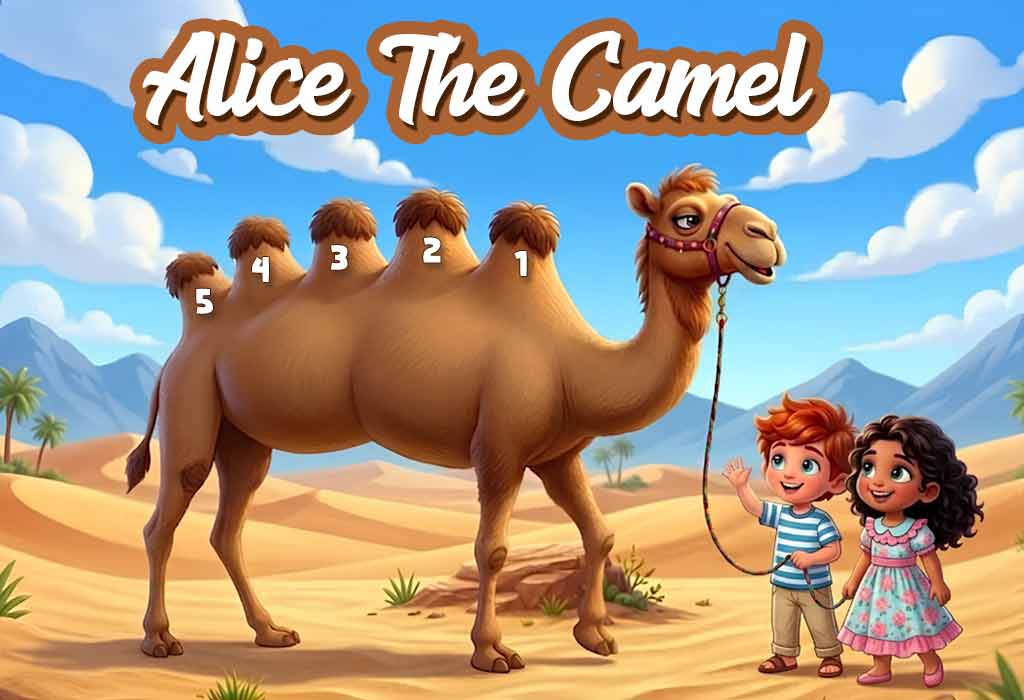
A playful and catchy tune, this rhyme tells the funny story of a camel named Alice who seems to have fewer humps each time the song repeats. Children love the silly twist at the end, which turns the camel into something unexpected and makes them giggle. The repetitive pattern and counting element keep kids engaged while helping them remember the sequence easily. It is a great rhyme for early learning as it introduces basic counting, builds listening skills, and encourages participation through actions and singing. Parents and teachers often use it to make learning fun, interactive, and full of laughter.
Alice The Camel Song Lyrics
Enjoy singing along with these fun and rhythmic Alice The Camel words that children love to repeat.
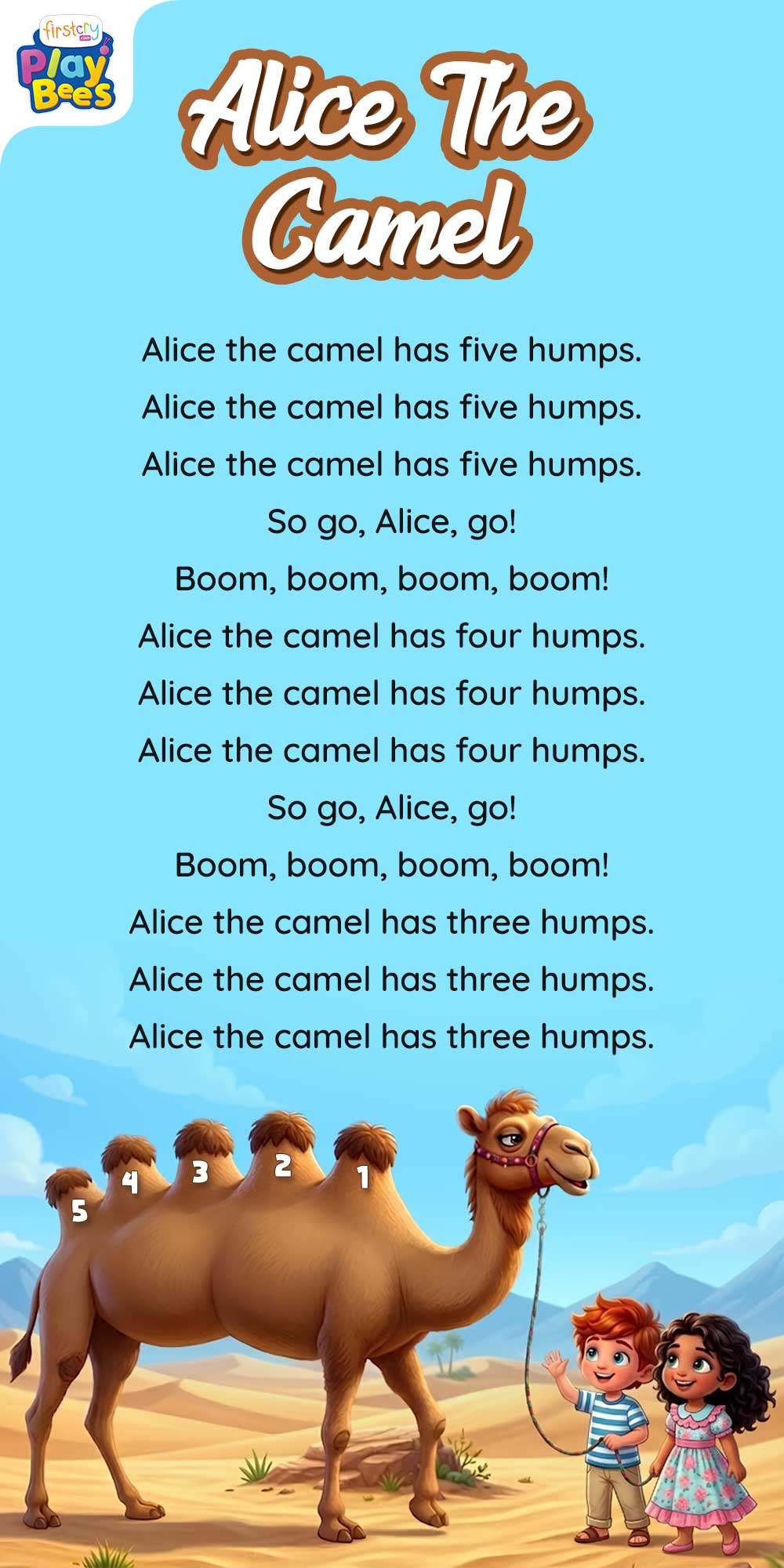
Alice the camel has five humps.
Alice the camel has five humps.
Alice the camel has five humps.
So go, Alice, go!
Boom, boom, boom, boom!
Alice the camel has four humps.
Alice the camel has four humps.
Alice the camel has four humps.
So go, Alice, go!
Boom, boom, boom, boom!
Alice the camel has three humps.
Alice the camel has three humps.
Alice the camel has three humps.
So go, Alice, go!
Boom, boom, boom, boom!
Alice the camel has two humps.
Alice the camel has two humps.
Alice the camel has two humps.
So go, Alice, go!
Boom, boom, boom, boom!
Alice the camel has one hump.
Alice the camel has one hump.
Alice the camel has one hump.
So go, Alice, go!
Boom, boom, boom, boom!
Alice the camel has no humps.
Alice the camel has no humps.
Alice the camel has no humps.
‘Cause Alice is a horse, of course!
Other Versions of Alice The Camel Song
Many playful variations of this rhyme add extra fun and creativity to the original tune.
Gestures – How to Teach Alice The Camel to Kids
Adding simple actions makes this rhyme more interactive and enjoyable for children while helping them remember the sequence.
- Raise five fingers at the start to show the number of humps and gradually lower one finger in each verse.
- Tap your thighs or clap hands when saying “boom, boom, boom” to create rhythm and excitement.
- Use your hand to mimic a camel’s hump shape as you sing each line for visual learning.
- Encourage children to march in place while singing “So go, Alice, go” to keep them active.
- Act surprised and smile when reaching “no humps” to make the twist fun and engaging.
- Pretend to gallop like a horse at the end to reinforce the funny conclusion of the rhyme.
History & Quick Facts
The exact origin of Alice The Camel is not clearly documented, but it is widely believed to be a traditional children’s camp and classroom song that gained popularity in the mid-20th century. It does not have a known single author, as it evolved through oral storytelling and group singing activities. The rhyme became popular in schools and summer camps due to its repetitive structure, humor, and easy actions. Over time, it spread across different countries and cultures, becoming a favorite among preschool teachers and parents for teaching counting and rhythm.
Interesting Facts
- This rhyme is often used as a counting song, helping children learn numbers in a fun and memorable way.
- The humorous ending where the camel becomes a horse is what makes the rhyme especially enjoyable for kids.
- It is commonly sung in classrooms, camps, and playgroups around the world.
- The tune is simple and repetitive, making it easy for young children to follow and join in.
- The rhyme has been adapted into multiple languages while keeping its playful theme intact.
- Many teachers use it as an action song to improve coordination and participation in group settings.
Suitable Age & Learnings
This rhyme is best suited for children aged 2 to 6 years as it combines music, movement, and simple counting in an engaging way. It supports early childhood development by encouraging active participation and playful learning.
- Children learn basic counting skills as the number of humps decreases step by step in each verse.
- It improves memory and sequencing as kids remember the order of numbers and actions.
- The rhyme builds listening and language skills through repetition and rhythm.
- It encourages physical coordination when combined with gestures and movements.
- Kids develop a sense of humor by understanding the funny twist at the end.
- The rhyme introduces simple vocabulary related to animals and actions in an easy way.
FAQs
1. What is the rhyming scheme of Alice The Camel?
The rhyme follows a simple repetitive pattern with similar ending sounds, making it easy for children to remember and sing along.
2. Why do children enjoy Alice The Camel rhyme?
Children enjoy it because of its repetitive structure, funny ending, and interactive actions that keep them engaged.
3. How can I make this rhyme more interactive for my child?
You can add gestures, clapping, and movements to each verse to make the rhyme more fun and engaging.
Alice The Camel is a delightful nursery rhyme that brings laughter and learning together in a simple and engaging way. Its repetitive verses and playful twist make it a favorite among young children. The rhyme not only entertains but also supports early skills like counting, memory, and coordination. With easy actions and a catchy tune, it becomes a perfect group activity for classrooms and homes alike. Parents and teachers can use it to create joyful learning moments that children will remember. Overall, it remains a timeless rhyme that continues to spark smiles and curiosity in little learners.
Explore Other Rhymes for Kids:
Ten Green Bottles Nursery Rhyme With Lyrics
Five Little Monkeys Nursery Rhyme With Lyrics
Old Macdonald Had A Farm Nursery Rhyme With Lyrics