
Table of Contents
- What Is Division?
- Before You Begin: Check These Skills
- How to Explain Division to a Child
- How to Teach Division to Kindergarten Children
- How to Teach Division to Grade 1
- How to Teach Division to Grade 2
- How to Teach Division to Grade 3
- How to Teach Division to Grade 4
- Fun Activities and Games for Division
- Helpful Tips for Parents and Teachers
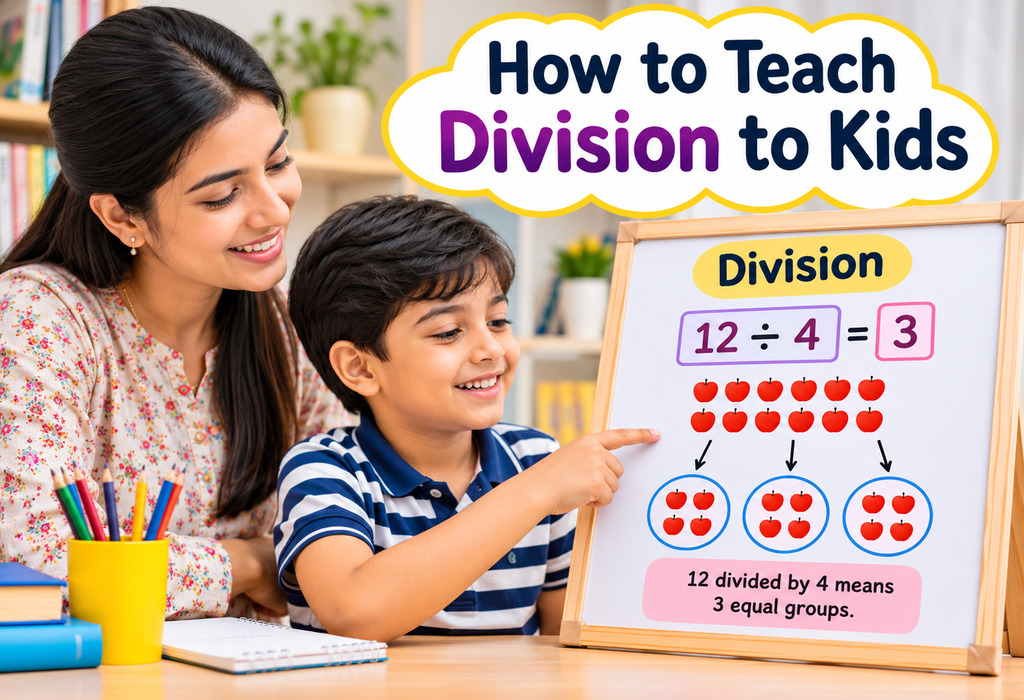
Division is often the first operation that makes children pause. Addition and multiplication feel like building, but division feels like breaking things apart. Many parents and teachers wonder how to teach division to kids without turning maths time into a stressful hour. The good news is that children already understand sharing long before they see the ÷ sign. Dividing laddoos among cousins or splitting a packet of biscuits with a friend is division in real life. If you are wondering how to teach division to kids, the best starting point is exactly this everyday sharing, followed by simple pictures and then numbers.
This guide walks you through easy methods, hands on activities, and practical tips that suit Indian classrooms and homes. Each method builds on the one before it, so children grow in confidence step by step.
What Is Division?
Division means splitting a total amount into equal groups, or finding out how many equal groups can be made. Every division sum has three parts. The dividend is the total number you start with. The divisor is the number you divide by. The quotient is the answer. When something is left over, we call it the remainder.
For example, in 12 ÷ 3 = 4, the number 12 is the dividend, 3 is the divisor, and 4 is the quotient. Introduce these words slowly, only after the child understands the idea through objects.
Before You Begin: Check These Skills
Division becomes much easier when a child is comfortable with a few basics:
- Counting forward and backward
- Understanding equal groups
- Knowing addition and subtraction facts
- Skip counting by 2s, 3s, 4s, 5s, and 10s
- Basic multiplication tables
If the child struggles with multiplication, spend a little time revising tables first. Division and multiplication are partners, and one supports the other.
How to Explain Division to a Child
The simplest answer to how to explain division to a child is to begin with a story. Say, “We have 8 rotis and 4 people. How many rotis will each person get?” Let the child place real rotis, toys, or pencils into groups.
Try these everyday examples at home:
- Sharing 10 chocolates equally among 2 siblings
- Placing 12 flowers equally in 3 vases
- Distributing 15 notebooks among 5 students
- Packing 20 marbles into 4 small bags
Always use the word “equal.” Children must understand that every group gets the same number. Once they can share objects confidently, ask them to describe what they did in words. This spoken explanation prepares them for the written sum.
How to Teach Division to Kindergarten Children
Little learners are not ready for symbols, and that is perfectly fine. When thinking about how to teach division to kindergarten, focus entirely on sharing and grouping with real objects.
Easy ideas for the youngest children:
- Give 6 buttons and 2 small bowls. Ask the child to share them fairly.
- Use stickers, blocks, or dry beans for hands on practice.
- Sing counting songs and play fair share games.
- Ask simple questions such as, “Can we make two equal groups?”
Keep the numbers small, usually within 10. Praise effort, and let the child discover that some numbers share equally while others do not. Avoid worksheets at this stage. Play is the real teacher.
How to Teach Division to Grade 1
Children in Class 1 are slowly meeting numbers in writing. For parents asking how to teach division to grade 1, the aim is to connect pictures with simple number sentences.
- Draw circles and dots. For 8 ÷ 2, draw 2 circles and place dots one by one until all 8 are shared.
- Introduce the words “share equally” and “groups of.”
- Show the ÷ symbol for the first time and read it as “divided by.”
- Keep all numbers within 20.
At this level, repeated subtraction works nicely too. Start with 10 counters and take away groups of 2 again and again. The number of times you subtract is the answer. Keep sessions short, around ten minutes, and end on a happy note.
How to Teach Division to Grade 2
Class 2 is where division becomes a proper topic. Here are the methods that work best for how to teach division to grade 2.
1. Use Arrays
An array arranges objects in rows and columns. Ask the child to arrange 12 counters into 3 equal rows. They will see 4 in each row, so 12 ÷ 3 = 4. Arrays also reveal the link between multiplication and division, because 3 × 4 = 12 and 12 ÷ 3 = 4 use the same picture.
2. Use Skip Counting
To solve 20 ÷ 5, count by 5s on your fingers: 5, 10, 15, 20. You said four numbers, so the answer is 4. Skip counting makes division feel like a game of jumping along a number line.
3. Use Fact Families
Show how one set of numbers creates four facts. With 2, 5, and 10, we get 2 × 5 = 10, 5 × 2 = 10, 10 ÷ 2 = 5, and 10 ÷ 5 = 2. Children love spotting these patterns.
How to Teach Division to Grade 3
By Class 3, children can handle larger numbers and begin to meet remainders. If you are thinking about how to teach division to grade 3, build on what they know and stretch it gently.
- Revise multiplication tables up to 10 every day for a few minutes.
- Introduce division facts using tables, such as 36 ÷ 6 by recalling 6 × 6.
- Teach remainders with a story. “We have 14 sweets and 4 friends. Each friend gets 3, and 2 sweets are left over.”
- Show division on a number line by jumping backward in equal steps.
- Introduce simple word problems using rupees, such as sharing ₹50 among 5 children.
Explain that a remainder is always smaller than the divisor. If the remainder is bigger, it means another group can still be made.
How to Teach Division to Grade 4
Class 4 students are ready for formal methods with bigger numbers. When planning how to teach division to grade 4, introduce long division slowly and make sure each step is clear.
Use the memory phrase “Divide, Multiply, Subtract, Bring down” to guide the process. Let us solve 84 ÷ 4 together:
- Divide: 8 tens ÷ 4 = 2 tens, so write 2 in the tens place.
- Multiply: 2 × 4 = 8.
- Subtract: 8 − 8 = 0.
- Bring down the 4 ones. Now divide 4 ÷ 4 = 1.
The answer is 21. Let the child use place value blocks or drawings of tens and ones before moving to the written method. Check every answer by multiplying the quotient with the divisor and adding the remainder. This habit builds accuracy and trust in their own work.
Fun Activities and Games for Division
Games make practice feel effortless. Try these at home or in class:
- Fair share party: Children divide snacks, balloons, or paper cups among toy guests.
- Division bingo: Call out sums like 24 ÷ 6 and let children mark the answers on their cards.
- Dice game: Roll two dice. The larger number is the dividend, and the smaller number is the divisor.
- Treasure hunt: Hide cards with division questions around the house. Each correct answer leads to the next clue.
- Kitchen maths: Ask children to divide a pizza, a bar of chocolate, or a plate of idlis equally.
Helpful Tips for Parents and Teachers
- Always begin with real objects, then pictures, then numbers.
- Link division with multiplication so the child sees both as one connected idea.
- Use words from daily life, like share, group, equal, and left over.
- Practise a little every day rather than for long hours once a week.
- Encourage children to explain their thinking aloud.
- Never rush. Allow mistakes, because they show where help is needed.
- Celebrate small wins to keep confidence high.
- Use the child’s interests, such as cricket scores, toys, or favourite snacks, in word problems.
Common Mistakes to Watch For
Children often mix up the dividend and divisor, writing 3 ÷ 12 instead of 12 ÷ 3. Remind them that the total always comes first. Some forget that division by zero is not possible, so explain it simply: you cannot share something among zero people. Others ignore the remainder or write it incorrectly. Gentle reminders and plenty of examples fix these problems quickly.
Division becomes simple when children see it as fair sharing and equal grouping in everyday life. Start with real objects, move to pictures and arrays, and then introduce symbols and written methods at the right age. Match your approach to the child’s grade, from play based sharing in kindergarten to long division in Class 4. Keep practice short, joyful, and regular so that confidence grows alongside skill. With patience and creative activities, any child can learn to enjoy division and use it with ease.